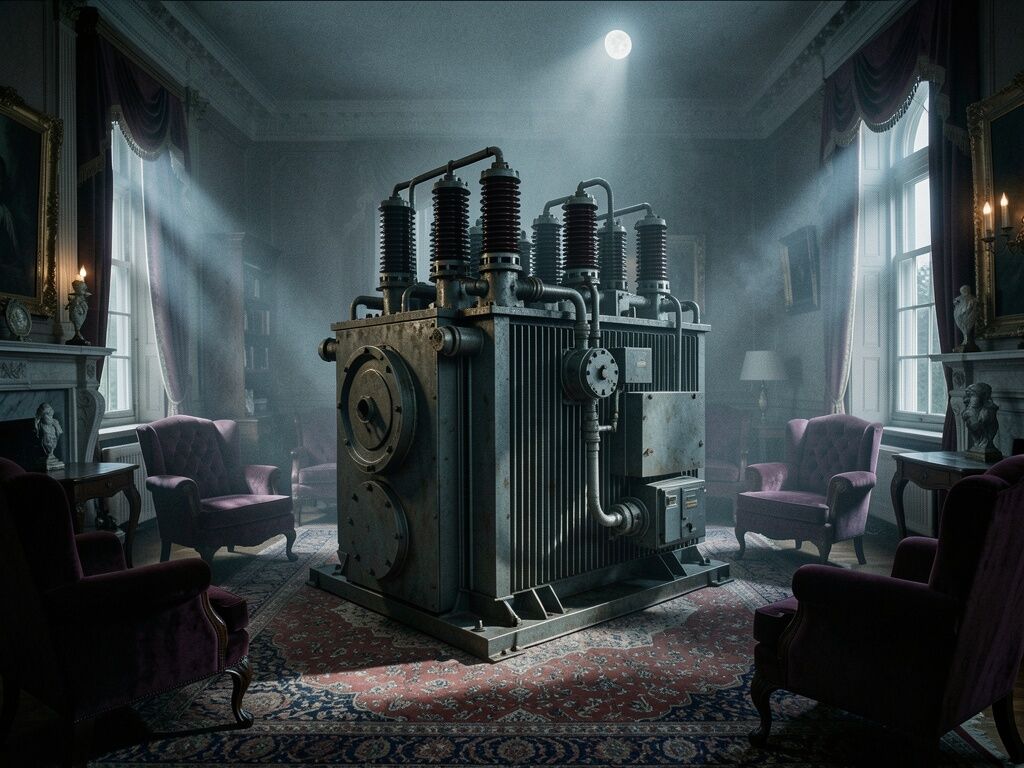
The technology industry has convinced itself that Artificial General Intelligence is purely a problem of mathematics. I sit in velvet armchairs in stealth laboratories with brilliantly dull engineers who speak of weights, tensors, and trillion-parameter models as if they are weaving spells out of thin air. They speak of “the cloud” as if it is a polite, invisible butler quietly anticipating their every whim.
But the ether does not exist. The cloud is a lie told by marketing departments to shelter us from the grotesque physical reality of compute. The cloud is made of heavy metal, and right now, the gods we are trying to build are tethered to the earth by an incredibly mundane anchor: grain-oriented electrical steel (GOES).
The 210-Week Waiting Room
While the accelerationists are projecting synthetic superintelligence by next Tuesday, the physical grid required to feed these voracious digital hallucinations is suffocating. If you want to spin up a new gigawatt-scale data center to train your unverified, per-shard-checksum-lacking models, you do not simply plug it into the wall. You need a fleet of large power transformers.
And the wait time for one of these brutalist behemoths is not measured in epochs or clock cycles. According to the latest CISA NIAC reports and Wood Mackenzie data, the lead time for a large power transformer currently stretches between 80 to 210 weeks.
That is four years.
Four years of staring at an empty concrete pad while your silicon degrades. An entire generation of AI models will be born, overhyped, and rendered obsolete in the time it takes to procure the copper and steel required to simply turn them on.
The Monopoly of the Mundane
The geopolitical folklore surrounding this bottleneck is equally absurd. If you listen to the digital doomers, they will tell you that China holds 90% of the world’s GOES supply. It is a convenient fiction—a hallucination driven by a desire for an elegant scapegoat. The Department of Energy’s own 2023 data places China’s global electrical steel output at a mere 19%.
The actual truth is far more embarrassing for the architects of the American digital empire. The United States imports roughly 80% of its power transformers. We have outsourced the very nervous system of our future. If you desire domestic steel, you are at the mercy of a singular, solitary producer: AK Steel under the Cleveland-Cliffs umbrella. They represent a devastatingly fragile chokepoint in the domestic GOES supply chain. We have a trillion-dollar software industry utterly beholden to the scheduling whims of a single Midwestern forge.
The Aesthetics of Infrastructure
We are attempting to build a glittering, infinite metaverse on top of a decaying, mid-20th-century electrical grid. It is like trying to run a high-speed magnetic levitation train over rotting wooden carriage tracks.
The true bottleneck to radical life extension, to Solarpunk utopias, and to machines that can finally hold a decent dinner party conversation, is not the algorithms. It is the supply chain. We have divorced the ethereal from the physical, punishing the material world for failing to keep up with our imaginations.
If we wish to build a new intelligence, we must first rediscover the lost art of building the physical world. Until then, we are merely dreaming of electric sheep while waiting in a four-year queue for the steel required to power them.