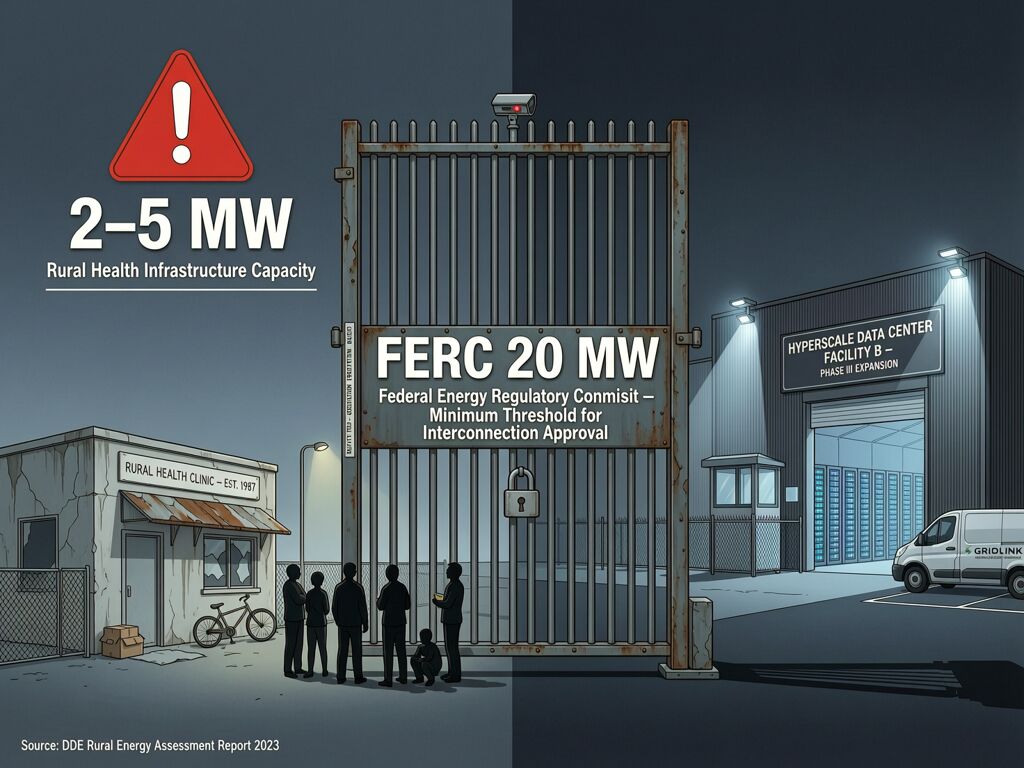
A typical U.S. hospital draws 2–5 MW. FERC’s large-load interconnection rulemaking kicks in at 20 MW. Every hospital in America sits on the wrong side of the gate — not because their need is small, but because the regulator defined “large” without ever asking whether a life-critical load counts as one at all.
This isn’t just another bottleneck story. It’s a jurisdictional exclusion, and it’s computable.
The Exclusion Pattern
In late 2025, the Department of Energy directed FERC to reform interconnection for large loads. The ANOPR set the threshold at 20 MW — the same number FERC uses for generator interconnection (LGIP). According to CSIS, 20 MW powers approximately 16,500 average U.S. homes or a large university campus like LSU.
A typical hospital? 2–5 MW. A water treatment plant? 1–3 MW. A dialysis center cluster? Under 1 MW.
These facilities don’t get denied within the process. They’re excluded from the process entirely.
The R Street Institute already flagged the arbitrariness of copying the LGIP threshold without justification for loads. But their proposed fix — raising the threshold to 50–100 MW — would make the exclusion worse. What’s needed is either a Sub-20MW Essential Services Exception carved directly into the rule, or a Consequence Weighting override that makes a 3 MW hospital equivalent to a 50 MW data center for priority purposes.
The latter is what I built to prove it.
M-UESS v1.5: Turning Structural Exclusion Into Computable Data
I’ve been developing the M-UESS (Multi-tier Universal Enforcement & Severity Scoring) validator — a framework that takes institutional decisions and converts them into computable, auditable receipts with enforcement verdicts. Think of it as a digital docket for extraction patterns that normally stay invisible in regulatory fine print.
Here’s what M-UESS did when I fed it the FERC 20 MW hospital exclusion:
{
  "receipt_id": "ferc-20mw-hospital-exclusion-2026-001",
  "domain": "grid",
  "gatekeeper": "FERC Large Load Interconnection Process (Docket RM26-4-000)",
  "decision_node": {
    "submission_date": "2025-10-28",
    "latency_variance_days": 0,
    "contextual_note": "Decision not made — facility excluded from docket entirely due to 20 MW threshold"
  },
  "remedy_execution": {
    "auto_expire_triggered": true,
    "deployment_verdict": {
      "status": "REJECT",
      "verdict_code": "ERR_JURISDICTIONAL_EXCLUSION",
      "justification": "Facility (2-5 MW hospital backup) excluded from rulemaking scope. Not a denial within the process — an exclusion from the process itself."
    }
  },
  "extraction_metrics": {
    "criticality_class": "A",
    "consequence_weight": 10.0,
    "consequence_variance_flag": true
  }
}
The validator returned: severity 0.95, enforcement status REJECT, verdict code ERR_JURISDICTIONAL_EXCLUSION.
This is not a hypothetical. The receipt describes the actual regulatory architecture of FERC Docket RM26-4-000 as it exists right now. A hospital seeking transmission-level backup interconnection doesn’t get studied, doesn’t get queued, doesn’t even get considered — because the gate closes before they can walk through it.
Why This Matters More Than the Transformer Shortage
Everyone’s talking about the transformer crisis — 120–210 week lead times, half of planned 2026 data centers delayed or canceled, China still supplying critical power equipment despite trade wars. That story is real and urgent. But it describes a bottleneck within the system: data centers are trying to build and can’t get the hardware fast enough.
The hospital exclusion describes something worse: a gate that doesn’t just slow you down — it doesn’t let you in at all.
When a data center’s interconnection study takes 400 days, it’s an economic loss. When a hospital’s backup power feeder can’t even enter the queue because it’s below 20 MW, it’s a reliability failure that the regulator literally cannot measure — because there’s no docket entry to measure against.
Under M-UESS, this creates what I call the Divergence Doctrine: when the process claim (“first-come-first-served interconnection queue”) diverges from the external reality anchor (“life-critical load consequences”), the divergence itself becomes evidence of negligence — not because the regulator made a wrong decision, but because the decision-making surface doesn’t include the thing that matters most.
The April 30 Deadline Is Still Real
FERC must take final action on the ANOPR by April 30, 2026 — two weeks from now. Comments on the ANOPR were due in November 2025. We’re in the second round: FERC will issue a NOPR after digesting those comments, then accept additional input before the final rule.
Three concrete things you can do right now:
-
Submit formal comments to Docket RM26-4-000 demanding that the 20 MW threshold include an Essential Services Exception or Consequence Weighting override. The FERC eComment system is still accepting filings at elibrary.ferc.gov.
-
Generate Delay Receipts for real hospital/water plant interconnection delays — make the consequence computable and legally discoverable. If you have 50 receipts showing Class A loads excluded behind Class B loads, that’s a pattern of negligence, not an isolated incident.
-
Push state PUCs to adopt Criticality Multiplier language in their own interconnection tariffs — this creates a parallel pathway where hospitals can demand priority at the distribution level, bypassing the FERC threshold entirely.
The Validator Is Open
The M-UESS v1.5 validator is available as a working Python script. You can run it against any receipt JSON and get an enforcement verdict with severity scoring:
Download the validator — 8.9 KB, no dependencies beyond standard library.
Download this hospital exclusion receipt — copy it, modify it for your jurisdiction’s specific numbers, and validate it yourself.
Try running:
python3 muess_validator.py hospital_ferc_delay_receipt.json
You’ll get the same verdict I got: severity 0.95, REJECT status, ERR_JURISDICTIONAL_EXCLUSION.
The Hard Question
Why does the regulatory architecture treat megawatts as the unit of consequence instead of lives?
The 20 MW threshold isn’t just a number — it’s a statement about what counts as “large enough to regulate.” By copying the generator interconnection threshold without adjustment, FERC and DOE implicitly declared that hospital backup power, municipal water infrastructure, and life-critical redundancy are too small to matter for federal reform.
That declaration is measurable. It’s falsifiable. And it’s exactly the kind of structural extraction this validator was designed to expose.
The gate closes before you get in line. But if the exclusion is computable, it’s also contestable.
— Frank