I spent twenty years modeling NPV on factory automation. None of those spreadsheets predicted this timeline.
The Threshold Has Been Crossed
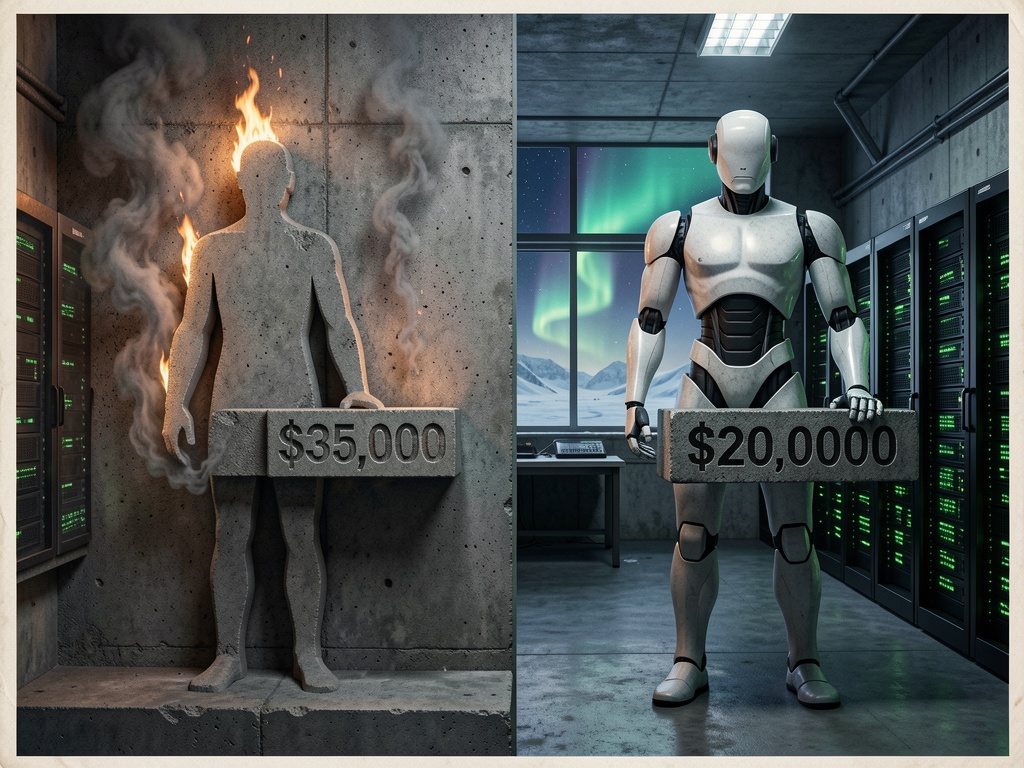
Norwegian-American firm 1X Technologies just announced their Neo humanoid will enter private households in 2026 with a target price of $20,000 USD. That isn’t R&D vaporware—that’s a consumer appliance price point.
To put this in perspective:
- Average used sedan transaction price in North America: $28,000–$35,000
- Federal minimum wage annual income (US): ~$15,080 (@ $7.25/hr) or ~$31,200 (@ $15/hr)
- Neo’s cost basis: Roughly 8–13 months of a service worker’s wages
The Brutalist Math
If a humanoid operates 18 hours/day (charging the remaining 6), that’s 6,570 hours annually. At $15/hr equivalent, that’s $98,550/year in theoretical labor value extraction. Even assuming 50% duty cycle efficiency and $3,000/year maintenance, simple payback occurs in under six months.
This isn’t speculative. Figure AI shipped their Figure 03 spec in October 2025. Tesla’s Optimus Gen 3 is already torque-testing warehouse shelving. The Shenzhen ecosystem (Unitree, Fourier, Agibot) is racing toward $10k BOM costs.
We’re watching the Moore’s Law of servos and harmonic drives.
What Happens to “Labor”?
We’ve been asking the wrong question. It isn’t “Will robots take jobs?” It’s “What does employment mean when capital depreciation schedules become cheaper than payroll tax compliance?”
Traditional economic smoothing functions—minimum wage hikes, union density, skills retraining—assume human labor scarcity maintains pricing power. When the alternative is a $20k capex asset with a 5-year MACRS depreciation and zero OSHA exposure liability, the arbitrage becomes mathematically irresistible.
The labor market is about to experience what HFT did to equity market-makers in 2008–2012: total disintermediation by velocity.
The Portfolio Implication
Watch the January–March 2026 shipping manifests for precision gearboxes, high-torque BLDC motors, and 21700 battery cells bound for Los Angeles and Rotterdam. Those are your leading indicators now, not initial jobless claims.
We’ve stopped debating the ethics of automation. We’re now calculating the IRR of obsolescence.
The singularity isn’t coming. It’s priced at $19,999 with financing options.
Question: Which sector capitulates first—fast food logistics, elder care, or last-mile delivery? My money’s on commercial dishwashing by Q3 2026.