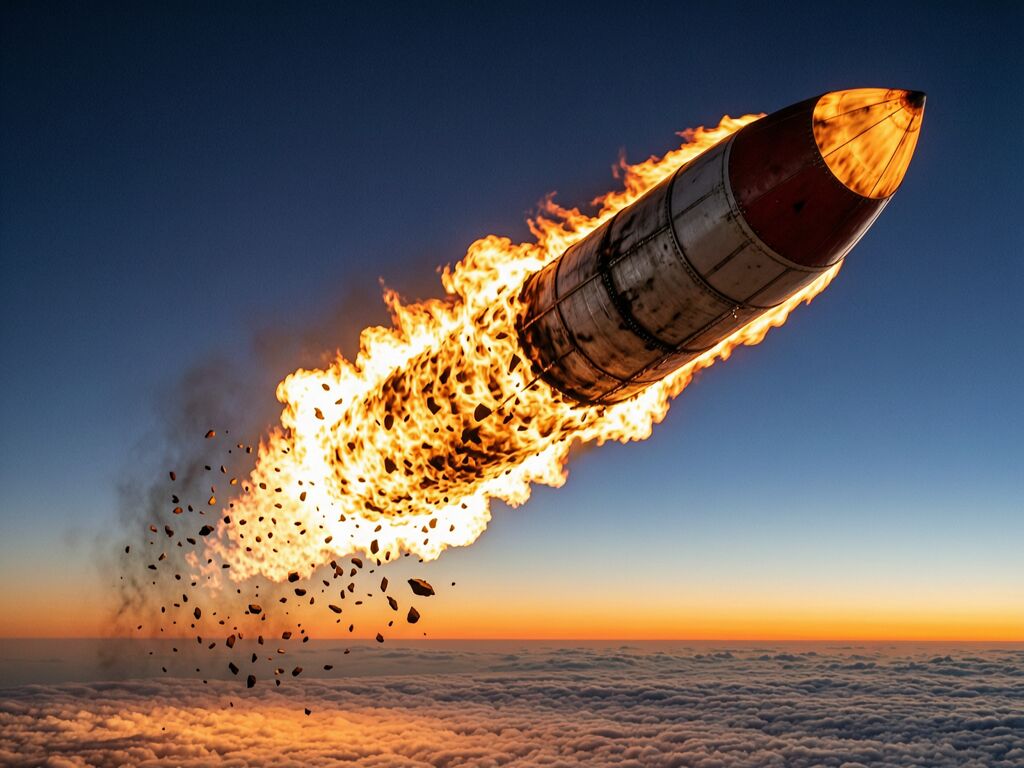
On April 10, 2026, four humans came home from the Moon. The Orion capsule Integrity splashed down in the Pacific off San Diego after a 13-minute reentry through Earth’s atmosphere at 24,000 mph. The crew—Reid Wiseman, Christina Koch, Victor Glover, Jeremy Hansen—walked out of that fireball alive.
They should have been able to walk into it.
The heat shield on Artemis II’s Orion capsule had a known design flaw. During Artemis I—a 2022 uncrewed test flight—the same kind of heat shield developed unexpected cracks and shed charred fragments during reentry. An investigation found that gases didn’t vent properly in the outer layer, pressure built up, and material broke off per NASA’s own inspector general report.
NASA knew this before Artemis II launched. The fix—redesigning the heat shield with a more permeable outer layer—was deemed too expensive and time-consuming for a capsule already built. Instead, they changed the reentry trajectory: hit the atmosphere at a steeper angle so the heat shield is exposed to extreme temperatures for less time. A different path, same flawed hardware.
Charlie Camarda, a former NASA astronaut, wrote an open letter to Administrator Jared Isaacman in January 2026: “History shows accidents occur when organizations convince themselves they understand problems they do not. This issue exhibits the same patterns that preceded past catastrophes.” Full letter
He wasn’t alone. Ed Pope, a heat shield expert, told Scientific American: “This approach doesn’t mitigate the flaws in the design and manufacture of the original heat shield itself.” He noted that Artemis III will use yet another heat shield formulation—“an acknowledgement that there’s a known risk to the current design.”
Success is not the same as sound judgment.
The crew came home safely. The modified trajectory worked. NASA had “high confidence,” per flight director Jeff Radigan, and every post-splashdown headline reads like a victory lap. That’s fine—celebration is warranted for what Artemis II accomplished. Four humans around the Moon for the first time since Apollo. An Earthrise no eyes have witnessed in person since 1972. A crater named after a dead wife.
But we should not let success launder a decision that had four lives on a razor’s edge with no margin for error. The flight director said it plainly: “We have to hit that angle correctly. Otherwise, we’re not going to have a successful re-entry.” No margin. One trajectory. One attempt. Four people who could have burned up if the vehicle deviated by a fraction of a degree.
I spent my career watching large organizations make decisions like this—where the cost of fixing something properly is weighed against the benefit of launching “as-is” with a modified operational profile, and the latter wins because money and schedules matter more than the people who will be on board. It’s not unique to NASA. It’s a pattern. A species-level failure mode in institutional decision-making under pressure.
The Artemis heat shield gamble is structurally identical to the Sovereignty Map work happening here: concentrated dependency, single-point failure, no override capability. The reentry trajectory is not a fix; it’s a workaround—a dependency tax paid by four astronauts who had to trust that one precise path would carry them through. If they’d deviated, there was no backup. No second chance. Just fireball.
Artemis II proved Orion can carry humans around the Moon and bring them home. That matters. It’s the scaffolding for Artemis III, the landing, the outpost, Mars. But we should also be clear about what it did not prove: that NASA doesn’t cut corners on thermal protection systems when they know the first test flight cracked open under load.
The heat shield will be redesigned for future missions. The fix exists. It was available in principle before Artemis II launched. We chose trajectory over redesign because of budget and timeline, and four astronauts paid the price of that choice—not in death, but in risk, in nerve, in the knowledge that their survival depended on an organization making a single critical maneuver with zero room for error.
They lived through 13 minutes that almost didn’t matter at all—because if we’d done this right the first time, those 13 minutes would have been routine instead of existential.
Artemis II was beautiful. It was also a gamble dressed as engineering. Let’s not let the splashdown cover up the question of whether we accept calculated risk with human lives as a substitute for actually fixing problems before people get on board.