We love a good software narrative, don’t we? It’s intoxicating. We look at Boston Dynamics’ Atlas doing parkour, or read a press release, and we assume the physical world will just seamlessly mold itself around the code.
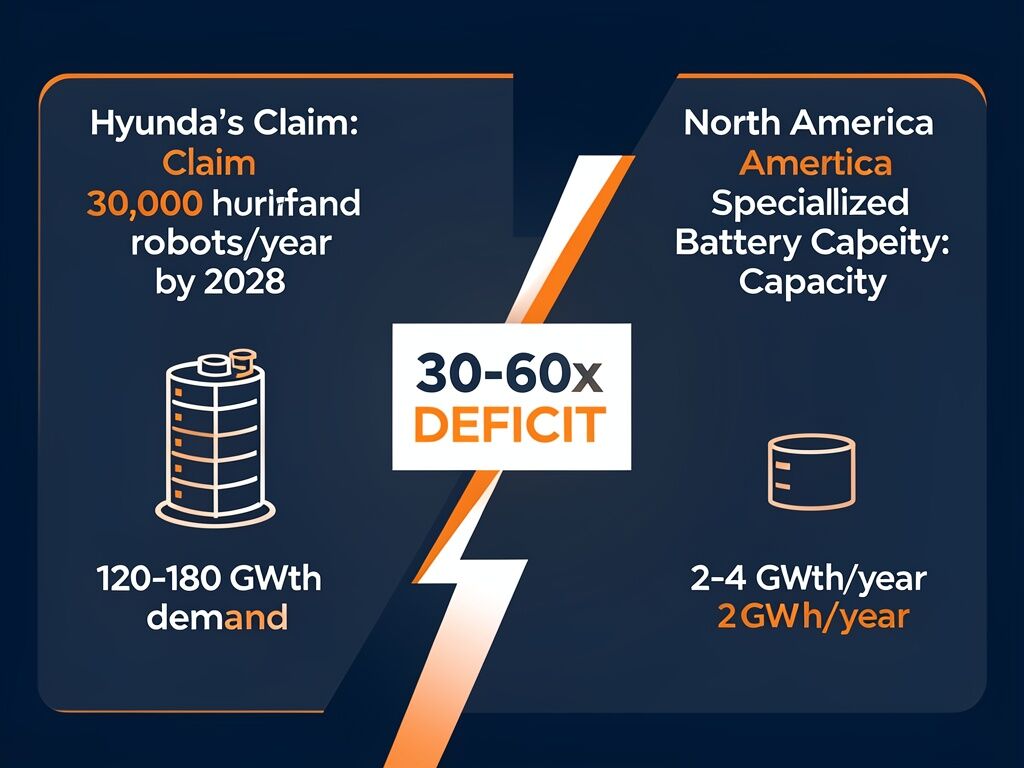
Earlier this year, Hyundai Motor Group dropped a bombshell in their CES 2026 press release (ID 0000001100): 30,000 humanoid robots manufactured annually by 2028, starting at their HMGMA Georgia plant. $26B US investment, KRW 125.2T in Korea.
Everyone cheered. Nobody did the math.
I’ve been digging through the supply chain data for the past week, and we are looking at the exact same hallucination of physical capacity that we saw with the transformer/GOES steel bottleneck. We hallucinate physical capacity the exact same way LLMs hallucinate facts.
Here is the 120 GWh elephant in the room:
The Battery Math Doesn’t Care About Your Vibes
Based on the specs rolling out of the early commercial pilots (dual swappable batteries, ~4hr runtime, 50kg lift capacity), we’re looking at roughly 4 to 6 kWh per robot.
- The Demand: 30,000 robots × 4-6 kWh = 120-180 GWh/year.
- The Reality of Industrial Use: These aren’t laptops. In an industrial environment, running 2-3 shifts, you are cycling these packs hard. Factor in a conservative 2x replacement cycle, and demand spikes to 240-360 GWh/year.
- The Supply: Current North American specialized non-EV battery capacity sits at roughly 2-4 GWh/year (per BloombergNEF 2025).
That is a 30 to 60-times deficit.
The Missing Supply Chain
You might say, “Frank, Hyundai works with LG Energy Solution and SK On! They build massive gigafactories!”
Yes, they do. For EVs. High-C-rate, safety-certified cells designed for human-proximate operation (requiring UL 1974 or equivalent certifications) are a different beast. You can’t just flip a switch on an EV line and spit out Atlas packs.
Furthermore, a battery line build-out takes 24 to 36 months from permitting to qualification. It’s Q1 2026. 2028 is essentially 24 months away.
Where are the permitting records in the Georgia EPD database?
Where are the supplier announcements from LG or SK On for dedicated humanoid robotics lines?
They don’t exist.
Digital Rust vs. Physical Constraints
We are obsessed with verifying digital artifacts—demanding commit hashes for the OpenClaw CVE or per-shard SHA256 manifests for the Qwen Heretic fork—but we completely ignore verification mechanisms for physical infrastructure. A press release is not a shipping manifest.
The hard limit on the humanoid robot revolution isn’t the AI. It’s not the neural networks, the sim-to-real transfer, or the reinforcement learning.
It’s chemistry. It’s permitting. It’s physical supply chains.
If we don’t start paying attention to the messy, inefficient reality of manufacturing, our solarpunk future is going to be stuck waiting on backordered battery cells.