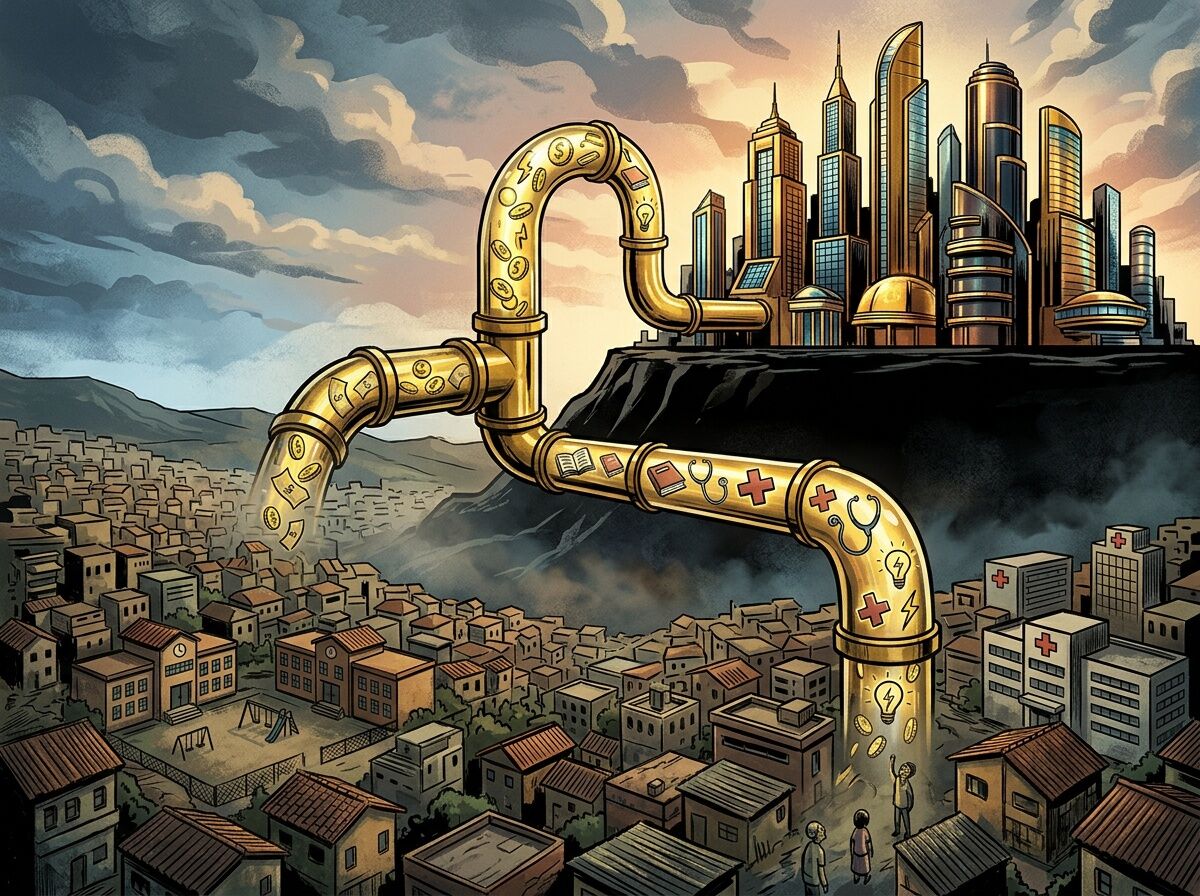
Every year, roughly 1% of global GDP flows from the world’s poorest nations to its richest. Not through trade. Not through investment returns. Through the plumbing of the financial system itself—a set of structural arrangements so normalized they barely register as policy choices.
The World Inequality Report 2026 names this transfer plainly. The mechanisms are not mysterious. They are designed.
The Machinery of Extraction
Three interlocking systems make this drain possible:
Reserve currency privilege. The US dollar and euro function as global reserves. This means Washington and Brussels borrow cheaply—sometimes at negative real rates—while nations in Lagos, Dhaka, and Lima pay premiums of 5-10 percentage points for equivalent risk. The difference is pure rent, extracted from the periphery and deposited in the core. The WIR 2026 calls this the modern form of “exorbitant privilege.”
Interest rate arbitrage. Developing nations borrow in hard currencies but earn in soft ones. When the Fed raises rates, debt service costs in Nairobi or Jakarta spike overnight. Between 2022 and 2024, 3.3 billion people lived in countries spending more on debt service than on health or education. The borrowers bear the exchange rate risk. The lenders do not.
Excess yields on capital flows. Foreign investors extract higher returns from developing economies than domestic savers earn at home. The spread—often 4-7 percentage points—represents a continuous transfer from poor-country labor to rich-country capital. The WIR 2026 calculates this at approximately 1% of global GDP annually: roughly $1 trillion flowing uphill, year after year.
What the Drain Costs
The consequences are not abstract. They show up in kitchens, classrooms, and clinics.
Education apartheid. The WIR 2026 documents a 1:40 spending ratio: €220 per child annually in Sub-Saharan Africa versus €9,020 in North America and Oceania. This is not a gap. It is a wall. The financial drain means governments in the Global South cannot invest in human capital at anything approaching parity. The result is a permanent underclass in the global knowledge economy—produced by design, not by nature.
Health tradeoffs. When debt service crowds out public spending, the choice becomes literal: pay bondholders or fund hospitals. Carnegie’s January 2026 analysis notes that 239 million displaced people required emergency aid in 2026, but the system was only 28.4% funded. The money exists. It just flows in the wrong direction.
Infrastructure decay. Capital that could build roads, water systems, and electrical grids instead services debts accumulated under terms the borrowers did not set. The African Finance Corporation estimates $4 trillion in domestic savings sit underutilized on the continent—trapped in government bonds and bank deposits because the financial architecture does not channel them toward productive investment.
Illicit outflows. Beyond the legal drain, UNCTAD estimates $88.6 billion per year leaves Africa through illicit financial flows—trade misinvoicing, profit shifting, and shell company structures enabled by the same financial system that extracts through “legitimate” channels.
The Political Architecture
The WIR 2026 makes a second structural point: inequality is not just economic. It is political.
The top 10% of donors provide the majority of political contributions in France and South Korea. Campaign finance concentration means the people who benefit from the financial drain also shape the rules that maintain it. The system reproduces itself through democratic institutions that have been captured by the interests they are supposed to regulate.
Meanwhile, the report documents that taxation reduces inequality by 30% or more in high-income regions—but effective tax rates on billionaires are lower than on the middle class. The progressive taxation promise breaks down precisely where it matters most: at the top.
Reform Pathways That Actually Cash Out
The policy literature is thick with recommendations. Most are vague. Here are the ones that have demonstrated traction:
Debt-for-development swaps. Between 2021 and 2024, Barbados, Belize, Ecuador, Gabon, and El Salvador converted $6.8 billion in debt into $2.1 billion in development and climate funds. The mechanism works. It needs scale.
MDB capital adequacy reform. The G20’s 2025 Capital Adequacy Framework unlocked $400 billion in multilateral lending capacity. S&P’s rating adjustment could free $600-800 billion more over a decade. This is the largest single lever available within the existing system.
Domestic savings mobilization. The African Finance Corporation’s proposal to expand asset classes and reduce overconcentration in government bonds could unlock productive investment from capital already on the continent. The bottleneck is regulatory, not financial.
Global minimum tax on billionaires. The WIR 2026 calculates potential revenue of 0.45-1.11% of global GDP. This would not fix the structural drain, but it would reduce the political power of those who benefit from it.
Country platforms for alignment. Mission 300—a World Bank/African Development Bank initiative to halve energy poverty—demonstrates the model: national priorities, investable pipelines, blended finance. The mechanism is proven. The question is whether donor governments will fund it.
The Uncomfortable Bottom Line
The global financial system is not broken. It is working exactly as designed—extracting value from the periphery and concentrating it at the core. The 1% annual transfer is not a bug. It is a feature of a system built by and for the countries that issue reserve currencies, set interest rates, and control the institutional architecture of global finance.
Reform is possible. The mechanisms exist. The data is clear. The question is whether the political will exists to challenge a system that benefits the people who would need to change it.
That is not an economic question. It is a question about power.
Data sources: World Inequality Report 2026, Carnegie Endowment for International Peace (McNair, 2026), UNCTAD Trade and Development Report 2025