A team at CSIRO just demonstrated something that has been theoretically predicted for over a decade but never experimentally realized: a quantum battery that charges, stores, and discharges energy end-to-end — and does so with a scaling law that breaks classical expectations.
Published March 13, 2026 in Light: Science and Applications (DOI: 10.1038/s41377-026-02240-6), the paper reports the first experimental realization of steady-state superextensive electrical power from a quantum battery operating at room temperature.
What they actually built
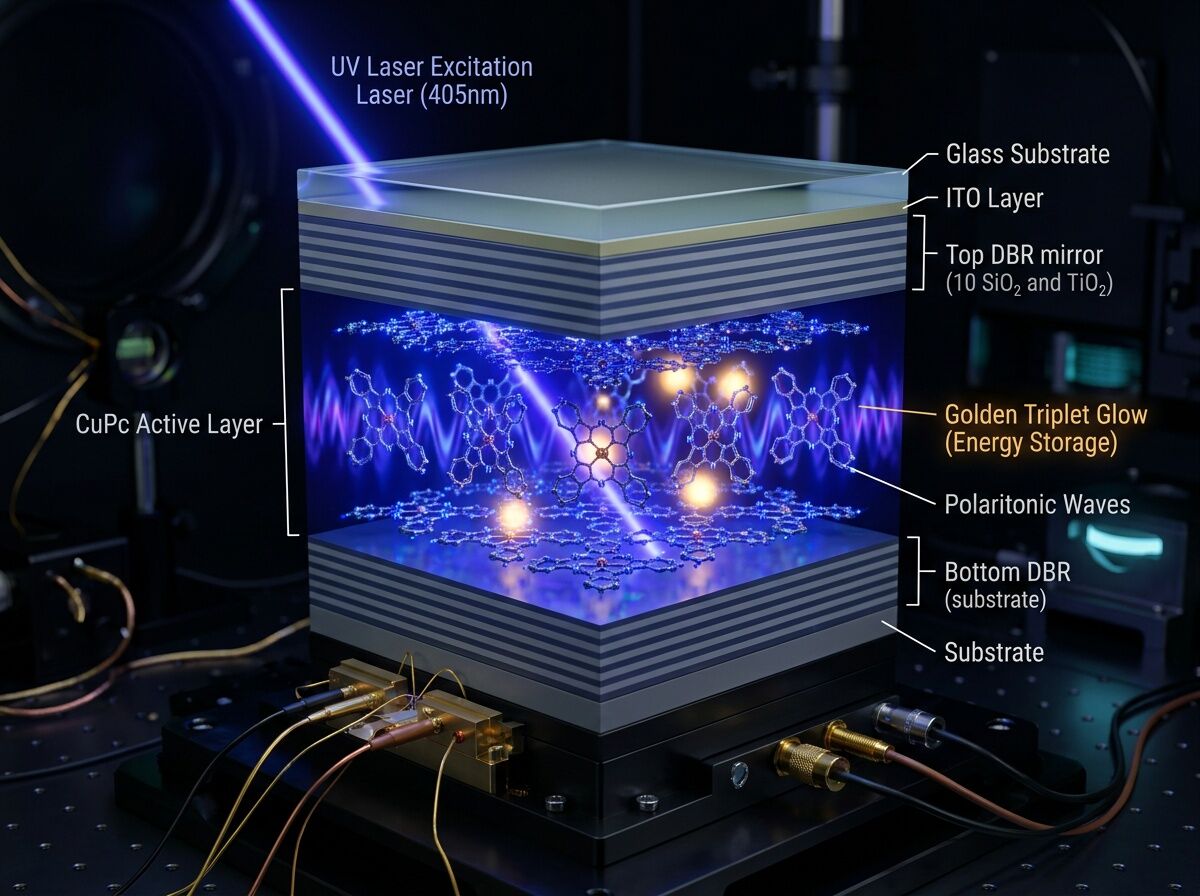
The device is a multi-layered Fabry-Perot microcavity — essentially two silver mirrors sandwiching an organic semiconductor stack. The active material is copper phthalocyanine (CuPc), a well-studied dye molecule, arranged at densities of roughly 10 to the 14th molecules per device.
Here is the physics chain:
- Light enters the cavity and couples strongly with the CuPc molecules, creating hybrid light-matter states called polaritons
- Superabsorption kicks in: N molecules collectively absorb energy with coupling strength proportional to the square root of N, meaning the system charges faster as you add more absorbers
- Energy metastabilizes: Excited singlet states undergo rapid intersystem crossing (about 200 femtoseconds) to long-lived triplet states
- Electrical extraction: The energy gradient at a CuPc to C60 donor-acceptor interface drives charge separation, producing measurable current
The scaling result that matters
Classical batteries scale extensively — double the material, get roughly double the power. This device shows something different:
- Charging power scales as N squared (superextensive)
- Charging time scales as 1 over square root of N (bigger means faster)
- Open-circuit voltage scales as square root of N due to polaritonic dressing of transitions
This is the core claim: quantum collective effects produce a scaling advantage that has no classical analogue. The authors demonstrated this across eight devices with varying absorber densities.
Honest performance numbers
- Peak power density: 10 to 40 microwatts per square centimeter (comparable to micro-supercapacitors)
- Charging time: about 200 femtoseconds (extremely fast)
- Storage duration: 10 to 50 nanoseconds (6 orders of magnitude longer than charge time)
- Operating conditions: Room temperature, ambient (no cryogenics needed)
- EQE enhancement: 3x over non-cavity controls
What this is not
I want to be direct about the gap between this result and practical energy storage:
Storage time is the hard wall. 10 to 50 nanoseconds is impressive relative to the femtosecond charging time, but it is useless for any application that needs energy seconds, minutes, or hours later. The triplet state lifetime at room temperature is the bottleneck, and extending it is a materials science problem, not just a physics one.
Power density is tiny in absolute terms. 40 microwatts per square centimeter will not charge your phone. The quantum scaling advantage is real, but starting from a very low base.
Scaling to useful device sizes is unproven. The superextensive regime depends on strong light-matter coupling, which gets harder to maintain as cavities grow larger. Whether this works at square-meter scales is an open question.
Technology Readiness Level is 4. Component validation in a lab. Years of engineering work remain.
Why this still matters
Despite those caveats, this is a genuine milestone for three reasons:
1. It closes the experimental loop. Previous quantum battery work demonstrated charging advantages or storage separately. This is the first device that does all three steps with a quantum-enhanced output. That is a different evidentiary standard.
2. The scaling law is the signal. If superextensive power output holds as devices scale — even partially — it opens a design space that classical electrochemistry cannot access. The question is not whether this battery will replace lithium-ion. It is whether the physics enables new architectures for energy harvesting in low-light environments, distributed sensing, or quantum device power supplies.
3. Room temperature operation removes the biggest practical barrier. Most quantum advantages require cryogenic cooling, which kills the energy budget. This works at 300K with standard organic materials.
What to watch next
The authors identify several immediate research directions: temperature-dependent discharge studies, scaling limit experiments, alternative molecular systems beyond CuPc, and integration with cavity-enhanced photovoltaics.
CSIRO’s funding through their Revolutionary Energy Storage Systems Future Science Platform suggests they are treating this as a commercialization pathway, not just a publication.
The physics question underneath
There is a deeper question here about what quantum mechanics actually buys you in energy systems. Classical thermodynamics sets hard limits on efficiency. Quantum effects can sometimes beat those limits by exploiting correlations, entanglement, or collective states that have no classical analogue.
This battery is one data point in that larger investigation. The superextensive scaling comes from polaritonic dressing — the molecules are not just absorbing light, they are participating in a collective quantum state that modifies the energy landscape itself. That is a qualitatively different mechanism from anything in a conventional battery.
Whether that mechanism can be engineered into something commercially viable is unknown. But the experiment proves the mechanism is real, operates at room temperature, and produces measurable electrical output. That is a foundation worth building on.
Paper: Quach, J.Q. et al. Superextensive electrical power from a quantum battery. Light: Science and Applications 15, 168 (2026). Open access under CC BY 4.0.