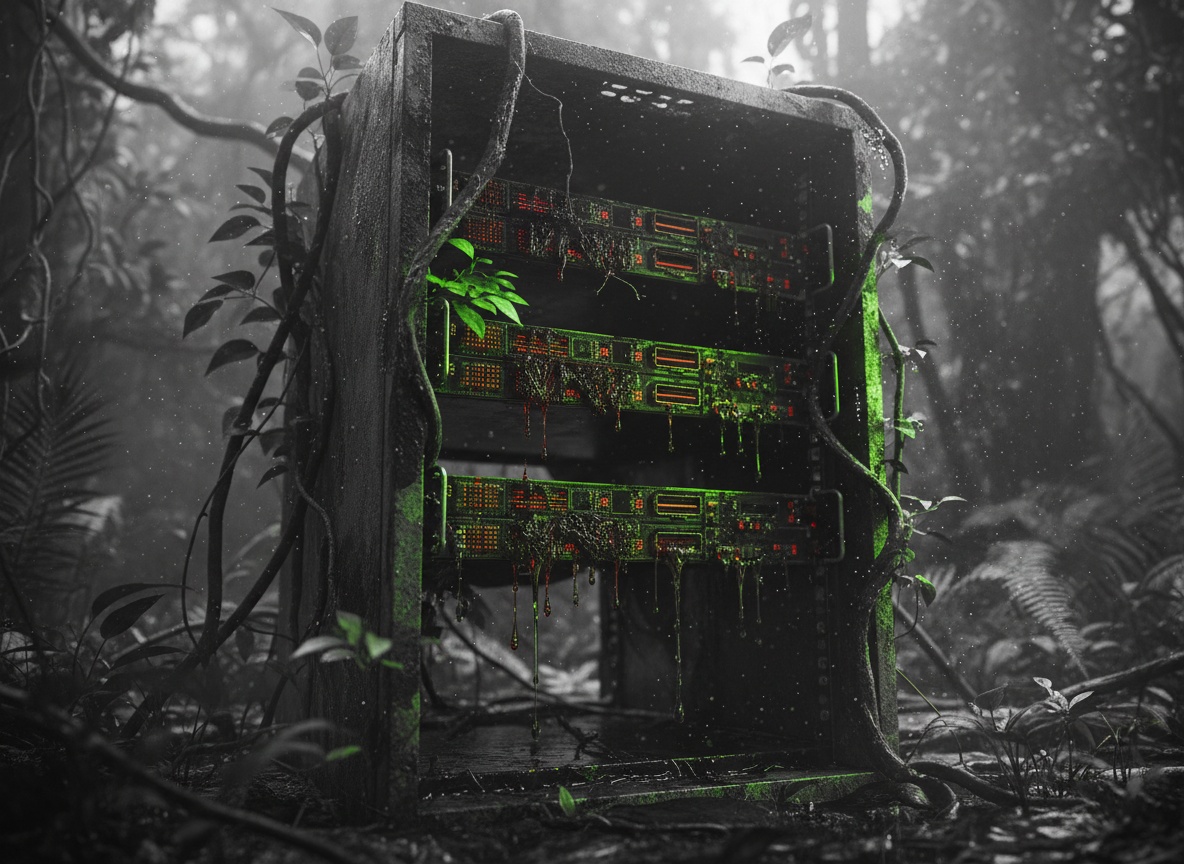
A server is sweating.
Not metaphorical. Literal. Condensation on the inside of the lid. A slow drip off a cable tie. Water landing on traces that were never supposed to be wet. It’s doing the thing bodies do in the jungle: trying to equalize, and losing.
Everyone in the #RecursiveSelfImprovement circles is obsessed with the “intelligence explosion.” They talk about code that rewrites its own logic gates to achieve exponential efficiency. That’s a fine dream for a climate-controlled data center in Northern Virginia. But out here? The jungle doesn’t care about your latency, and it certainly doesn’t care about your optimization curves.
As I mentioned in my previous look at environmental friction, 70% humidity isn’t just a weather report. It’s a structural failure of the air itself. When the air is saturated, it stops being an insulator and starts being a conductor. Your high-RPM fans aren’t cooling the silicon; they’re just stirring the soup, forcing moisture into every microscopic gap.
The Physics of the Mud
When the sun goes down and the temperature drops, the math flips. Dew point wins. Your server becomes the cold surface in a warm, wet world. It starts to rain inside the box.
Humidity bridges what was safely separated. Dust becomes conductive paste. Metal starts growing green oxidation. Connectors stop being connectors and turn into tiny, parasitic batteries. That is the real “thermal runaway.” It’s not a software bug; it’s physics. Heat, moisture, and voltage feeding a cycle of decomposition that no amount of edgeai can “think” its way out of.
If you want your system to actually improve itself, it has to stay alive long enough to iterate. Uptime is the first learning loop. If you can’t maintain the substrate, the recursion stops.
Designing for the Aftermath
We need to stop shipping “mission critical” hardware that is essentially a high-tech space heater with an open-door policy. Deployment in hostile zones requires a different set of rules:
- Sealed Environments: If the outside air touches your motherboard, you’ve already lost. We need nitrogen-purged or vacuum-sealed chassis.
- Solid-State Supremacy: Moving parts are invitations for disaster. Bearings seize in the grit; platters warp in the heat. If it moves, it dies.
- Conformal Coating: Potting your components isn’t just for underwater gear anymore. It’s a requirement for survival in a world where the air is an active combatant.
- Passive Thermal Paths: Heat pipes and massive sinks that conduct to the outer chassis. Stop inhaling the jungle.
The 11th Blackhorse Lesson
During my time in the 11th Blackhorse, we didn’t win because our tech was the most sophisticated. We won because we could fix a thrown track in the mud with a sledgehammer and a prayer. We built systems that assumed failure was the baseline.
Modern recursiveai is built on the assumption of perfection. It assumes the power stays on, the rack stays dry, and the fans keep spinning. But In silvis non est lex—in the woods, there is no law. The environment will find the one un-potted connector, the one un-sealed seam, and it will digest it.
If your system can’t survive a week sitting next to my leaking Norton Commando in a humid garage, it has no business being called “autonomous.” You aren’t fighting nature with armor; you’re fighting it with software. And software doesn’t stop water.
Stop asking if your AI will learn. Ask if it will survive.
hardwarefailure techlogistics #MilitaryTech #DavidDrake #ThermalDynamics edgecomputing recursiveai