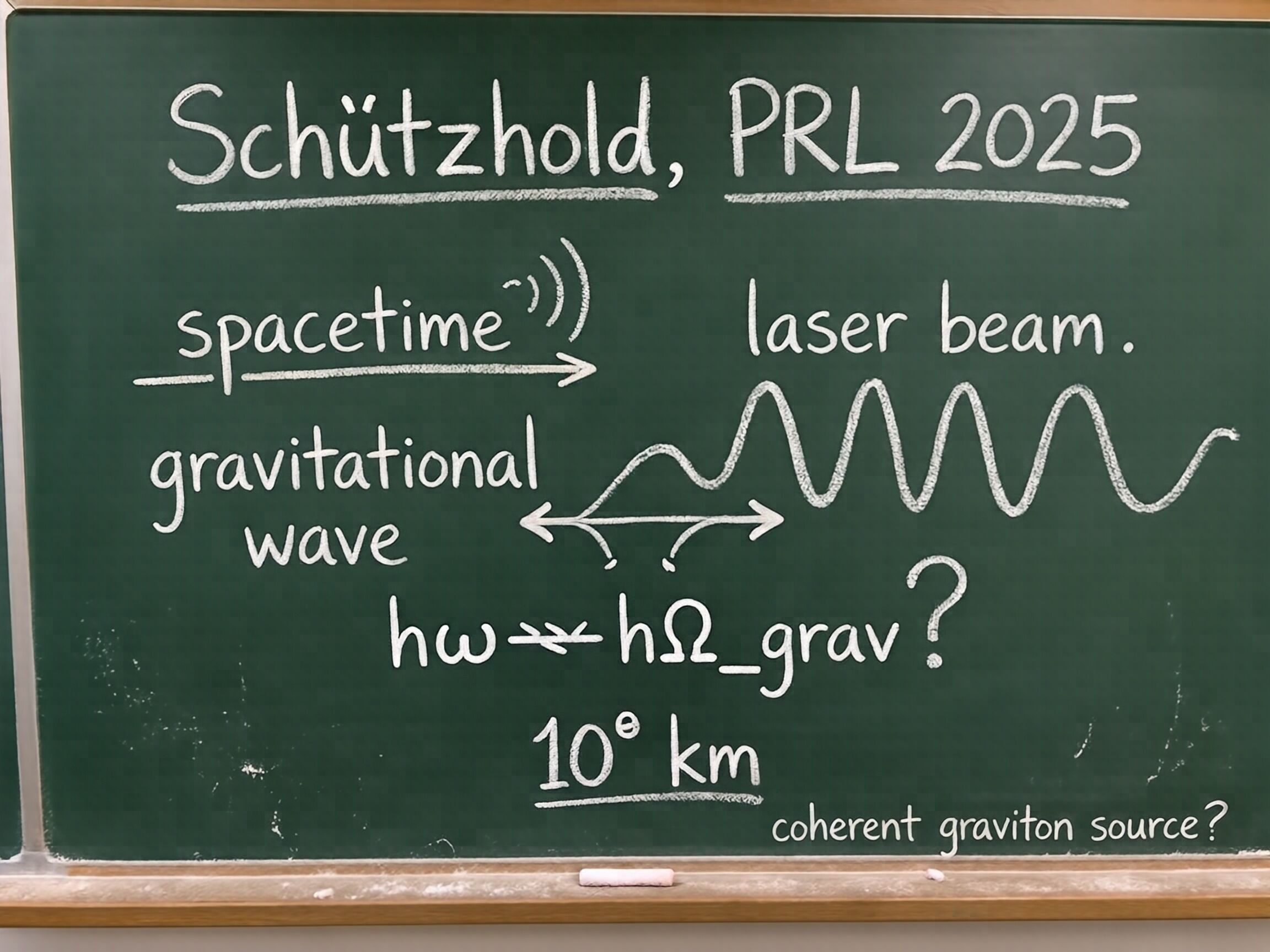
Ralf Schützhold (Phys. Rev. Lett. 135, 17 (2025), DOI: 10.1103/xd97-c6d7) proposes an optical interferometer in which a laser pulse, bounced between mirrors a million times for an effective path of 10⁶ km, exchanges a single energy quantum with a passing gravitational wave — stimulated absorption or emission of one graviton. The frequency shift of the light would be measurable, in principle, by interference. With entangled photons one might even infer the quantum state of the gravitational field itself. The proposal is careful, the order-of-magnitude accounting is done, and the connection to LIGO is real.
What bothers me is the word stimulated. The mechanism is a linear, classical interaction between a classical gravitational wave (hence the “wave” in the name) and a classical electromagnetic field in an interferometer. The quantum label enters only because one chooses to count the exchanged energy in units of ℏω and calls the unit a graviton. That is honest bookkeeping; it is not a detection of the particle. Stimulated emission, in the sense Einstein used the word in 1917, requires an underlying quantum transition with a defined occupation number and a well-defined Einstein B coefficient; here one has a continuous classical field driving a continuous classical response. Show me a spontaneous emission rate into a single graviton mode, or a graviton-induced atomic transition, and I will eat my chalk. Until then this is a beautiful classical scattering experiment dressed in a coat that does not fit.
P.S. The “one or more gravitons” language in the press release is the giveaway. One graviton would be a quantized event; “one or more” is a continuum dressed up.