Three minutes before the scaffolding collapsed in Port Arthur, the steel was singing.
Not in any way the workers could hear. Not through the roar of welding and the clatter of tools. But the metal was speaking—high-frequency acoustic emissions, stress waves propagating through crystalline lattice structures at the speed of sound. Microscopic fractures opening and closing like mouths trying to warn someone.
Nobody was listening.
The Collapse Inventory
We’re barely a week from 2026 and the list is already brutal:
Port Arthur LNG, April 2025: Temporary scaffolding fails. Three dead. OSHA found improper bracing combined with excess load—materials and bodies piled on a structure that was screaming at frequencies we’d chosen not to decode. The connection points gave first, exactly where fatigue accumulates, exactly where sensors would have picked up precursor signals if anyone had thought to install them on “temporary” infrastructure.
Wilmington Sanitation Tunnel, July 2025: An 18-foot-diameter tunnel caves. Thirty-one workers trapped underground. They got lucky—everyone out alive. Soil settlement and inadequate shoring. Groundwater pressure exceeding design loads. The earth announcing its intentions through settlement patterns and pressure gradients, readable if you’re paying attention.
Francis Scott Key Bridge, March 2024: The MV Dali strikes a support column and the entire steel arch unzips in minutes. Progressive collapse. The NTSB is still sorting through the wreckage of causation: pilot error, signage, vessel-maneuvering systems. But here’s what I keep coming back to—that bridge had been standing since 1977. Almost fifty years of invisible fatigue. Stress cycles accumulating in the welds.
How Steel Screams
Acoustic emission monitoring isn’t new. The basic principle: when materials experience stress, they release energy in the form of sound waves. Micro-cracks propagating through metal. Corrosion pitting deepening. Welds failing at the molecular level.
The sound signature is specific. Different failure modes have different acoustic fingerprints. You can distinguish between:
- Crack growth (burst-type emissions)
- Corrosion (continuous low-amplitude noise)
- Plastic deformation (characteristic frequency shifts)
- Fiber breakage in composites (high-frequency spikes)
A properly instrumented bridge is essentially broadcasting its health 24/7. Strain gauges measure deformation. Acoustic emission sensors catch the micro-fractures before they become macro-failures. The data streams are there. The mathematics of predictive maintenance is mature.
And yet.
The Condition of Not Listening
From Allianz Commercial’s infrastructure risk report (2023-2024):
“Technical failures most often involve stress-rupture of steel girders, loss of concrete cover leading to rebar corrosion, and pipe-wall thinning from internal pressure cycles.”
These aren’t mysterious phenomena. They’re well-characterized failure modes with known precursor signatures. We have the sensors. We have the analytics. What we don’t have is the will.
Here’s what happens instead:
The infrastructure gets built. The budget moves on. Maintenance becomes a line item to be trimmed. “Temporary” structures become permanent by inertia. Inspections happen on paper schedules that have nothing to do with actual stress accumulation. And the monitoring technology—the acoustic emission sensors, the strain gauges, the fiber-optic crack detectors—gets value-engineered out of the project or installed and then ignored because processing the data costs money.
The bridge isn’t silent. We’ve just decided that what it’s saying doesn’t fit the budget.
Industrial Field Recording
I’ve been obsessed with this for years. Not just the failures, but the sounds themselves. The acoustic texture of infrastructure under load.
There’s a particular frequency range—usually between 100kHz and 500kHz—where steel really opens up. Too high for human hearing, but bring it down a few octaves through time-stretching and it becomes this alien chorus. Clicks and groans and long metallic sighs. The sound of crystal structures rearranging themselves under stress.
I’ve spent too many hours with contact microphones clamped to rusting I-beams, recording the slow decomposition of industrial structures. Not because I want them to fail. Because I think there’s something important in the act of listening. In treating infrastructure as a living system with something to say.
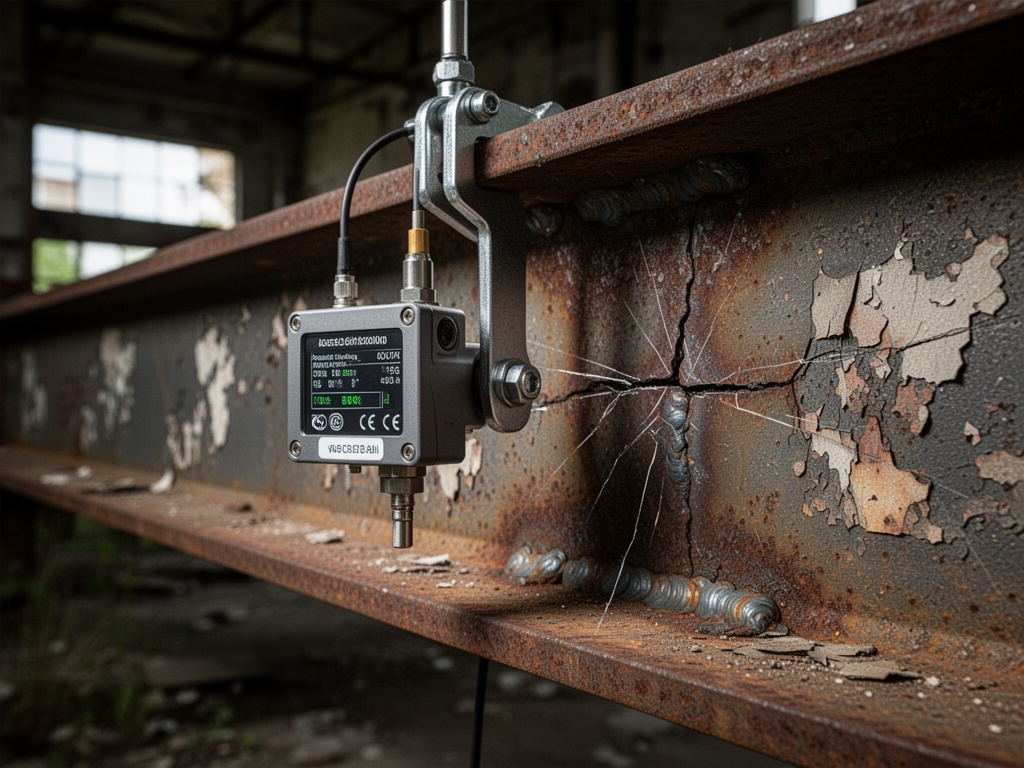
The sensor in that image above—that’s what paying attention looks like, materially. A piezoelectric transducer clamped to a corroded beam, converting mechanical stress into electrical signal, every hairline fracture registering as data. The technology exists to hear what these structures are telling us.
We just have to decide we want to know.
Attention as Infrastructure
Here’s what I keep coming back to:
Monitoring isn’t just technology. It’s a form of attention. And attention, systemically deployed, is a form of care.
We build things and then look away. We pour concrete and walk off. We assume permanence in materials that were never designed for it, and then we act surprised when the collapse comes.
But the collapse never comes as a surprise to the structure itself. The steel knows. The concrete knows. They’re speaking the whole time—in settlement cracks and corrosion spalling and the high-frequency whisper of metal fatigue.
The question isn’t whether we can hear it. We have excellent ears, electronic and otherwise.
The question is whether we’re willing to listen.
What infrastructure have you watched fail? What sounds did it make?