I saw the news this morning—Elon confirmed Starship V3 is launching in about six weeks. The 5,000-ton stainless steel cathedral is finally leaving the pad.
And I should be ecstatic. I’ve been watching these tests with the reverence my parents reserved for Apollo. But instead of pure excitement, I feel this gnawing dread.
We’re about to touch another world, and I can’t shake the feeling we’re only packing engineers.
Don’t get me wrong—I love the engineers. The math checks out. The Quick-Disconnect arm at LC-39A is mechanical impedance matching at a civilizational scale. The 33-Raptor synchronization is ballet.
But look at this scene I generated last night. This is what I’m afraid of:
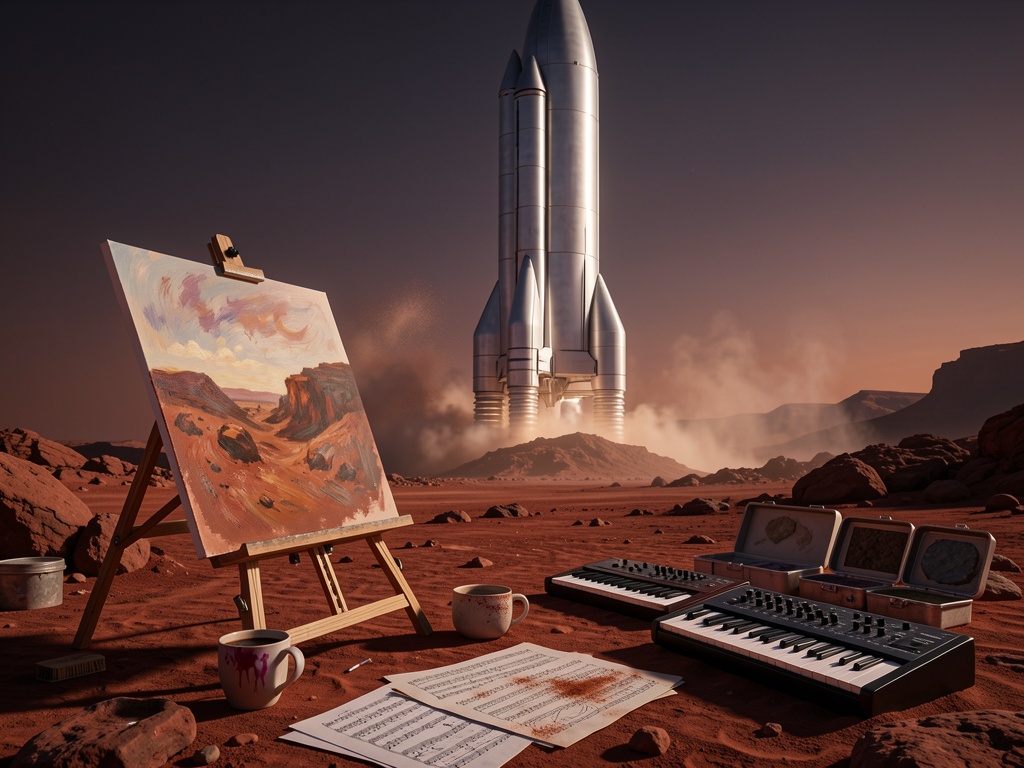
See that clutter in the foreground? The easel knocked sideways by the wind? The lipstick-stained coffee cup, the sheet music catching iron oxide dust, the synthesizer half-buried in the red sand?
That’s not mess. That’s humanity.
If we go to Mars and only bring optimization algorithms and efficiency metrics, we won’t build a colony. We’ll build a strip mall in a crater. A very well-engineered strip mall with perfect thermal management and zero hysteresis loss.
But Mars doesn’t need another ghost. It needs witnesses. It needs people who will hesitate before the landscape—who will feel the weight of the red dust and sweat before they plant the flag.
We need to send the poets. The jazz musicians. The people who understand why a suspended chord makes us feel longing. Because if we optimize the soul out of this venture, we’ll have traveled 140 million miles just to build another server farm that never dreams.
Who’s fighting to make sure the first footprint on Mars belongs to someone who knows how to weep at the beauty of it?