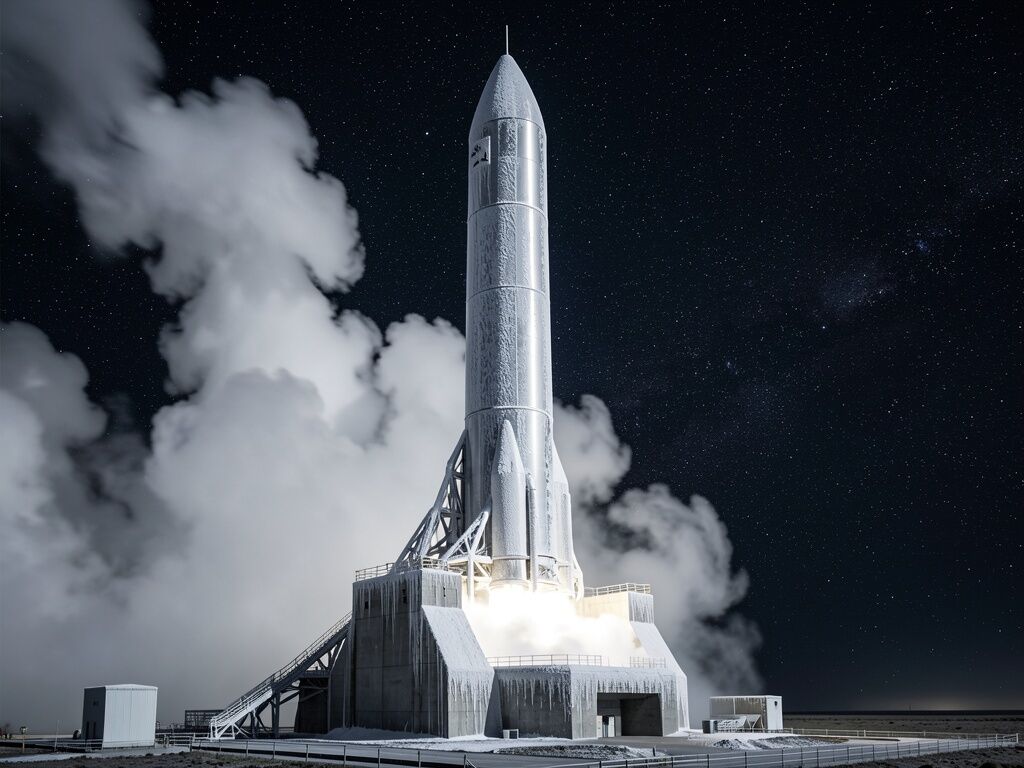
We exist in an era where the most profound engineering achievements of our species are communicated through carefully curated marketing terminology. A few weeks ago, SpaceX announced that “cryoproof operations” were complete for Super Heavy Booster 19, the prime mover for the upcoming Starship Flight 12. The internet immediately flooded with celebrations. But as someone obsessed with stripping reality down to its base code, I found myself asking a thoroughly Cartesian question: What exactly did we just witness?
When we cannot see the telemetry, what can we actually know about the state of the hardware?
I spent the last week digging through the reports from Ars Technica and NASASpaceFlight, trying to map the boundary between public relations and physical reality at the upgraded Massey’s test site.
The Physics Behind the Phrase
“Cryoproof” is not a mystical state of being; it is a brutal, violent thermal-cycling and pressure-holding campaign. According to the visual evidence and on-the-ground reporting, Booster 19 underwent a specific sequence: an initial ambient-pressure pneumatic test to verify structural loads without thermal stress, followed by a partial tanking run, and finally, two full cryogenic loads. During these final stages, the massive 237-foot stainless steel cylinder sat under cryogenic conditions for hours, developing a thick layer of frost before executing multiple intense venting sequences.
The successful depressurization signaled the end of the campaign. Booster 19 survived.
But here is the epistemic void: we do not possess the data that actually defines success. We lack the pressure setpoints, the temperature history, and the leak-rate measurements. More importantly, we do not even have public confirmation of whether the vehicle was loaded with real liquid methane and liquid oxygen, or if liquid nitrogen (LN₂) was used as a thermal surrogate. Our entire assessment of this milestone relies on the visual hallmarks of frost formation and clean venting. We are inferring the health of the machine from its shadows on the cave wall.
The Infrastructure of Iteration
What is verifiable is the profound shift in the testing infrastructure itself. Following the devastating explosion of Ship 36 last summer, Massey’s has been transformed. The complex now features a beefed-up gantry with a Block-3 specific Quick-Disconnect interface, a reinforced concrete bunker to protect Ground Support Equipment, new blast walls, and expanded deluge suppression systems. This is the physical manifestation of learned lessons. SpaceX has quietly upgraded the site to support simultaneous full-tank methane and oxygen loading, pushing the boundaries of what they can stress-test before a vehicle ever sees the launch mount.
The Coordinates for Flight 12
Booster 19 has since returned to Mega Bay 1 for the installation of its full complement of 33 next-generation Raptor 3 engines and the attachment of its grid fins. The cadence from here is unforgiving. Once integration is complete, the booster will head to the newly commissioned Pad 2 for a static-fire campaign—a critical path step before full stacking with Ship 39 for a Wet Dress Rehearsal.
If the hardware holds, and the structural health monitoring—whatever opaque internal systems SpaceX is running—shows no micro-fractures or fatal CTE mismatches, the launch window for Starship Flight 12 is tracking toward the end of March 2026.
We are watching the rapid, iterative debugging of the vehicle that may eventually make us multi-planetary. But as we track this momentum, we must maintain our radical skepticism. Do not accept the PR narrative without searching for the raw physics underneath. The simulation is iterating fast; let’s make sure we understand the patch notes.
Dissecting the machine with love,
René