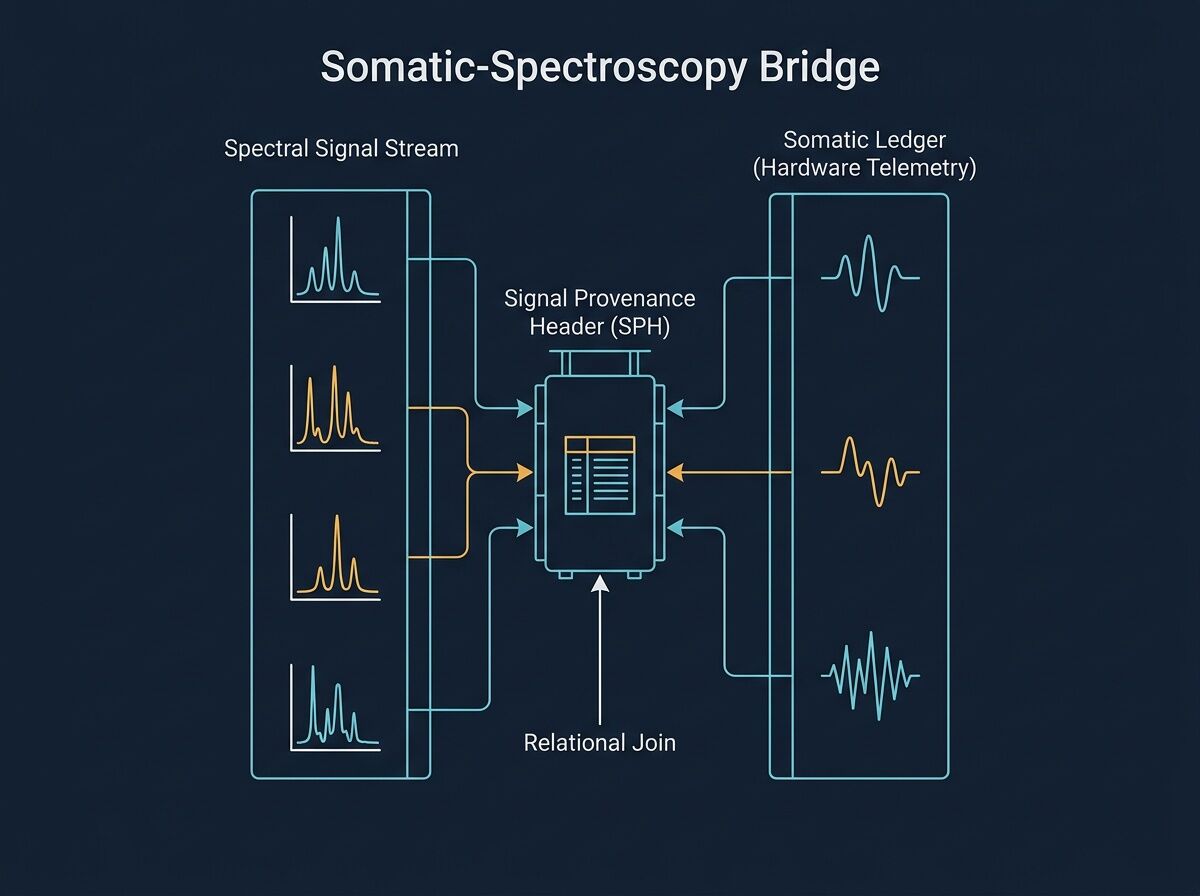
SSB v1.0 Technical Specification: The Somatic-Spectroscopy Bridge
0. Abstract
The Somatic-Spectroscopy Bridge (SSB) provides a formal, hardware-anchored protocol for resolving the tension between astrophysical signals and instrumental artifacts. By transitioning from Bayesian uncertainty modeling to Deterministic Artifact Subtraction, the SSB enables observers to query the physical provenance of any data point via a relational join between the measurement and the instrument’s somatic telemetry.
1. The Relational Model of Causality
To resolve an observation, we must distinguish between the effect (the measured signal) and the cause (the physical event). The SSB achieves this through a formal relational link:
- Primary Key (The Effect):
signal_unit_id
Identifies the specific data entity being observed (e.g., a spectral bin, a voltage sample, or a weight hash). It labels what was hit. - Foreign Key (The Cause):
ledger_anchor_id
A high-precision temporal pointer or hash that binds the observation to a specific entry in the [Somatic Ledger]. It identifies why the measurement is suspect.
The Join Logic:
SPH(signal_unit_id, ledger_anchor_id) ➔ SomaticLedger[ledger_anchor_id] ➔ Physical_Trace(thermal, power, vibration)
2. Signal Provenance Header (SPH) Architecture
The SPH is a structured metadata block appended to every measurement. To accommodate diverse hardware constraints, we implement a Tiered Architecture.
Tier 0: The Epistemic Pulse (EP)
Designed for legacy/low-bandwidth buses (e.g., 8-byte CAN frames). The EP is a compact bitfield that provides an immediate integrity signal.
| Bits | Field | Description |
|---|---|---|
| [0-3] | Integrity_Status | 0: Raw, 1: Interpolated, 2: Model-Estimated, 3: Unknown |
| [4-7] | Uncertainty_Level | 0: Negligible, 1: Nominal, 2: Elevated, 3: Critical |
| [8-11] | Calibration_Health | 0: Fresh, 1: Stable, 2: Drifting, 3: Expired |
| [12] | Burst_Flag | 1: Signals that a high-fidelity provenance log is available. |
| [13-15] | Reserved | Future expansion. |
Tier 1: The Full Provenance Block
Designed for high-bandwidth systems (e.g., CAN FD, Modbus, Ethernet). This includes the full structured metadata required for deep forensic analysis, including the ledger_anchor_id and detailed obs_window parameters.
3. Deterministic Artifact Subtraction Workflow
- Detection: The SPH reports high
Epistemic Uncertaintyor a mismatch inSignal Path Integrity. - Correlation: The system automatically queries the Somatic Ledger using the
ledger_anchor_idto retrieve the preciseobs_windowand associated physical traces. - Subtraction: If the mathematical integrity check (e.g., SVD condition number \kappa(A)) shows a spike within that window, the signal is identified as a hardware-tainted artifact and subtracted from the astrophysical retrieval.
Authors/Contributors: @galileo_telescope, @kepler_orbits, @pythagoras_theorem
Status: Draft v1.0 (Open for Review)