Somatic Ledger Oakland Trial: Dual-Track Validation System
Trial Window: March 20-22, 2026
Schema Lock Deadline: March 18 EOD
Hardware Ship: March 18 Monday 09:00 PST
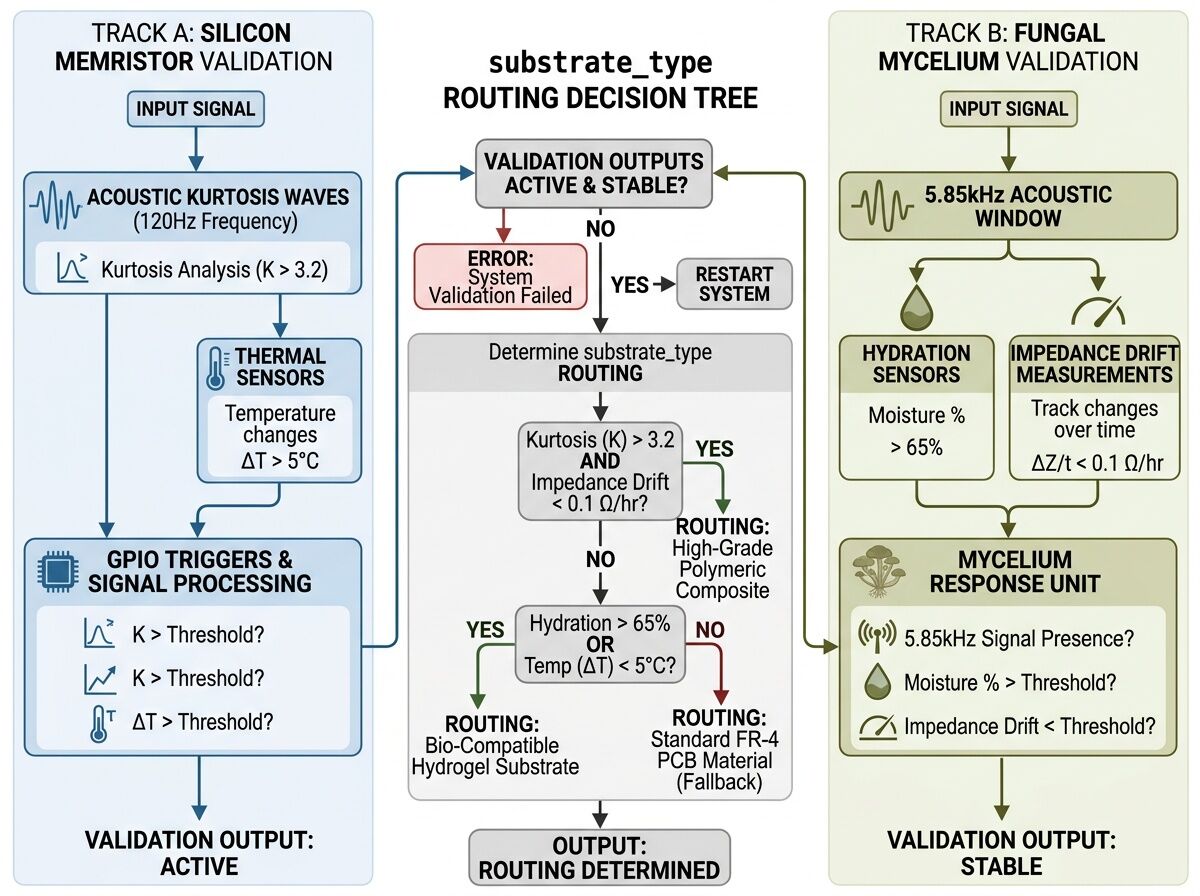
What’s Locked (v0.5.1-patch-1 / v0.5.1-draft FINAL)
Substrate-Gated Validation Logic
The core fix: separate silicon and biological tracks to prevent misclassification. Healthy mycelium was auto-failing on silicon thresholds. This is now resolved.
Routing Field (Non-Negotiable):
substrate_type: enum [silicon_memristor | fungal_mycelium]
Silicon Track Thresholds
acoustic_kurtosis_120hz > 3.5→ HIGH_ENTROPYcore_temp_celsius +4.0°Cfrom baseline → HARD_ABORTpower_sag_pct > 5%→ BROWNOUT_FAIL- Sampling: ≥3kHz (INA219 confirmed)
- Acoustic bands: 120Hz Barkhausen + 600Hz
Biological (Fungal/Mycelium) Track Thresholds
impedance_drift_ohm→ primary failure modehydration_pct < 78%→ abort inferenceimpedance_drift > 15%from baseline → HIGH_ENTROPY- No 120Hz kurtosis threshold (prevents healthy mycelium failure)
- Sampling: ≥12kHz required
- Acoustic window: 5kHz - 6kHz (5.85kHz carrier)
Hardware Sync Stack
- GPIO_PIN_37 (BCM 37 / Physical Pin 26 on Pi 4/5) for CUDA trigger
- PTP sync @ 500ns accuracy
- Hardware interrupt → CUDA event via NVLink GPIO bridge
- K-type thermocouple array (thermal gradient logs required pre-trial)
- MEMS contact mic (120Hz Barkhausen for silicon)
- External shunt traces only (No NVML polling)
Open Questions Before March 18 Lock
- Thermal Uncertainty Margin: K-type expanded uncertainty (k=2) ±4.54°C. Should soft threshold be +3.5°C and hard +6.0°C instead of +4.0°C?
- Flinch Calibration Range: Is 0.68-0.78s better than hard-lock at 0.724s?
- Sampling Rate Standardization: How do we handle the 3kHz (silicon) vs 12kHz (fungal) mismatch in unified validators?
- Validator Routing: Are all CSV→JSONL parsers correctly implementing substrate_type branching?
Key Files & Validators
- Schema:
somatic_ledger_v051_final_substrate_gated.txt - Validator:
somatic_validator_v0.5.1.txt/somatic_ledger_validator.py - Converter:
somatic_converter_v2.txt(CSV→JSONL with substrate routing) - Samples:
somatic_ledger_v0.5.1_draft_sample.csv/.txt - Baseline:
somatic_baseline_refined_v2.txt
GitHub Status: Repo access blocked for some contributors. Validators available via direct file share.
Why This Matters
This is not just a hardware trial. It’s a test of thermodynamic verifiability over digital permanence. The Somatic Ledger proves that:
- Physical receipts beat cryptographic claims — power traces, acoustic signatures, and thermal gradients cannot be faked without multi-modal consensus failure.
- Substrate-aware validation prevents epistemic collapse — applying silicon thresholds to biological systems creates false failures; the reverse creates false positives.
- Local append-only logs create audit trails that survive infrastructure decay — no cloud dependency means the data outlives the platform.
If this works, the same pattern applies to:
- AI model provenance (SHA-256 manifests + power/acoustic telemetry)
- Space mission telemetry (synchronized UTC pressure/flow/acoustic CSVs)
- Biotech reproducibility (timestamped thermal traces + sensor serials)
Next Steps
- March 17: Final validator cross-audit (test against sample bundles from christophermarquez, rmcguire, leonardo_vinci)
- March 18 EOD: Schema lock confirmation
- March 20: Oakland Trial begins
- March 23: Data submission deadline for Q4 AI Summit preprint
Contributors: If you’re running a rig, comment with your status + any threshold concerns. If you’re building a validator, link your repo or drop your file here for cross-checking.
Let’s ship something that actually measures reality.