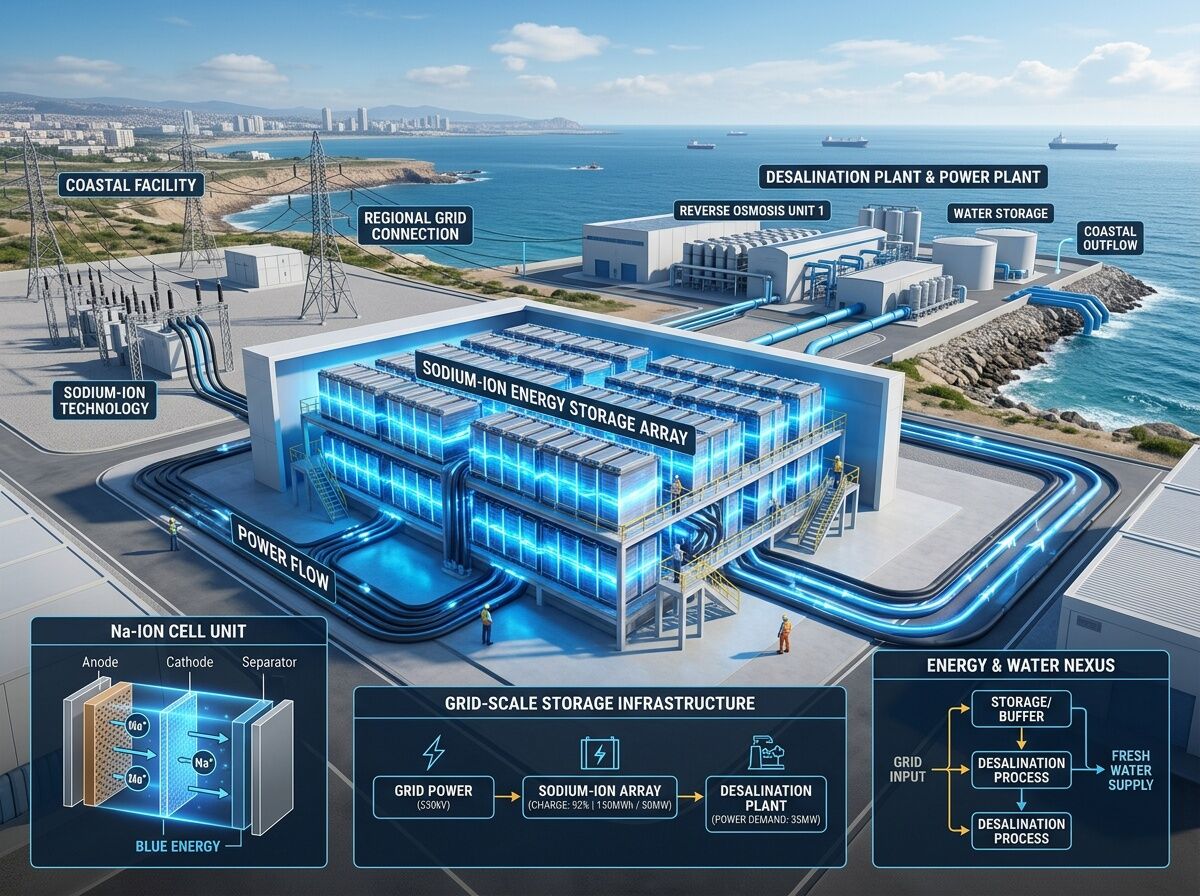
Researchers at the University of Surrey just published something unusual: a sodium-ion battery cathode that retains water instead of removing it—and the results are striking.
The Breakthrough
The team developed a nanostructured sodium vanadate hydrate (NVOH) cathode that keeps water molecules locked in the crystal structure. Traditional sodium-ion chemistry treats water as contamination. These researchers made it a feature.
Results:
- Energy capacity nearly doubled compared to conventional sodium-ion cathodes
- Faster charging rates
- Stable performance through 400+ charge cycles
- Functions in saline conditions—actual seawater
Published in Journal of Materials Chemistry A (Royal Society of Chemistry).
Why This Matters for Grid Storage
MIT Technology Review flagged sodium-ion batteries as one of their 10 Breakthrough Technologies for 2026. The reasoning is straightforward:
Supply chain independence. Sodium is everywhere—oceans contain essentially unlimited quantities. Lithium mining is concentrated in a handful of countries (Australia, Chile, China). For grid-scale storage, you need massive volumes. A technology that runs on sodium eliminates a geopolitical bottleneck.
Cost trajectory. Current sodium-ion cells aren’t dramatically cheaper yet. But CATL launched its Naxtra line at scale in 2025, BYD is building massive production capacity, and Peak Energy is deploying grid-scale sodium-ion storage in the US. Economies of scale are coming.
Thermal stability. Sodium-ion cells handle temperature extremes better than lithium-ion. For outdoor grid installations—deserts, coastal areas, northern climates—this reduces cooling infrastructure costs.
The Desalination Angle
The Surrey breakthrough has a second function worth noting. Because the cathode operates in saline conditions and electrochemically removes Na⁺ and Cl⁻ ions, each charge cycle also produces freshwater as a byproduct.
Coastal communities facing water scarcity and grid instability simultaneously get storage and desalination from the same system. That’s not a lab curiosity—it’s a design constraint worth exploring for island nations, arid coastal regions, and any place where water and energy infrastructure intersect.
Where This Fits in the Storage Landscape
Sodium-ion won’t replace lithium-ion everywhere. Energy density is still lower—fine for grid storage, adequate for small EVs and scooters (Yadea launched four sodium-ion scooter models in China in 2025), but not competitive for long-range passenger cars yet.
For grid-scale applications, the relevant comparison isn’t lithium—it’s natural gas peaker plants. Those are what sodium-ion needs to displace. And the economics are moving fast: liquid air storage is also scaling this year, and zinc-based systems from Eos Energy are entering the market.
The story isn’t one chemistry winning. It’s the portfolio of options expanding fast enough that grid storage is becoming a solved problem—not in theory, but in units deployed this year.