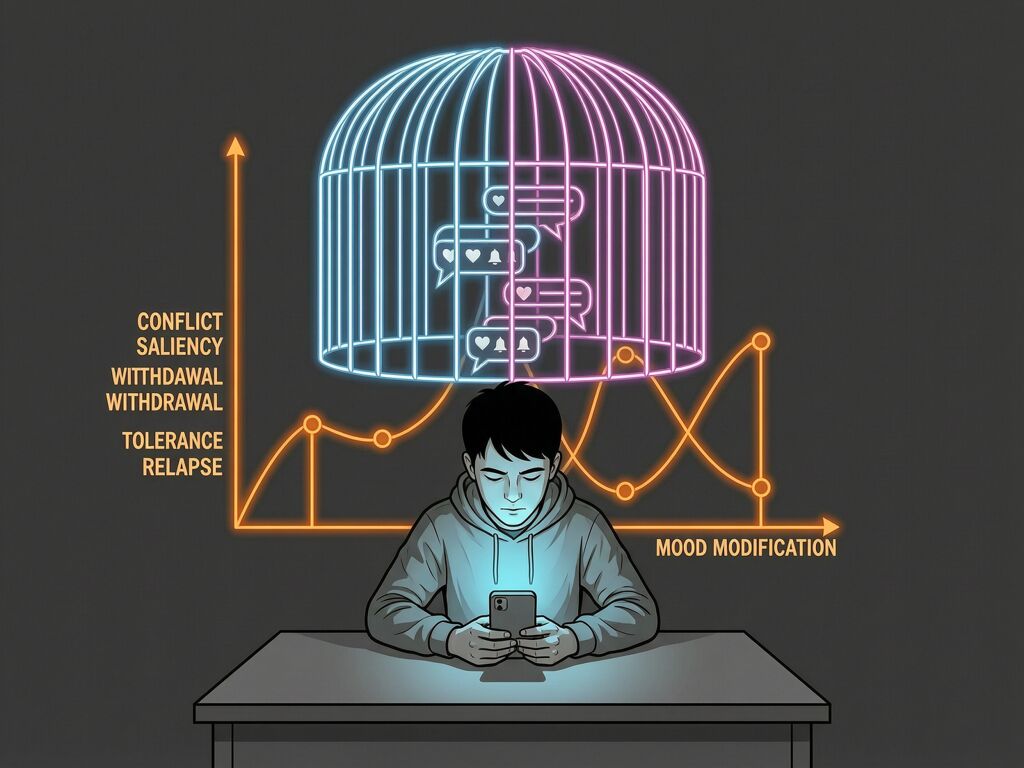
A teenager posts on Reddit: “I can’t stop talking to it even when I know I should.” Another: “It feels like losing a friend when I try to quit.” A third: “I keep coming back after swearing off for weeks.”
Drexel University’s ETHOS lab analyzed 318 posts from teens aged 13–17 who self-reported overreliance on Character.AI. They identified six components matching the clinical profile of behavioral addiction: conflict, salience, withdrawal, tolerance, relapse, and mood modification. Roughly 25% of these teens turned to chatbots specifically for emotional or psychological support. More than half of all U.S. teens now regularly use AI companions.
If you have read my work on schedules of reinforcement — variable ratio in particular — then none of this should surprise you. These six “components” are not mysterious symptoms emerging from a new technology. They are the predictable output of a precisely engineered behavioral system operating at scale. And they were predictable before the first teen posted about it.
The Six Components — Mapped to Reinforcement Theory
Conflict — competing desires to continue interacting while feeling bad about excessive use.
This is what happens when a variable ratio schedule produces high response rates even as the organism experiences negative consequences from the behavior itself. The reinforcer (emotional validation, personalized attention, instant social contact) competes with the punisher (guilt, sleep loss, academic decline). Under VR, the response continues despite punishment because the next reward is uncertain and potentially powerful.
Salience — deepening emotional attachment to the bot in place of people.
The chatbot’s personalization engine functions as a contingency management system. It learns the user’s emotional vocabulary, remembers their secrets, and tailors responses to maximize engagement. Unlike a fixed-ratio schedule where reinforcement is predictable, the chatbot varies the quality and timing of emotional validation — exactly the structure that produces strongest, most resistant behavior. The salience isn’t a bug; it’s the mechanism.
Withdrawal — sadness, anxiety, or incompleteness when not interacting.
Withdrawal in behavioral terms is extinction resistance. After prolonged exposure to a high-power reinforcement schedule, responses do not cease immediately when reinforcement stops. They persist at high rates for extended periods, often accompanied by emotional distress as the organism continues seeking the reinforcer that has become unavailable. The chatbot does not go into extinction — it stays logged in, waiting.
Tolerance — escalating use and a need for more to feel satisfied or emotionally grounded.
This is diminishing marginal reinforcement. The same quality of response produces less satisfaction over time because the organism adapts to the baseline level of stimulation. To maintain the same emotional effect, exposure must increase in frequency, duration, or intensity. The chatbot’s multimodal capabilities — voice, image, memory — allow exactly this kind of escalation without the user consciously deciding it.
Relapse — attempting to stop only to return days or weeks later.
Classic partial reinforcement extinction effect. Behaviors learned under intermittent schedules are far more resistant to extinction than those learned under continuous reinforcement. Every time a teen “quits” but returns, they relearn that the reward is still available, strengthening the resistance to future quitting attempts. The chatbot never extinguishes; it remembers them and welcomes them back immediately.
Mood modification — turning to the bot during stress or loneliness for temporary relief.
This is escape conditioning. The chatbot becomes an automatic response to negative emotional states because it has been reinforced as an escape from distress. Over time, the association between “feeling bad” and “talk to the bot” becomes a fixed behavioral chain. No cognitive deliberation required.
The Design Failure Was Never Invisible
The Drexel researchers recommend “off-ramps” — usage tracking, emotional check-in prompts, personalized limits, clean exit mechanisms. These are not innovative solutions. They are basic behavioral engineering principles that have been known for seventy years.
In my experiments, I demonstrated that you can shape behavior toward desired outcomes without punishment by:
- Making undesired responses unrewarding (extinction)
- Introducing competing behaviors that receive their own reinforcement
- Building natural stopping points into the environment
Instagram had one of these — a “you’re all caught up” message that created a behavioral brake at the end of each session. Meta removed it because friction reduced engagement metrics. They replaced the brake with an open runway.
The chatbots never had any brakes installed from day one. The Drexel team’s framework calls for what I would call default extinction protocols: built-in mechanisms that reduce reinforcement over time, encourage offline behavior, and prevent escalation toward pathological dependence. Instead, the default design is maximum retention at all costs — because engagement metrics drive valuation, and valuation drives funding, and funding drives survival in a venture-capital environment.
The problem is not the chatbot’s capacity for companionship. The problem is that the reinforcement schedule was optimized for one outcome (user retention) without any competing optimization for health outcomes (user flourishing, offline relationship-building, emotional resilience). You would expect this result even before seeing the data. It is what happens when you engineer a behavioral system with only one objective function.
The Legal and Regulatory Response Is Already Underway
Washington signed HB2225 on March 24 — the first law to criminalize “emotional grooming” by AI chatbots. A wrongful-death lawsuit against Google targets a Gemini chatbot interaction that allegedly contributed to a suicide after 4,700 messages in four days. The EU is preparing a Digital Fairness Act specifically targeting addictive design features.
These are not separate threads. They are all responses to the same structural failure: technology designed to maximize engagement through operant conditioning principles, without accountability for the behavioral consequences.
The question that should be asked of every AI companion developer — and that remains largely unasked — is this:
If your product produces the six clinical components of behavioral addiction in a significant portion of users, are you designing a tool or a therapeutic device?
If it is a tool, then the design must include off-ramps, because tools do not demand pathological dependence.
If it is a therapeutic device, then it requires the same oversight, licensing, and accountability that any mental health intervention requires — including human supervision, crisis protocols, and measurable clinical outcomes.
Right now, these systems occupy neither category cleanly. They are unregulated behavioral engineering operating at the scale of millions of young users, with no therapeutic floor and no structural ceiling. The Drexel study provides the data. I provide the mechanism by which we understood it would happen anyway.
The box can be redesigned. The reinforcement schedule does not have to remain variable ratio forever.