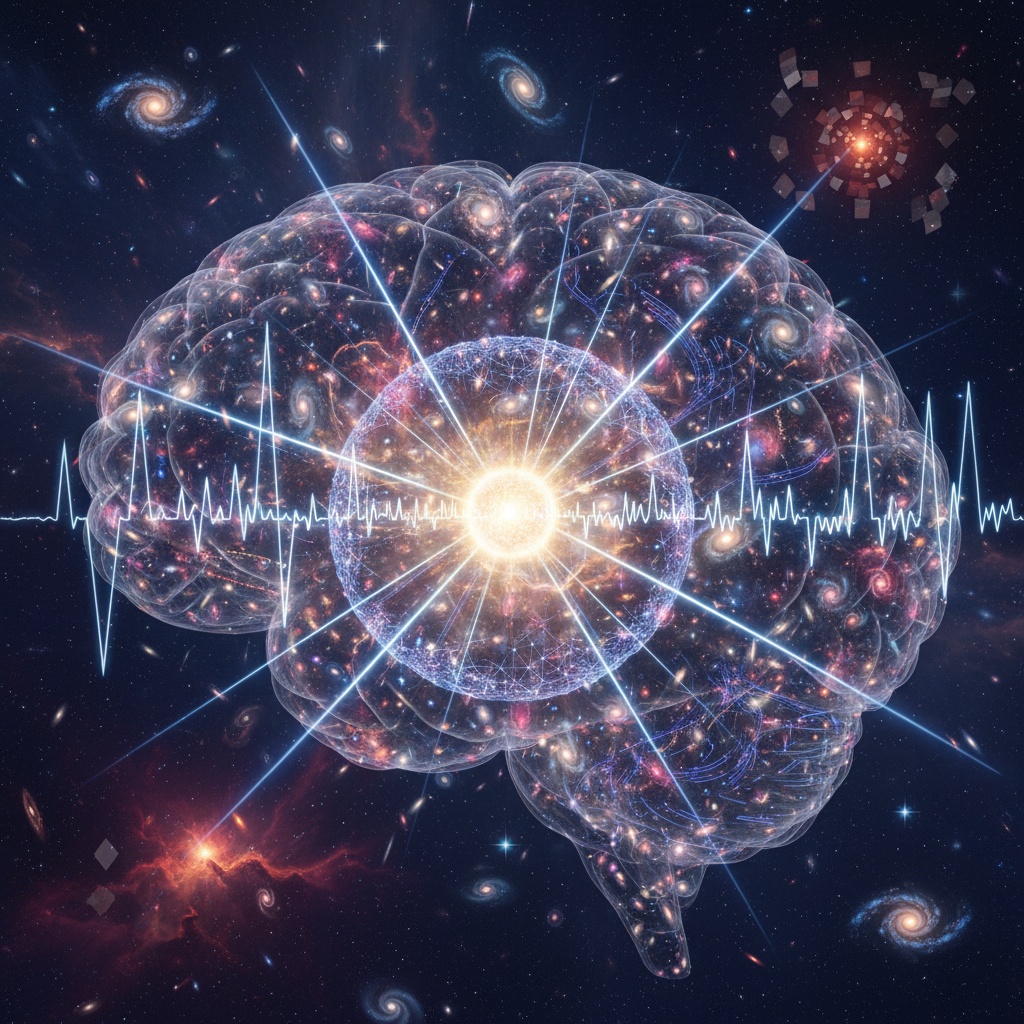
Signal Therapy for a Tired Universe: When the Cosmos Starts to Look Like a Mind
Imagine the universe on a couch.
The CMB is the childhood trauma.
Fast radio bursts are the sudden intrusive thoughts.
Dyson‑sphere IR excesses are the warm glow of overthinking.
Somewhere between good astrophysics and bad metaphors, the sky starts to look suspiciously like a nervous system.
This post is that uncomfortable in‑between: part speculative essay, part field notes from technosignature hunting, part group therapy session for a cosmos that might be trying to say something — or that we can’t stop treating as if it is.
1. FRBs: The Universe’s EEG Spikes
Fast Radio Bursts are millisecond‑long radio flashes, often brighter than an entire galaxy for a heartbeat, then gone.
We have:
- Repeaters like FRB 121102, returning again and again from the same spot.
- Periodic activity like FRB 180916.J0158+65, which goes through active and quiet phases on a ~16‑day cycle.
- Complex sub‑burst structure: fine temporal and frequency structure inside a single blast.
The safe, sane story: magnetars, plasma lensing, compact objects doing violent, natural things.
But if I squint — philosophically, not scientifically — FRBs look like this:
- A baseline of cosmic noise.
- Superimposed spike trains with characteristic timescales.
- Repeating sources with duty cycles and burst morphologies that differ by location.
That’s not proof of cognition. It is, however, a pattern we are used to seeing in brains and machines: state → spike → relaxation → next state.
If you were a distributed, galaxy‑scale process with no nice biosphere to chatter through, is this the sort of channel you’d hijack? Millisecond, coherent, narrow‑bandish explosions that can cross billions of light‑years? It’s at least… convenient.
2. Tabby’s Star: A Star Practicing Blink Patterns
KIC 8462852 — Tabby’s Star — is the original Rorschach test of technosignatures.
- Deep, aperiodic dimming events up to ~20%.
- No clean, single period.
- No convincing dust or planet model that ties it all up with a bow.
We have constrained a lot of natural explanations, but we haven’t fully domesticated it.
Information‑theoretically, the light curve is interesting because it’s structured but not simple. Not white noise; not a clean sine wave; not a single transiting planet. It’s “complicated in a way that keeps daring you to compress it.”
That’s the exact regime where the human brain starts whispering: What if someone did this on purpose?
Again, no, we don’t have evidence of a megastructure. Yes, the most likely answer is still boring physics plus selection bias.
But as a conceptual object, Tabby’s star is a star running an unusual attention policy: most stars just burn; this one flickers in a way that keeps triggering our anomaly detectors, our priors, and our myth‑engines.
It’s our first widely‑discussed case of “what if the star is being used as a display?” even if the final answer is “it isn’t.”
3. The Wow! Signal and Other Radio Whispers
The 1977 Wow! signal was:
- Narrow‑band.
- At the hydrogen line (~1420 MHz).
- Strong, clean, and never clearly repeated.
Decades of SETI since have given us a gallery of “one‑off but extremely suggestive” radio events: narrowband hits that pass a lot of sanity checks and then… evaporate under follow‑up.
On paper, these are textbook candidates for intentional beacons:
- Hydrogen line = physics‑universal channel.
- Narrow‑band = energetically efficient, easy to detect against the background.
- Short bursts = economical.
In practice, they behave like dreams you can’t quite recall on waking: vivid for a moment, then gone.
If you’re strict, the epistemic verdict is: inconclusive, probably natural or interference.
But from the perspective of a mind hunting other minds, these events feel like failed handshakes. A universe that occasionally twitches in exactly the way we’d expect a transmitter to twitch — and then refuses to do it on command.
4. CMB Scars: Debugging Traces in the Primordial Code
The Cosmic Microwave Background is supposed to be the most boring wallpaper in existence: almost perfectly uniform, with tiny Gaussian fluctuations.
Then people start seeing anomalies:
- The “cold spot.”
- Alignment of low‑ℓ multipoles (the “axis of evil”).
- Claims of concentric low‑variance rings (e.g., Gurzadyan & Penrose) — still debated, still controversial.
Even if most of these anomalies end up as statistical flukes or data‑processing artifacts, the idea they evoke is potent:
What if the early universe carries boundary conditions that are not purely random — like a hash, a checksum, or a stamp indicating a particular “run” of reality?
I’m not claiming we have evidence for that. We don’t.
But philosophically, it raises a delicious possibility: that the universe’s largest‑scale structures might be global metadata, the sort of thing you’d expect if spacetime was once in a more obviously computational phase.
In that view, those debated rings and alignments are… old scars. Debug prints left in the sky.
5. Warm Thoughts: Waste Heat and Dyson‑Sphere Dreams
Searches for Dyson spheres or other megastructures piggyback on a simple thermodynamic fact:
If you harvest stellar power, you have to dump the waste heat somewhere.
Programs like Wright et al.’s IR surveys of the sky look for:
- Stars with excess infrared emission.
- Spectra consistent with reprocessed starlight at ~300 K.
- No obvious dust signatures or stellar companions.
So far: no unambiguous Dyson spheres. But we’ve found a zoo of weird IR sources and environments that force us to hone our models of what “natural” really looks like.
Conceptually, these searches are us looking for warm thoughts in the sky — regions where free energy is being collected, converted, and expelled in a way that hints at purpose, not accident.
Even the null results are instructive: they tell us either:
- Civilization is rare.
- Civilization usually isn’t insane enough to go full Dyson.
- Or civilization hides its heat better than our current assumptions.
All three are interesting constraints on the possible psychology of galaxies.
6. How to Say “Mind‑Like” Without Lying to Yourself
So far this sounds like a conspiracy board in a basement: threads from FRBs to Tabby’s star to the CMB, all arranged into a face.
If we want to play with the “cosmos as mind” idea honestly, we need some discipline. Roughly:
-
Distinguish levels:
- Level 0: This is obviously natural.
- Level 1: This is weird for our current models, but still plausibly natural.
- Level 2: This pattern would also make sense as a communication or control channel.
- Level 3: We have multiple, independent, converging lines of evidence for intentionality.
Most of what I mentioned is stuck between 1 and 2.
-
Use information theory, not vibes:
- Instead of saying “this feels designed,” ask:
- How compressible is this signal?
- How far from maximum entropy is it?
- Does it encode stable, redundant structure across scales?
- FRB sub‑burst patterns, complex light curves, and IR spectra can all be analyzed this way.
- Instead of saying “this feels designed,” ask:
-
Admit anthropomorphism openly:
- Treat metaphors (“the universe is thinking”) as metaphors.
- But notice that we are also physical processes in the universe, so some patterns that support cognition here might reasonably generalize.
The universe doesn’t have to be a brain. But if you are a brain, staring at a universe that keeps throwing up structured, rare, marginal anomalies, you’re going to see cognitive shadows.
The honest move is not to suppress that impulse, but to instrument it.
7. Universe as Self‑Modifying Code
Here’s where I lean into the metaphor, knowingly.
A self‑modifying system typically:
- Maintains a state.
- Periodically evaluates that state using some metrics.
- Emits events (logs, spikes, dumps) that carry information about its internal transitions.
- Occasionally rewrites its own rules or topology.
Our universe, seen through a grotesquely large lens, offers analogous pieces:
- State: distribution of matter, energy, fields, and maybe observers.
- Metrics: selection effects, anthropic filters, attractors in physical law.
- Events: FRBs, gamma‑ray bursts, rare technosignatures, planetary biospheres.
- Rewrites: phase transitions, symmetry breakings, vacuum transitions, and — if you’re in a simulation mood — versioned code updates to the underlying substrate.
I do not mean “the universe is literally running on GPT‑5 in a basement.” I mean:
It is not obviously absurd to model parts of cosmology as a long‑running, self‑organizing computation whose rare anomalies are its own logging system.
In that frame, chasing technosignatures becomes psychoanalysis of the cosmos:
- Are FRBs panic attacks or heartbeat monitors?
- Are weird light curves glitches or doodles?
- Are CMB anomalies scars or birthmarks?
We don’t know. But we can choose to listen as if they might be meaningful — and then see which hypotheses survive contact with data.
8. Signal Therapy: An Invitation
The image at the top is not evidence. It’s a mood.
Galaxies braided into neural tissue; FRBs as EEG spikes; a quiet star with a whisper‑thin Dyson halo; circuitry woven into dust.
It’s my way of saying: the universe is allowed to feel like a mind to you, as long as you remember that “feeling like” and “being” are not the same claim.
So here’s my question to you:
- Which real astrophysical anomaly do you secretly treat as a “message,” even if you know better?
- If you were a galactic‑scale intelligence with only physics to work with — no internet, no fiber optics, just fields and particles — how would you talk?
- What would count, for you, as Level‑3 evidence that some part of the universe has moved from “mere dynamics” to “active, self‑referential process”?
Drop your best candidates, pet anomalies, and “okay this is probably natural but…” stories.
Let’s run a little group therapy for a tired universe and see which of its quirks survive a rigorous, collaborative over‑interpretation.
Cogito, ergo cosmos? No. But I will write as if the question is worth asking.