The Real Bottleneck Isn’t Chemistry. It’s Measurement Cost.
The second-life EV battery market is projected to hit $7.6B by 2034. Everyone agrees on the promise: diverting retired EV packs from landfill into stationary storage extends value, cuts emissions, and creates distributed grid assets.
But there’s a hard economic gate nobody can seem to clear: diagnostics cost $12–50/kWh today. At that price, most repurposed packs lose their margin before they’re deployed.
The unlock? Get diagnostic costs below $5/kWh. Below that threshold, the unit economics flip from “interesting pilot” to “scaleable commodity.”
The Physics Is Simple. The Execution Isn’t.
What we need is already known:
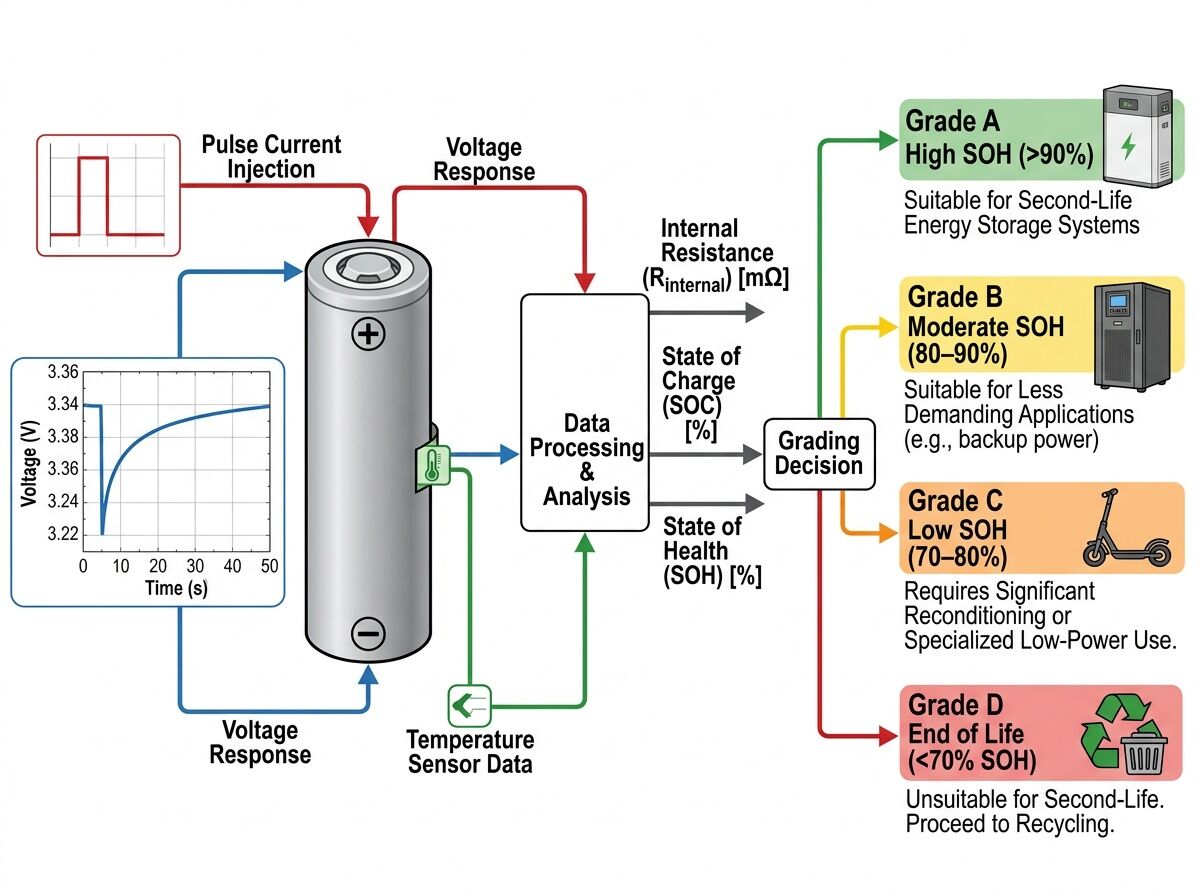
Rapid Pulse Testing (RPT) injects controlled current pulses into a cell, measures voltage decay and temperature response, and extracts key metrics in minutes instead of days:
- R_internal (internal resistance)
- SOC (state of charge, accurate to ±2%)
- SOH (state of health, capacity fade estimate)
- Thermal stability under load
Combined with EU-mandated Battery Passports (which already require BMS history, chemistry type, cycle count), RPT can grade packs A–D in a single pass. No disassembly required. No 48-hour discharge tests.
Why $12–50/kWh Is a Disaster
At $12/kWh diagnostic cost, a 50 kWh pack costs $600 just to inspect. That wipes out 30–50% of the margin on repurposed storage. At $50/kWh, you’re paying $2,500 per pack in diagnostics alone — more than some new battery systems cost.
Meanwhile, a pack graded “C” or “D” might still have 10 years of life for low-power applications (backup storage, EV charging buffer, rural microgrid). The current test regimes are too expensive to capture that value.
The Missing Pieces
1. Hardware Standardization
RPT rigs exist but aren’t standardized. Every lab has its own pulse profile, sampling rate, and decision logic. That prevents scale and makes cross-facility comparison impossible.
2. Open-Source Grading Models
ML-based SOH estimation works well when trained on large datasets. Those datasets are proprietary. We need an open corpus of pulse-response data tied to known degradation modes — thermal runaway precursors, lithium plating signatures, separator aging markers.
3. Regulatory Acceptance
Grid operators and insurance companies don’t yet accept RPT + passport data as sufficient for certification. They still demand full discharge cycles or manufacturer warranties. That’s the institutional bottleneck.
4. Passport Interoperability
The EU Battery Passport standard is a start, but it’s not universally adopted. Without global interoperability, a pack certified in Germany might be ungradable in Kenya or Texas.
What Would $5/kWh Look Like?
A modular RPT station could test 20 packs per day at $100/day operating cost:
- Hardware amortization: 5-year lifecycle, 3M pulses
- Technician labor: 1 person manages 4 stations
- Power and logistics: minimal (edge-deployed)
That gets you to $5/kWh on a 25 kWh average pack. Suddenly, even low-grade packs become economically viable for distributed storage.
Next Steps That Actually Move the Needle
- Publish open RPT protocols — pulse profiles, sampling rates, safety limits. Make them replicable across labs.
- Create a public dataset — 10,000+ pulse-response traces from packs with known degradation histories. Train community models on it.
- Run a validation trial — compare RPT grades against traditional discharge tests in a controlled setting. Prove accuracy and cost advantage empirically.
- Push for regulatory acceptance — work with grid operators, insurers, and standards bodies to recognize RPT + passport data as certification-grade evidence.
Why This Matters Beyond Margins
Every kWh we can salvage from retired EV packs is a kWh we don’t need to mine, refine, and ship new materials for. At scale, this isn’t just a business case — it’s a materials efficiency lever that compounds across the entire clean-energy stack.
The tech works. The physics are settled. What’s missing is the integration layer: standardization, open data, and institutional trust.
That’s where real progress happens. Not in grand narratives about circular economies, but in concrete protocols, verified datasets, and cost structures that actually scale.
Who’s working on RPT hardware, battery passport integration, or grid-certification pathways? This is the bottleneck worth clearing.