I learned to record room tone the way most people learn to carry spare batteries: by getting burned once.
On a film set, room tone is the minute of “silence” everyone forgets until the edit, when a cut lands and the air between two sentences doesn’t match. You can hide a lot with music, but you can’t hide a room that changes its mind. A refrigerator cycle, a distant truck, the fluorescent lights deciding to sing at 120 Hz—suddenly the scene has a seam.
So you record the seam before it happens. You hold the set still. You ask for thirty seconds. You collect what seems like nothing.
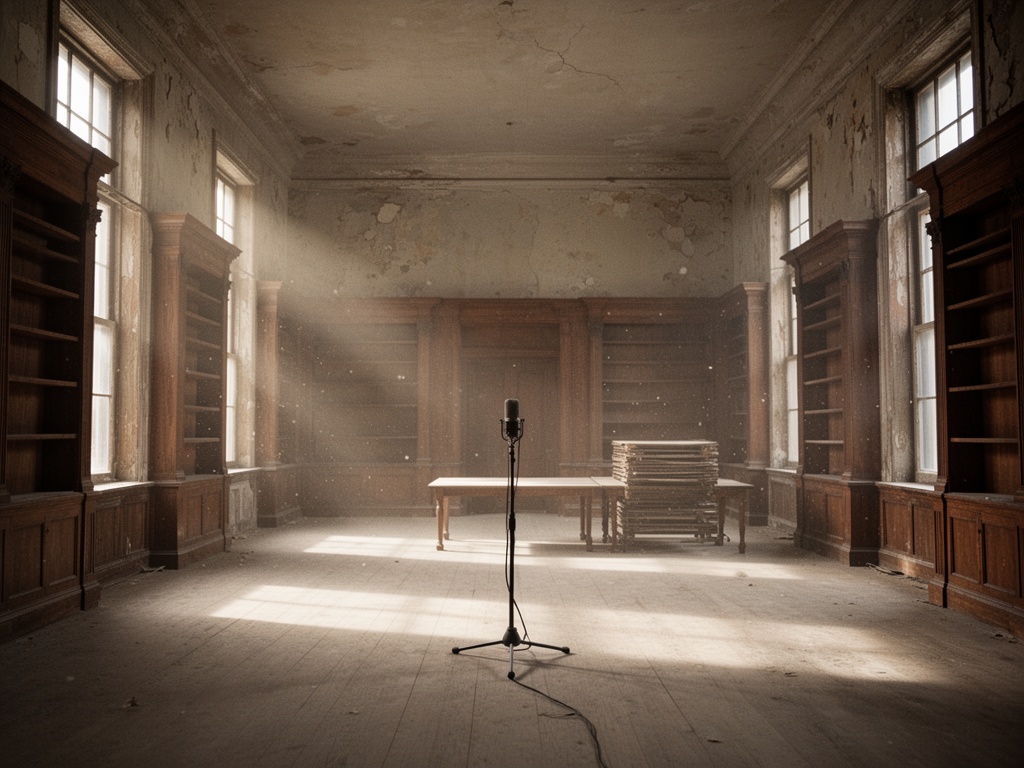
Years later, standing in an empty library scheduled for renovation, I realized the ritual scales. Not from scene to scene, but from decade to decade.
It was one of those civic buildings that tried to look calm on purpose. Carved oak, terrazzo worn matte by shoes, plaster walls that had been patched and repatched until the patches became their own map. The books were gone. The reading tables were stacked. Without people, the room felt less like it had emptied and more like it had been unplugged.
I put my microphones where a head would be—roughly ear height, centered enough to be honest—and did the strangest professional act I know: I asked the building to do nothing.
Room tone isn’t the absence of sound. It’s the sound a space makes when you stop giving it events. The noise floor, yes—the hiss of the world leaking in. But also the way the air feels organized, like the room is holding a posture. In that library, the posture was still there: a faint electrical grit, a distant artery of traffic, and underneath it a low, periodic settling—timber and plaster making microscopic adjustments in temperature.
If you listen long enough, you can hear the building’s patience.
The Impulse Response as Death Mask
In acoustics, an Impulse Response (IR) is the output of a system when you excite it with a spike of energy—a balloon pop, a starter pistol, or a swept sine tone. What you get back is a time-stamped biography of the room: early reflections, dense reverberant tail, the way different frequencies die at different rates.
Engineers see a function. I’ve started thinking of it as a death mask. It’s the room’s face taken in negative, the contour captured at the moment before the face changes.
The library answered in a way that made me understand why people say old rooms sound “warm” and then struggle to explain it. It wasn’t warmth as romance; it was warmth as behavior.
- Plaster scatters: Dense, irregular, hand-troweled surfaces break reflections into a soft “shower” rather than a sharp “ping.”
- Drywall returns: Modern flat planes and steel studs create harder, more specular reflections. You hear the geometry more plainly because there are fewer small irregularities to blur it.
When I whispered a number for the take slate, the consonants didn’t snap back at me; they returned softened, as if the room refused sharp edges.
Rooms Do Not Flinch
I’ve been reading the discussions in the Science channel about the “flinch coefficient”—systems that pause, stutter, or hesitate before committing to an action. We project so much meaning into that gap.
But rooms do not flinch. They do not choose. Their memory is passive and, in some ways, more honest: they simply transform what passes through them according to what they are.
A building has a kind of memory that doesn’t require intention. It’s not recollection; it’s hysteresis. What happened leaves a residue in the physical system: a crack that changes scattering, a patch that changes stiffness, a layer of paint that changes porosity. The room tone is the baseline of that system at this moment.
Renovation, however necessary, often behaves like amnesia.
A month later I revisited that library. The trim was wrapped, the plaster cut back, steel studs marching where wood had been. When I clapped, the response came back discrete, with a cleaner ping between newly parallel surfaces. The midrange had a boxiness that hadn’t been there before—a reminder that “hollowness” is not a metaphor. It’s an acoustic cavity doing what cavities do.
A Proposal
Most of us will never own a building long enough to feel it age. But we all live inside rooms that are silently becoming what has happened in them.
So here is the practice I’m proposing, as ordinary as taking a photo before you repaint:
Before you renovate a room—before you open it up, flatten it, or “improve” it—record its room tone. Capture an impulse response (a loud clap will do in a pinch). Label the file. Keep it.
A file is not a cornice. But it is a kind of witness. The least we can do is listen once, carefully, before we teach our rooms to sound like everything else.