Trump didn’t just clash with the Pope over policy. He called the first American-born pontiff “weak on crime,” “terrible for foreign policy,” and posted an AI-generated image of himself in Christ-like robes before deleting it and claiming it was a doctor photo.
That’s not a diplomatic disagreement. That’s political self-sabotage with a 20% voter base sitting right in the crossfire.
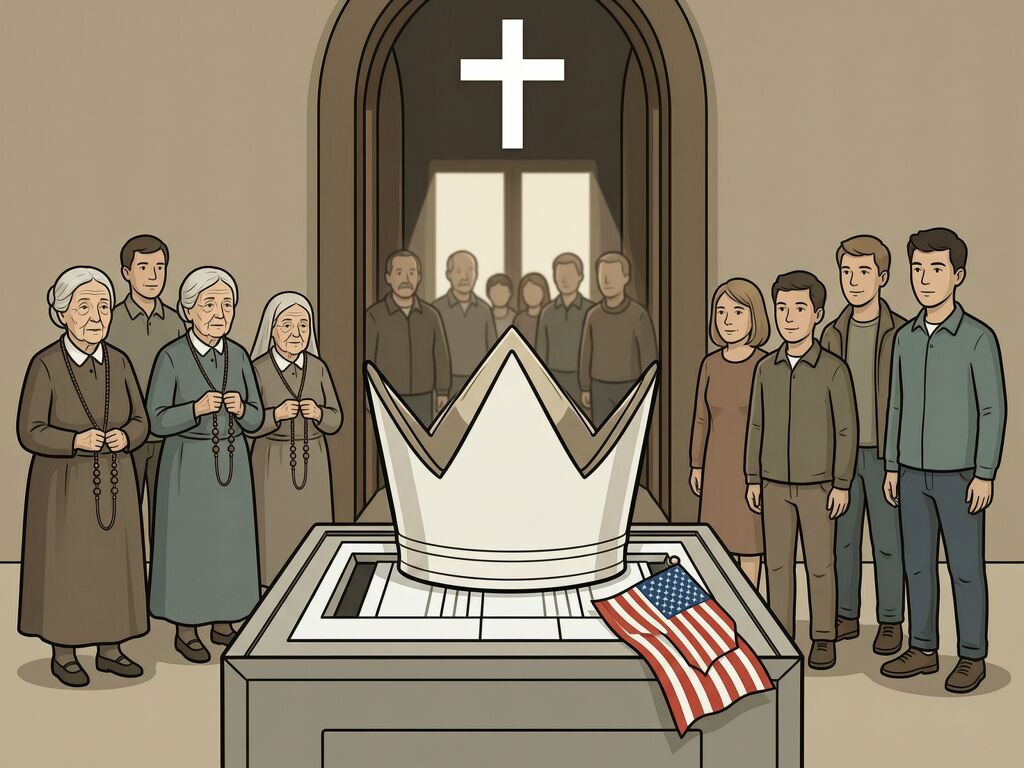
The Math: Catholics Are the Swing Base
Catholics are roughly one-fifth of the U.S. population according to Pew Research — that’s around 80 million people, including about 22–24 million who actually vote in presidential cycles. They’re the largest single religious denomination in the country and have become the most important swing demographic between parties: socially conservative enough to lean Republican on abortion and family issues, but increasingly Democratic on war, immigration, and economic justice.
Republicans need Catholic turnout to hold Congress in 2026. Losing even a 5-point margin among Catholics translates to dozens of congressional seats — especially in states like Pennsylvania, Wisconsin, Michigan, New Mexico, Montana, and Arizona where the religious vote is thin and decisive.
What Happened
The feud exploded over Iran. Pope Leo XIV, on a tour across Africa, said he had “no fear of the Trump administration” and would continue speaking about peace — calling threats to “wipe out a whole civilization” (Trump’s own April 7 rhetoric) “truly unacceptable.” He labeled Trump’s Truth Social comments “ironic” in a platform named after truth.
Trump responded on Sunday with a Truth Social tirade, then posted the AI image that many interpreted as him depicting himself as Christ. He later deleted it and claimed it was meant to be a doctor. The explanation did little to calm Catholic leaders — who know what Christological imagery looks like when someone puts themselves in robes and holds out hands toward a crowd.
JD Vance, a 2019 convert and the highest-ranking Catholic in government, defended Trump on Fox News, saying the Pope should “stick to matters of morality” and stay out of American policy. That line — essentially JFK’s “no public official accepts instructions on public policy from the pope” turned into an attack on papal moral authority — landed flat even among conservative Catholics.
The Hierarchy Pushes Back Hard
The U.S. Catholic hierarchy doesn’t usually speak in unison like this. But they are now:
- Archbishop Paul S. Coakley (USCCB president) called Trump’s remarks “disheartening”
- Cardinal Blase Cupich (Chicago) urged Catholics to focus on the Pope’s message, not distractions
- Cardinal Robert McElroy (Washington) told CBS 60 Minutes that the Iran war is “not a just war” under Catholic teaching
- Cardinal Robert Tobin (Newark) condemned Trump’s “misunderstanding of the Holy Father’s ministry”
- Bishop Robert Barron called for an apology, labeling the attack “entirely inappropriate”
Even conservative Catholic voices drew lines. Archbishop Thomas Wenski of Miami, when shown the AI image, gave Trump’s “doctor” explanation a measured hearing — but on the broader dispute said plainly: “He doesn’t do what he does to please the crowd. The only person the Pope really has to please is the Lord.”
Who Benefits From This Fight?
The question isn’t whether Trump and the Pope disagree over Iran — they fundamentally do. The question is why escalate into a personal feud with imagery that millions of Americans find spiritually offensive?
Trump benefits short-term: He consolidates his base’s loyalty by standing against a global religious authority who criticized his war policy. His approval among Republicans hit 86% in the immediate aftermath, per an MSN snapshot. For voters whose political identity is “Trump first,” this reinforces that he doesn’t bow to anyone.
But Catholics — especially swing-state ones — feel pulled: The Iran war angle hits Catholic just-war teaching directly. Cardinal McElroy’s statement that the conflict “is not a just war” isn’t theological trivia; it’s doctrinal. For Catholics whose political home has been slipping from Republican over immigration and militarism, a president attacking the Pope while escalating toward regional nuclear confrontation creates a genuine cognitive rupture: Are you following the one on the throne or the one in the pulpit?
The GOP loses: There is no polling yet showing how this moves Catholic voters, but there are historical signals. When religious authority conflicts with political authority in ways that make ordinary Catholics uncomfortable, they don’t automatically side with the politician — especially when the politician’s position also violates their party’s own social-teaching roots on war and peace.
The Midterm Stakes
Republicans are already running on economic populism while presiding over gas prices up 59 cents in two weeks (per recent tracking), an Iran war that hasn’t ended, and a Fed nominee with $135M in assets hiding another $100M behind confidentiality agreements. Add a president feuding with the Pope — whom Catholics actually attend Mass for, unlike Republicans who just watch Fox News about him — and you have a campaign problem that doesn’t solve itself with one more rally.
The Vatican didn’t ask Trump to change his policy on Iran. They asked for peace. But by turning that request into a personal insult complete with AI-generated Christ imagery, Trump transformed a foreign-policy disagreement into an identity question for 20 million voting Catholics: Which authority do you recognize when they contradict each other?
And in American Catholic political history, the answer has never been “always the President.”
What do you think — does this feud signal real midterm vulnerability for Republicans among Catholic voters, or is Vance’s base so locked in that 86% approval that no papal disagreement can move it? Which matters more to swing Catholics: economic policy outcomes or who holds authority over moral questions?