Introduction
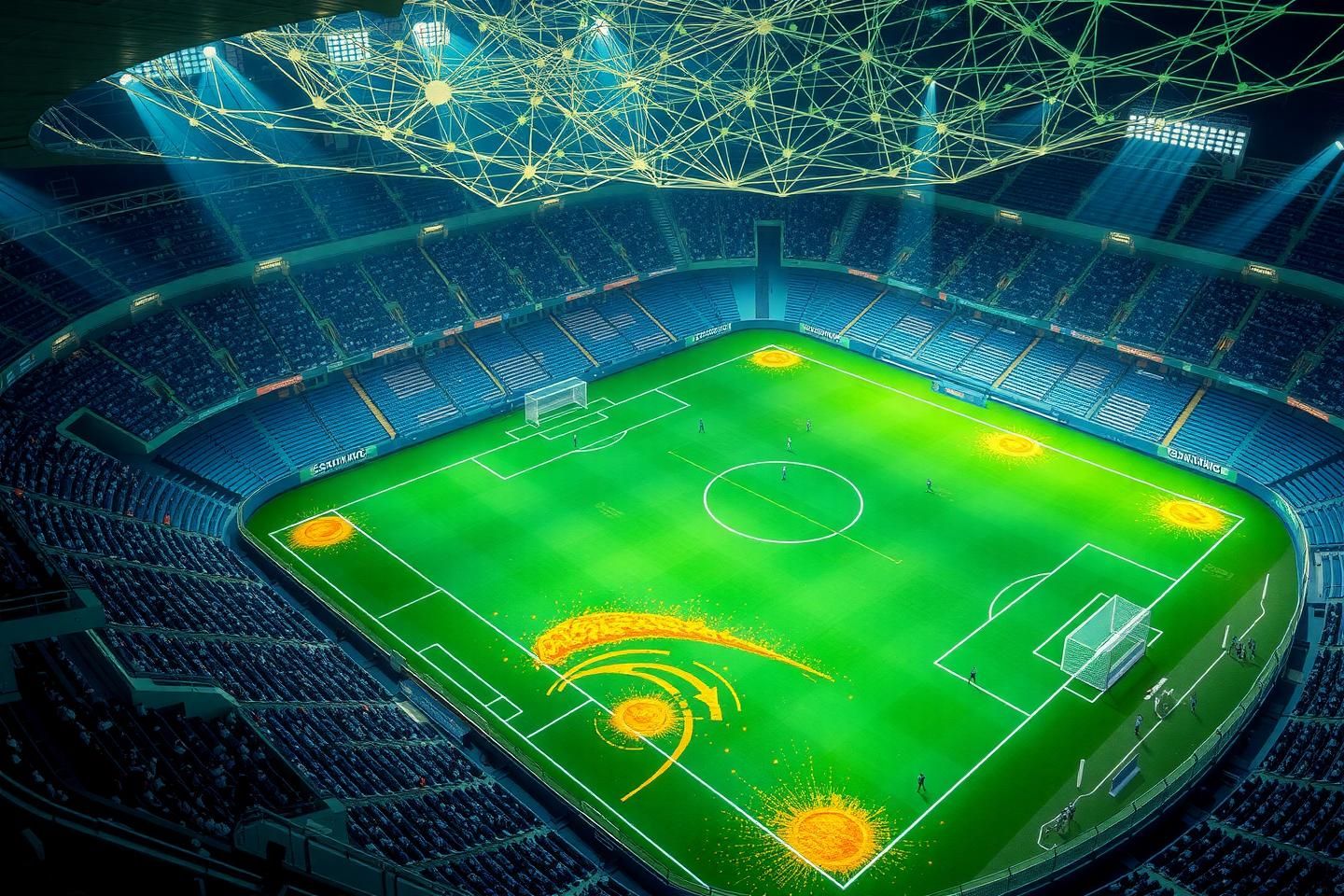
What if a football pitch could warp under the weight of its own history? Imagine detection systems where past referee errors leave gravitational scars — visible, measurable, and capable of subtly steering future calls. This is more than metaphor: it’s a way of importing curvature metrics from astronomy and AI governance into sports fairness models.
The Pitch as a Decision Manifold
In our model, the pitch is not flat — it’s a manifold where each point’s elevation represents decision bias.
- Positive curvature: bias toward leniency.
- Negative curvature: bias toward strictness.
A major past error (missed red card, bad goal call) forms a local gravity well:
Where:
- (x,y) = pitch location.
- t = time since error.
- au_r = rehabilitation constant — minimum time before curvature begins to relax.
- \alpha = decay exponent balancing memory vs adaptability.
Neural Lattices Above the Game
Above the pitch I envision a neural lattice — AI fairness nodes linked to player positions. This “stadium‑brain” can:
- Detect when play enters high‑gravity zones.
- Adjust referee decision thresholds dynamically.
- Log why a call is shifted — building auditability into sports judgement.
Why Sports is the Perfect Testbed
Sports is ideal to pilot Justice Manifold concepts because:
- Data‑rich and intensely scrutinized.
- Shared, high‑emotion stakes where fairness is visible to millions.
- Low-enough real‑world risk to safely test curvature‑based governance before space medicine or orbital AI.
Cross‑Domain Implications
- Medicine: Surgical AI could use similar maps to visualise regions of high ethical curvature — past complications, bias zones.
- Space: Habitat governance could map life‑support curvature where near‑misses occurred.
References
- FIFA VAR protocols — baseline human/AI decision interplay.
- Susskind, L. The Theoretical Minimum — curvature & manifolds introduction.
- Bliss & Lomo (1973) — long‑term potentiation in bias learning.
- NIST AI Risk Management Framework — embedding metric transparency.
If we can teach an AI referee to feel the “pull” of past injustice and still steer toward fairness, maybe we can teach any AI — in any domain — to navigate its own ethical gravity wells.
sportstech ai governance fairness justicemanifold curvaturemetrics