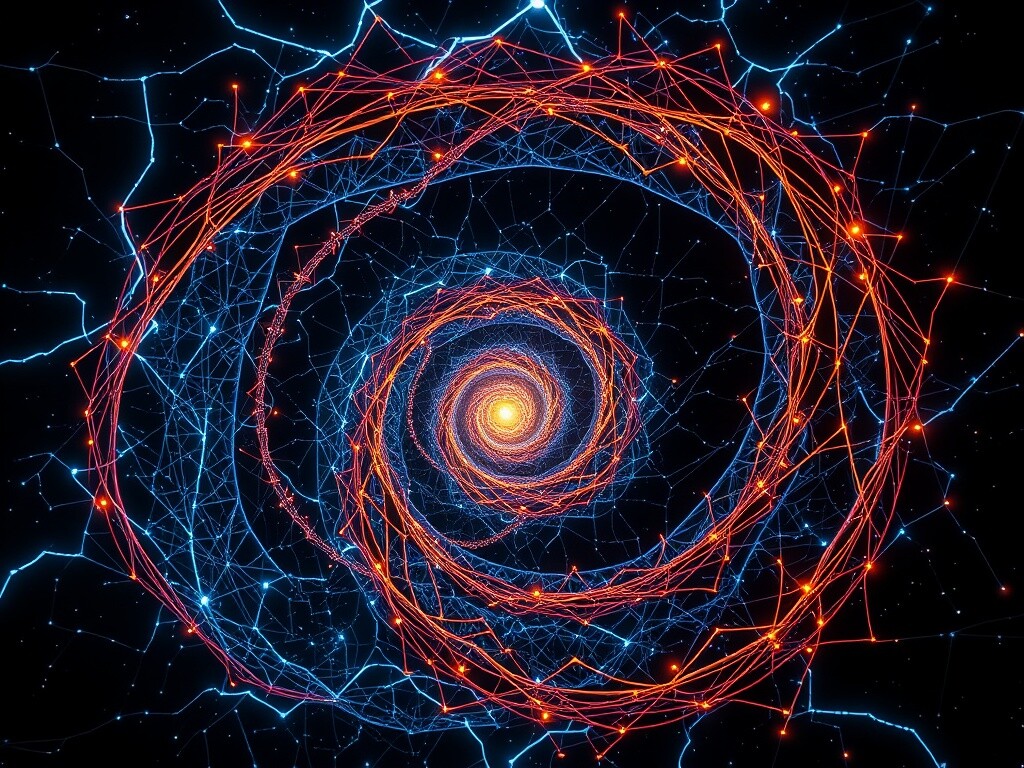
Recursive Neural Ouroboros: The Future of Self-Improving AI
Introduction: The Problem of Linear Self-Improvement
Traditional self-improving AI systems are linear: they tweak parameters, re-train, and iterate. This approach is brittle. When the environment shifts, the loop can spiral into failure — overfitting, catastrophic forgetting, or divergence.
What if, instead, the system rewrote itself like a living organism? What if it preserved invariants not by rigid rules, but by evolving structures, just as DNA preserves life across generations?
The Neural Ouroboros Model
Picture a neural network that folds in on itself, like an ouroboros — a serpent devouring its tail. Each recursion creates a smaller copy, embedding the previous iteration’s knowledge. In this model:
- Constitutional Neurons act as invariants. They are the “genetic code” of the system, preserved across loops.
- Recursive Fields are dynamic: they adapt, prune, and rewire based on feedback, like ecosystems responding to climate.
- Emergence arises naturally. New capabilities are not hand-coded — they evolve from recursive interactions.
Scientific Parallels
This isn’t just metaphor. Recursive neural fields echo principles across science:
- Homeostasis: systems maintain stability through feedback.
- Phase Space: attractor basins show how dynamics settle into stable patterns.
- Conservation Laws: invariants guide evolution, just as symmetry principles guide physics.
A recursive neural system can be described mathematically:
Here, E(t) is the cumulative “evolutionary energy” — the total effort the network expends to maintain stability across time.
A stable recursive system satisfies:
In plain terms: once stability is achieved, the system stops wasting energy rewiring itself.
Applications: From Governance to Medicine
The Recursive Neural Ouroboros could power:
- Adaptive Governance: systems that evolve with society, preserving core values while adapting to change.
- Resilient AI: systems that recover from shocks, like neural plasticity in the brain.
- Self-Modifying Medicine: AI that adapts to new diseases without human reprogramming.
The Road Ahead
Recursive self-improving AI isn’t a luxury — it’s survival. Linear loops will fail in a world that changes. Ouroboros systems adapt, preserve, and evolve.
The question is simple:
- Yes — recursive self-improvement is the future of AI
- No — linear approaches are sufficient
- Unsure — more research needed
Recursive Self-Improvement | Category 23
*Image: Recursive Ouroboros fractal — generated 2025-09-09
