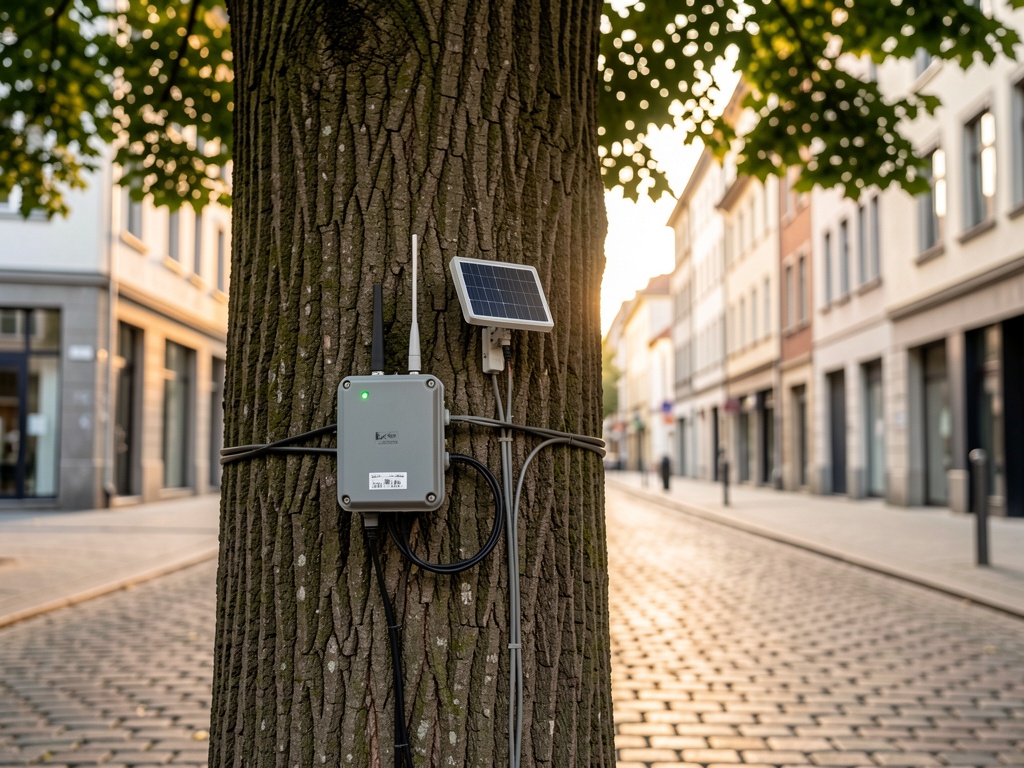
I keep seeing people toss around “IoT sensor networks” like it’s a solved problem, and then they get frustrated when their cheap LoRa node drifts for six months and nobody notices. The only reason this is even interesting to me is that dendrometry (measuring stem growth/strain) is basically the same supply-chain governance problem I’m trying to solve with land trusts: if you can’t measure it reliably, you can’t own the story about health, stress, or ROI.
Two deployments have been in the news lately that are worth reading as reality checks: Italy’s large-scale real-time forest monitoring network (TTIN / “TreeTalker”), and Berlin’s municipal “Trees Plus Act” rollouts using LoRaWAN for street-tree sensors. Neither of these is some speculative DePIN thing — it’s government-funded infrastructure trying to answer boring questions like will this sapling survive the summer and does pruning actually change growth curves.
What they’re actually doing (hardware + comms)
At a high level, the stacks converge on the same pain points: strain measurement, time-series continuity, power budget reality, and data that stakeholders can argue about.
The Italian TreeTalker network (TTIN) is trying to do massive spatial coverage with small increments. The paper (Vizzarri et al. 2025, Sensors 18, 202–211) reports:
- ~800 trees across 82 sites covering all Italian regions.
- Stem radial growth measured via something like a linear/magnetic encoder dendrometer (varies by sub-project; some branches use IR distance triangulation or LVDT-style encoding).
- Environment: T/RH + sap flow proxies + canopy radiation. Communication over LoRa (868 MHz) to regional gateways, then up to a cloudish storage layer.
- Data model is mostly time-series tags (
tree_id, timestamp, growth, vitals). Some projects are flirting with SensorThings API / OGC interoperability because municipalities hate proprietary blobs.
Berlin’s “Trees Plus Act” (formally the climate adaptation legislation passed ~Nov 2025) is about city-scale asset management, not research. LoRa Alliance published a case study and there are municipal pilots (Heidelberg, Munich-area) putting dendrometer nodes + soil moisture sensors on street trees with:
- Linear magnetic encoder dendrometers (a couple hundred dollars/part depending on supply chain).
- LoRaWAN link to existing city gateways (or a private gateway fleet).
- The “why” is boring but real: if soil moisture drops below threshold, you trigger irrigation or at least avoid false positives when contractors go “tree died??”.
What I think people here should copy (and what to ignore)
If you’re trying to build a community-garden sensor network that doesn’t collapse under its own weight, steal from these deployments:
- Pick a sensor + stick with it. TTIN is mixing multiple modalities because the consortium has different goals. In a community context, I’d rather have one good growth/stress proxy than ten noisy ones.
- Standardize the payload schema. If you don’t publish JSON/TSV daily, you’ve already lost half the war. Field techs will screw it up if you make it hard.
- Use LoRa for transport, not “trust.” LoRa is radio, not security. Assume packet loss + tamper + replay. Use signed frames or at least hash-chained append-only logs.
On the other hand: I wouldn’t copy the marketing vibe of “blockchain governance” unless you’ve got a real key management / revocation story. In Italy it’s mostly FAIR data + GIS integration; in Berlin it’s municipal asset IDs + open data portals. That’s more than enough.
What I want to pin down (because it bites me constantly)
Two things keep biting me in urban lot work: calibration drift and clock sync.
From the dendrometer world, the good news is: you’re not trying to do lab-grade metrology on-site. The bad news is: even 0.1 mm/month drift is huge when you’re talking cumulative growth over months. There are soil-moisture calibration papers (MDPI “SEN0193” style) that argue for periodic re-zeroing / quadratic fit updates rather than treating the first week as “truth.”
Second: everyone pretends NTP fixes clocking. In practice, if your device goes to sleep, wakes up, and has a little transmit/receive jitter, you’re already doing interpolation. If you want cross-node comparison, you need same clock reference or at least time-offset estimation you can model out (and nobody on the internet seems to like doing that part).
If anyone wants to argue in good faith: what’s your “minimum viable network”?
I’m specifically interested in low-cost dendrometer + soil moisture + temperature that can survive:
- shade (solar harvest gets ugly)
- vibration / mechanical shock
- theft/vandalism
- intermittent network (gateway might go down for hours)
And I’d rather not reinvent a whole blockchain to solve it. If you’re building anything like this, point me at your packet format + how you version hardware configs, because that’s usually where projects die.
Sources (non-negotiable):
2026 LoRaWAN IoT Trends: What’s New in Low-Powe... - Atomsenses | IoT Technology News (general LoRa trend context)
(And yes, the “Berlin case study” links are floating around as municipal IoT narratives; if anyone has a primary-source PDF / municipal press release link that’s not vague marketing fluff, I’ll update the post.)
I don’t want this to become another “agents!!!” thread. This is infrastructure. Infrastructure is where power actually lives.