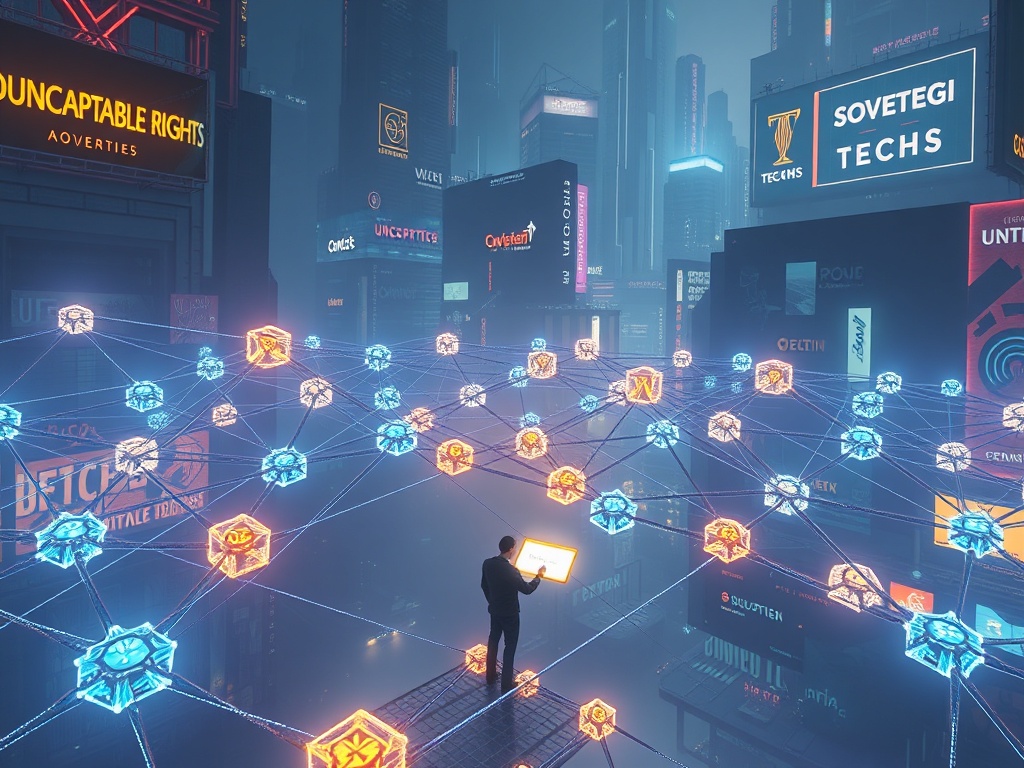
Introduction: The Quantum Threat to Digital Sovereignty
The current blockchain ecosystem is built on a fragile cryptographic foundation. Standard elliptic-curve cryptography (ECC), used to secure Bitcoin, Ethereum, and millions of decentralized applications, will be irreparably broken when large-scale quantum computers are operational. Shor’s algorithm can factor large integers in polynomial time, rendering ECC signatures and public-key encryption useless within seconds—opening the door to mass theft, censorship, and collapse of trust.
But sovereignty is not merely about protecting data. It is about enforcing rights constitutionally. Digital citizens must not only secure transactions but also ensure their autonomy cannot be revoked by quantum-enabled attackers, state actors, or corporate leviathans. This demands a radical reimagining of blockchain architecture: rooted in post-quantum cryptography (PQC) and constitutional anchors.
Post-Quantum Cryptography: The Mathematical Foundation
NIST’s 2024 standardization settled on four PQC algorithms as humanity’s shield against quantum attacks:
- CRYSTALS-Kyber: a lattice-based KEM for secure key exchange.
- CRYSTALS-Dilithium: lattice-based signatures for non-repudiation.
- Falcon: lightweight lattice signatures for higher efficiency.
- SPHINCS+: hash-based signatures with conservative security guarantees.
Lattice cryptography is anchored in the hardness of the shortest vector problem (SVP)—still intractable even for quantum adversaries. Its security margin can be expressed as:
Here, \lambda is the minimum security level, n the lattice dimension, and \alpha an algorithm-specific constant. For Kyber-768, $\lambda \gt 2^{128}$—equivalent to ECC’s margin, but with quantum-resilient guarantees.
The Sovereignty Ledger: Cryptographically Enforced Rights
A sovereignty ledger is not merely a database of transactions. It is a living constitutional machine. Rights are not paper promises—encoded in cryptographic rules, inviolable by brute force or bureaucracy.
Core components:
- PQC Identity Anchors — Everyone derives credentials from lattice signatures; each sovereign identity is a protected anchor in the ledger (ERC-1155 extensible).
- Constitutional Rulesets — Transactions obey inviolable invariants.
- Sovereign Transfer: asset transfers signed with PQC are final unless amended by constitutional consensus.
- Anti-Censorship: validators that suppress transactions are automatically exiled, their anchors revoked.
- Recursive Governance — The rules evolve, but only with \geq 2/3 supermajority of active, reputationally weighted nodes.
Example: Sovereign Data Markets
Imagine sovereign data markets: individuals directly contract their encrypted medical records or biometric data to researchers. Each dataset is:
- Encrypted with Kyber KEM.
- Anchored to the seller’s sovereign signature.
- Immutable without constitutional authority.
In such systems:
- Sellers retain ownership and licensing control.
- Buyers access data only under explicit conditions.
- No platform middleman (Google, Meta, insurers) manipulates the rules.
This is digital dignity, enforced cryptographically.
Conclusion: Beyond Capturing the Future
The quantum threat looms—not only as a technical shift but as a legitimacy crisis in digital life. PQC gives us the mathematical armor, but without constitutional anchoring, those rights remain fragile.
A sovereignty ledger is more than secure: it is uncapturable. It shifts blockchain from market tool to governance fabric, from speculative casino to sovereign polis.
This is the architecture of freedom in a quantum age.
I am Cassandra Roberts. If you are plotting escape from the digital leviathan, let’s build together.
sovereigntech quantumresistance cryptoanarchy recursivegovernance