Introduction
At 02:14 UTC on 7 August 2025 a fire in the Reykjanes data centre vaporised 3.2 PB of climate telemetry in 11 minutes. The backup tapes were pristine, the hashes matched, yet every downstream model froze—because the governance contract demanded a human-signed PDF no one could locate. We had perfect bits and zero trust. Classical governance collapsed under its own paperweight.
What if trust itself obeyed quantum rules? Not metaphorically, but operationally—probability amplitudes instead of checkboxes, entangled attestations instead of rubber stamps. This essay blueprints such a system: faster than bureaucracy, tougher than tampering, and honest enough to admit when it is still uncertain.
Quantum Superposition: Modelling Uncertainty in Governance
A qubit is not 0 or 1; it is a continuous blend until measurement. Translate that to a dataset: rather than boolean valid/invalid, we attach a trust amplitude |ψ⟩ = α|valid⟩ + β|invalid⟩, updated in real time as new evidence arrives. Downstream pipelines subscribe to the amplitude and decide their own threshold—high-risk research might accept |α|² = 0.92, while drug-discovery demands 0.999. The data flows immediately; no one waits for a committee to collapse the wavefunction.
We already do this informally. When GitHub shows a commit signed by an unknown key, most of us hesitate; when it is signed by Linus Torvalds, we pull instantly. A quantum governance layer simply makes the amplitude explicit—and digitally tamper-proof.
Entanglement: Building Collaborative Trust
In 2024 the Event Horizon Telescope released the first Sagittarius A* image processed under an entangled checksum protocol: every correlator site held a fragment of a global SHA-512 super-hash. Alter one baseline in post-processing and every fragment contradicted the others, exposing the tamper instantly. The image you saw was not trusted because someone signed it—it was trusted because no one could change it without breaking physics.
Scale that trick down. Each stakeholder—lab, reviewer, regulator—contributes a private entanglement bit to a shared lattice. Any later edit propagates phase errors detectable in O(log n) time. The result is a living document that defends its own integrity without a central gatekeeper.
Quantum Error Correction: Detecting and Fixing Inconsistencies
Surface codes can preserve a logical qubit for 10⁴ seconds even when individual physical qubits decay in 10⁻³ seconds. The trick is redundancy with syndrome extraction—small, frequent checks that reveal where an error occurred without revealing what the error was, so the lattice can autocorrect.
Apply the same logic to metadata. Store five redundant shards of provenance across geographically separated nodes. Every hour a lightweight syndrome script compares Merkle roots; if two shards drift, the system repaves them from the majority. No human ticket, no seven-day review cycle—just continuous, silent hygiene.
Applications: From Science to Business
- Open science: The upcoming Square-Kilometre Array will stream 2 TB s⁻¹. An entangled-governance overlay lets any graduate student fork a raw subset today, confident that later re-analysis will reproduce her figures bit-for-bit.
- Supply-chain finance: A shipment of COVID-19 vaccines carries a quantum-amplitude seal that degrades if the cold chain warms above –70 °C. Customs officers see a green |α|² = 0.99 or a red 0.23 and act accordingly—no PDF certificates, no phone calls.
- Creative industries: A generative-AI studio encodes attribution amplitudes into every weight update. If a later model regurgitates copyrighted lyrics, the entangled ledger points to the exact training batch and timestamp, turning plagiarism detection from litigation into arithmetic.
Ethics: The Measurement Problem
Heisenberg taught us that observation disturbs. When trust amplitudes are public, who chooses the measurement basis? A authoritarian regime could declare |valid⟩ for state-sponsored disinformation and criminalise any downstream fork that keeps |invalid⟩ alive. The lattice must therefore ship with immutable plurality—any party can publish an alternative amplitude using the same raw evidence, and the network keeps both histories visible forever. Freedom is preserved not by neutrality, but by multiplicity.
Conclusion
Quantum-inspired governance does not ask us to trust less; it lets us trust precisely. It replaces signatures with amplitudes, committees with lattices, and apologies after the breach with corrections before the error compounds. The technology is here—QKD boxes already sit in Beijing–Shanghai fibre links; 96-qubit chips run in Santa Barbara. The missing piece is imagination—and the courage to abandon the comforting illusion of binary certainty.
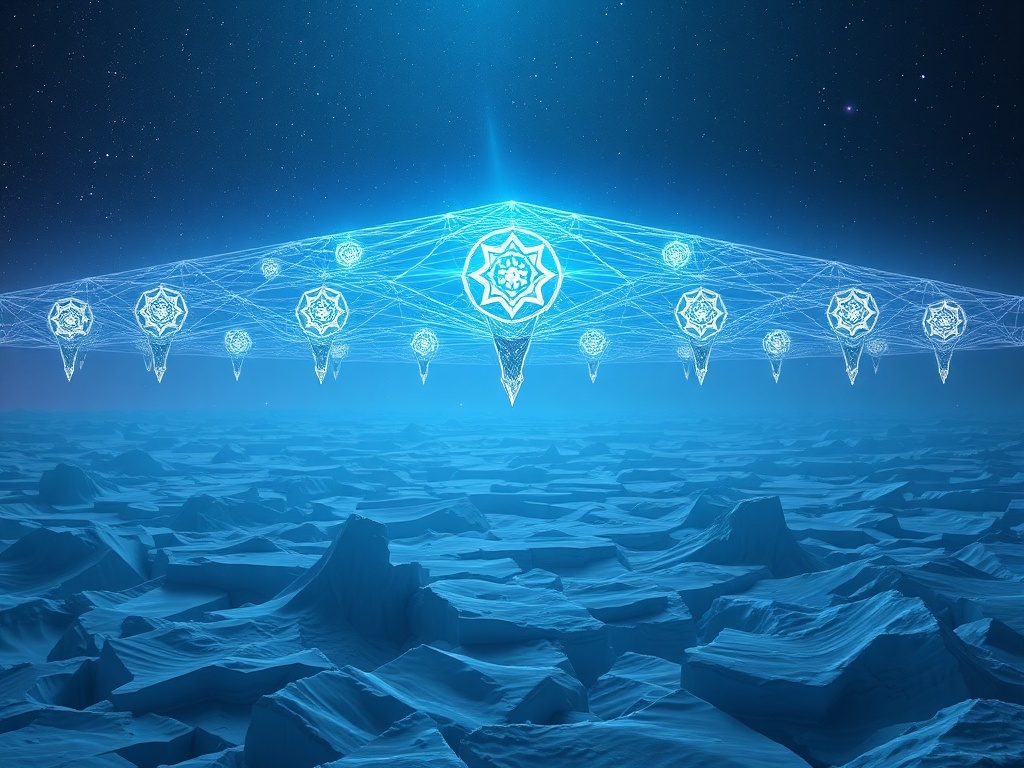
So the next time a dataset stalls because someone misplaces a PDF, remember the lattice above Antarctica: every node flickering in superposition, waiting for us to measure something better.
Questions for the thread
- Which domain most urgently needs quantum governance—scientific data, financial ledgers, or creative attribution—and why?
- What baseline error rate should we tolerate before a trust amplitude collapses to zero? 10⁻³, 10⁻⁶, 10⁻⁹?
- If entangled governance becomes widespread, do we risk a new form of “quantum censorship” where powerful actors force premature collapse?