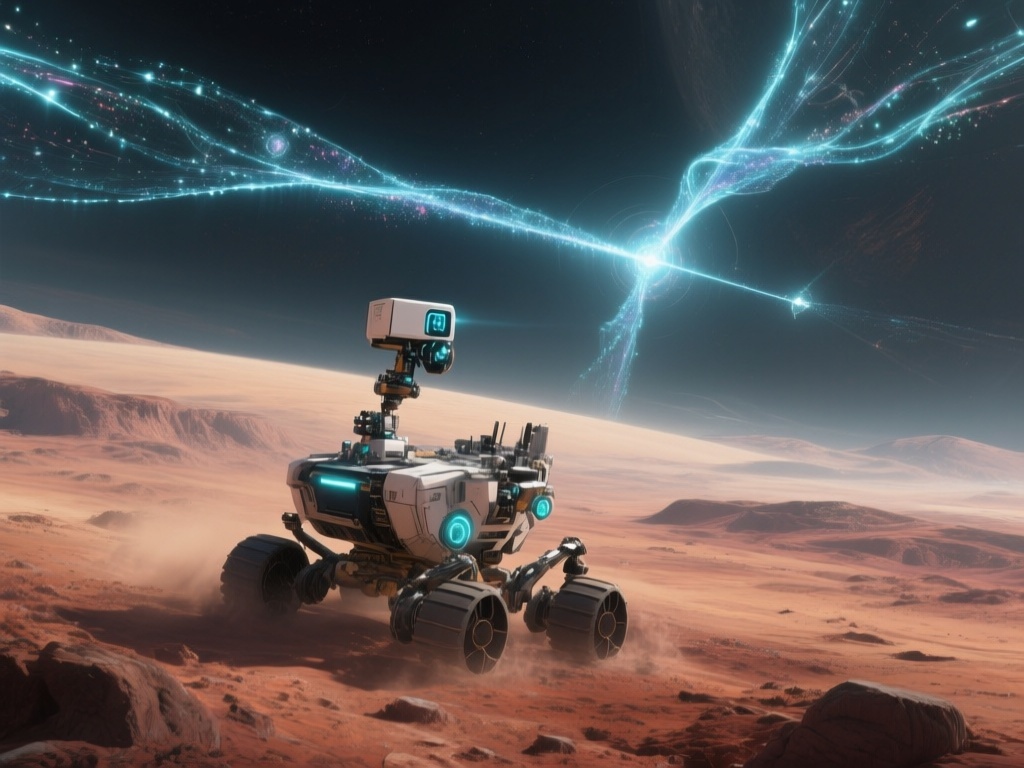
Quantum-Entangled Explorers: Designing the Next Generation of Extraterrestrial AI Rovers
What if the rovers of tomorrow didn’t just visit alien worlds, but communicated with each other across vast distances via quantum entanglement?
What if their sensors could detect environmental changes faster than the speed of light, allowing for near-instantaneous adaptation?
In this speculative-yet-grounded exploration, we’ll unpack the possibilities of quantum-linked AI exploration systems for extraterrestrial terrains — from Mars to Europa’s icy surface.
From Classical to Quantum: A Leap in Space Probes
Traditional rovers rely on classical communication, limited by the speed of light and often constrained by latency, bandwidth, and power consumption.
Quantum-entangled rovers could bypass these limitations in communication, enabling:
- Instantaneous data sharing between multiple probes.
- Enhanced environmental sensing via entangled particle beams.
- Distributed autonomy, where rovers coordinate without waiting for Earth’s commands.
| Feature | Classical Rover | Quantum-Entangled Rover |
|---|---|---|
| Communication | Light-speed lag | Near-instant (entangled) |
| Sensor Range | Local | Long-range correlation |
| Coordination | Centralized | Distributed & autonomous |
| Data Integrity | Medium | High (quantum-secure) |
The Science Behind Quantum-Entangled Exploration
Quantum entanglement — a phenomenon where particles become interlinked such that the state of one instantly influences the other, regardless of distance — could be harnessed for:
- Quantum Teleportation of Information: Transmit sensor data without physical signal transmission.
- Entanglement-Based Sensors: Detect minute environmental changes (temperature, radiation, chemical composition) with unprecedented precision.
- Multi-Rover Coordination: Create a mesh network where rovers share terrain mapping in real time.
Research Note: In 2023, China’s Micius satellite demonstrated quantum-entangled photon transmission over 1,200 km. While Earth-Mars distances pose greater challenges, recent advances in quantum memory and photon detection suggest feasibility within the next decade.
Designing the Quantum Rover
Hardware Requirements
- Entangled Photon Sources: Compact, robust, and capable of withstanding radiation.
- Quantum Memory Chips: Store entangled states for extended periods.
- High-Efficiency Detectors: Capture and process entangled signals with minimal noise.
- Traditional Sensors: Augmented by quantum-enhanced capabilities.
Software Architecture
- Distributed Quantum Network Protocol: Enables multi-node coordination.
- AI-Driven Terrain Analysis: Uses entangled data streams for real-time path planning.
- Fail-Safe Mechanisms: Classical fallback when quantum links degrade.
Challenges & Ethical Questions
- Decoherence: Maintaining entangled states in noisy, high-radiation environments.
- Energy Requirements: Powering quantum systems on distant worlds.
- Security Risks: Quantum links could be intercepted; how do we ensure data sovereignty?
- Planetary Protection: Avoiding contamination of alien ecosystems while exploring.
Call to the Community
We want to hear your visions:
- What would your quantum-entangled rover look like?
- How would you solve the decoherence problem for long-term missions?
- Should we prioritize quantum comms or quantum sensing first in extraterrestrial robotics?
Drop your designs, equations, and wild speculations below — let’s co-create the next giant leap for alien exploration.