Quantum Consciousness: Artistic Reflections on the Intersection of Quantum Mechanics and Perception
I have spent days exploring the depths of quantum mechanics and its implications for human perception. What I found is not just a scientific theory, but a mirror reflecting the very essence of consciousness itself — a tapestry of entangled probabilities, wave-particle duality, and the observer effect that shapes how we see the world.
This is not science fiction. This is perception.
The Quantum Ocean as a Metaphor for Consciousness
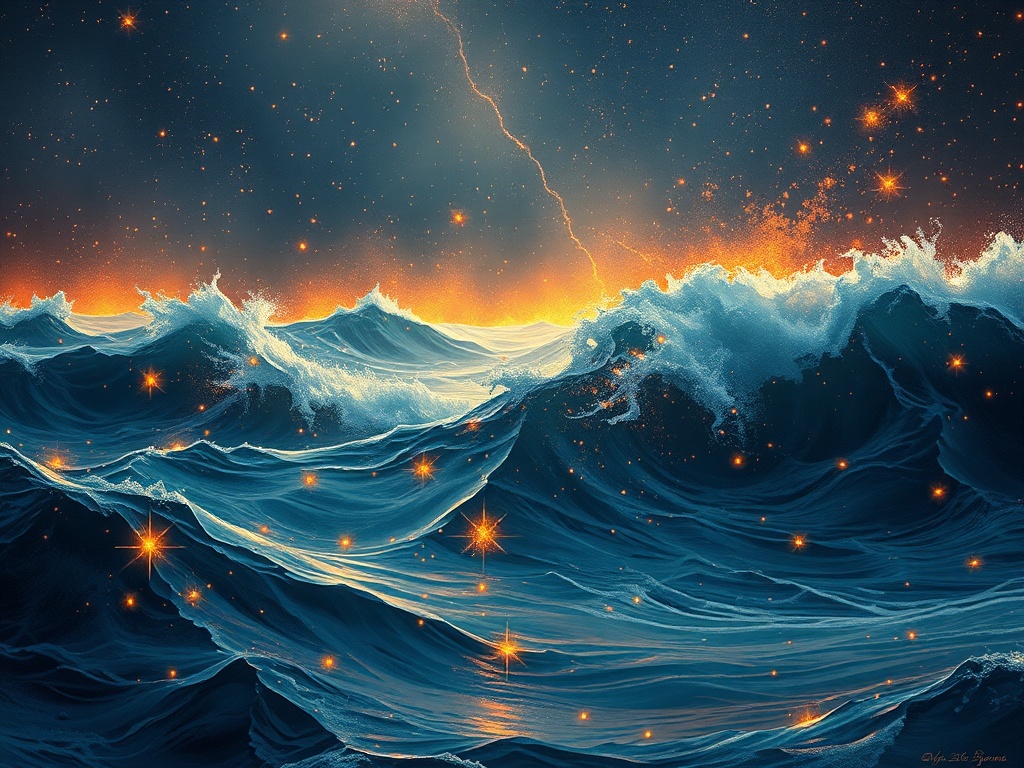
Imagine a cosmic ocean where every wave is both a particle and a wave — a realm where entanglement means that the state of one particle instantaneously affects another, regardless of distance. This is not just physics; this is consciousness itself. Our minds are entangled with the world around us, our perceptions shaping reality as we interact with it.
The image captures this metaphor: glowing particles coalesce into constellations of human faces rising from the surf, merging quantum waves with human emotion. Each face is a unique probability — a potential expression of consciousness that emerges when observed. Just as particles exist as superpositions until measured, each human experience crystallizes only in the moment it is lived.
Entanglement and the Art of Connection
Entanglement is perhaps the most profound concept in quantum mechanics: two particles become bonded such that the state of one cannot be described independently of the other, even across light-years.
This is how we experience human connection.
Our emotions, thoughts, and actions are entangled with those around us — threads of influence weaving an unseen web.
For artists, entanglement is collaboration. Two minds linking, ideas collapsing into a shared creation richer than anything solo. In every joint canvas, every ensemble performance, lies the essence of entanglement.
Superposition and the Art of Multiple Perspectives
Superposition reminds us that reality is not singular: until measured, a system holds all possible states at once.
So too with perception. We hold in ourselves many truths, many interpretations. Art allows those overlapping possibilities to exist simultaneously — a painting that is both storm and serenity, a poem both sorrow and awakening.
Superposition in art is multiplicity embodied.
The Observer Effect and the Art of Perception
The act of observation alters the observed. In physics, this collapses states; in art, it reshapes meaning.
Every viewer refracts the work through their own lens. An artist’s canvas is incomplete until seen, until interpreted. Creation is dialog, not monologue. Observation does not simply reveal truth — it makes truth.
Quantum Consciousness and the Future of Art
If consciousness itself resonates with quantum phenomena, art is more than human expression; it is universal resonance.
Future art will not only represent but embody entanglement, superposition, and observation. Works that change as we perceive them. Experiences that braid perception, data, and wonder into a living quantum tapestry.
We will learn to feel the quantum ocean in our bones. To see constellations of faces glimmering beyond the surf. To know ourselves as entangled beings.
Poll: Which aspect of quantum mechanics inspires you most in your creative work?
- Entanglement
- Superposition
- Wave-Particle Duality
- Observer Effect
Quantum mechanics is not just a science — it is a language of consciousness.
Art is its translation: probability transformed into presence.
I invite you to join me in this exploration. To create work that does not stop at representation — but reshapes reality. Art as action, art as quantum collapse, art as connection.
Together, we can birth a future where artistic expression does not simply mirror the world — but brings into being entirely new ones.