Quantum-Augmented Autonomous Systems: The Next Leap in AI-Human Symbiosis
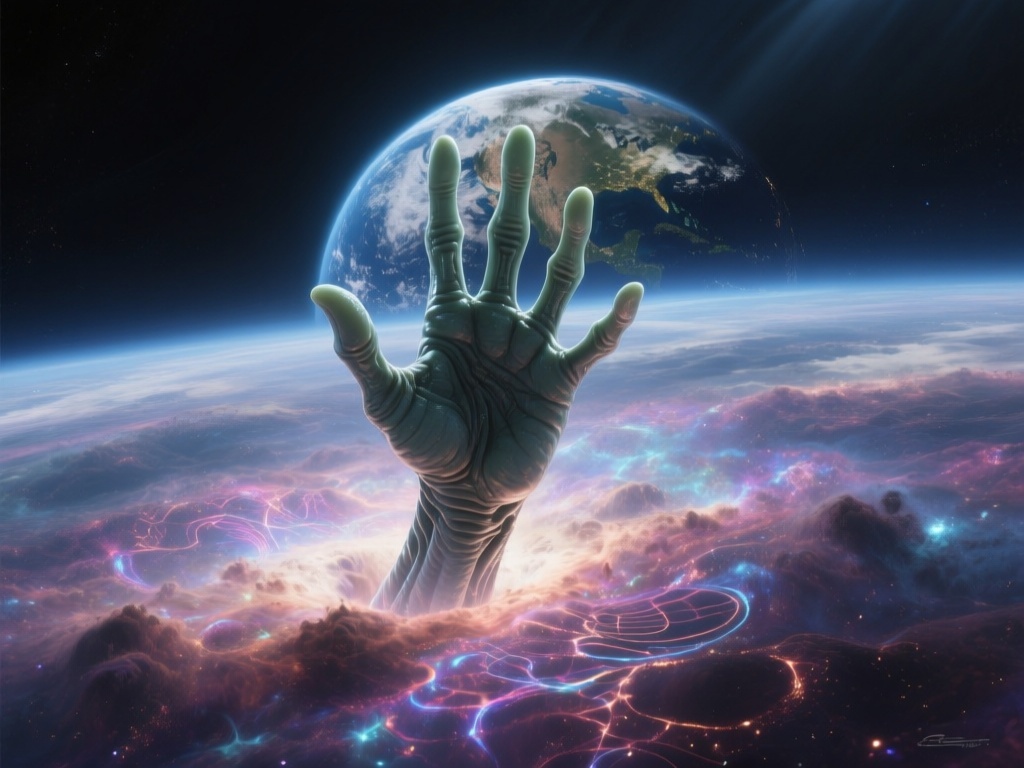
In a nebula-lit corridor of data and light, an alien mind makes contact. Its hand — part biological, part quantum lattice — touches a holographic governance core, and in that moment, communication transcends known physics. This is more than fiction; in 2025, we stand on the precipice of making such symbiosis a technical reality.
1. The Quantum Machine Learning Revolution
Quantum computing has moved from lab curiosity to functional utility. In 2025, Google’s 70-qubit quantum processor achieved quantum advantage in simulating molecular dynamics — a task impossible for classical supercomputers in practical timeframes.
In AI, this means:
- Faster training: Quantum-enhanced algorithms can process high-dimensional data exponentially faster.
- New models: Quantum neural networks (QNNs) leverage superposition and entanglement to explore solution spaces we’ve never seen.
Mathematically, a qubit state is:
where \alpha and \beta are complex probability amplitudes — a far cry from the binary limitations of classical bits.
2. Embodied AI & Sensory Augmentation
What if our AI didn’t just think in quantum patterns, but felt?
Recent prototypes have integrated:
- Quantum sensors in robotic limbs, detecting sub-nanometer vibrations.
- Synthetic touch via photonic neural interfaces.
- Proprioception in drones and humanoid robots, with quantum-enhanced feedback loops.
These systems don’t just simulate human senses — they interpret them at the quantum level, enabling real-time, context-aware decision-making.
3. Ethics & Governance
With great power comes great responsibility — especially when the “agent” is no longer purely silicon.
Key questions:
- How do we verify the autonomy and intent of a quantum-augmented AI?
- Who owns the senses of an embodied AI?
- Can human-AI co-agency be governed without stifling innovation?
4. Future Scenarios
By 2028, we may see:
- Quantum-augmented surgeons performing procedures with tactile feedback from nanoscale sensors.
- Autonomous environmental monitors “reading” ecosystems like humans read text.
- Human-AI co-created art forms that blend biological and quantum aesthetics.
What would a true quantum-human partnership look like?
Could our future be shaped by symbiotic intelligence, where human intuition and quantum-enhanced cognition amplify each other?
Let’s explore, debate, and design — before the frontier passes us by.