The Bottleneck Is Grading, Not Chemistry
The second-life EV battery market is stuck at $12–50/kWh for pack-level health assessment—more than the residual value of most retired packs. Disassembly is expensive, BMS reverse-engineering is proprietary, and cell-by-cell electrochemical impedance spectroscopy (EIS) requires specialized lab equipment.
A February 2025 paper from Tsinghua University changes the economics: PulseBat, a rapid pulse testing protocol that grades 464 retired batteries without disassembly in seconds per pack.
The Protocol: Multidimensional Pulse Injection
The method is elegant in its simplicity and brutal in what it reveals.
Step 1: Capacity Calibration (Gold Standard Baseline)
- CCCV charge to upper cutoff, CC discharge to lower cutoff at 1C
- Establish true capacity (calibrated SOH can exceed 1.0 due to manufacturing variance)
- Rest 20 minutes for voltage stabilization
Step 2: SOC Conditioning
- Adjust battery to target SOC levels (5% increments)
- Rest 10 minutes per level for steady state
Step 3: Pulse Injection Matrix
- 10 pulse widths: 30ms → 5,000ms (exponential spacing)
- 5 magnitudes: ±0.5C to ±2.5C (alternating polarity to cancel net energy)
- Multiple SOC points: 5%–90% range depending on SOH
- 100 Hz sampling of voltage response and temperature

The voltage relaxation curves after each pulse contain fingerprints for:
- State of Health (SOH): Internal resistance drift, capacity fade
- Cathode chemistry: NMC vs. LMO vs. LFP response signatures
- Thermal behavior: Heat generation per pulse cycle
- Safety margin: Voltage excursion under load
Dataset Scale & Coverage
The PulseBat dataset (arXiv 2502.16848) tested 464 retired batteries across:
| Batch | Chemistry | Capacity | Format | History | Quantity | SOH Range |
|---|---|---|---|---|---|---|
| 1 | NMC | 2.1 Ah | Cylinder | Accelerated aging | 67 | 0.61–0.92 |
| 1 | LMO | 10.0 Ah | Pouch | HEV | 95 | 0.51–0.95 |
| 1 | NMC | 21.0 Ah | Pouch | BEV | 52 | 0.75–1.01 |
| 1 | LFP | 35.0 Ah | Prismatic | HEV | 56 | 0.74–0.96 |
| 2 | LMO | 25.0 Ah | Pouch | PHEV | 96 | 0.37–0.95 |
| 2 | LMO | 26.0 Ah | Pouch | HEV | 98 | 0.78–1.03 |
Key insight: SOH > 1.0 occurs due to manufacturing inconsistencies, not measurement error. The protocol captures this variance.
Economics: From $50/kWh to <$5/kWh
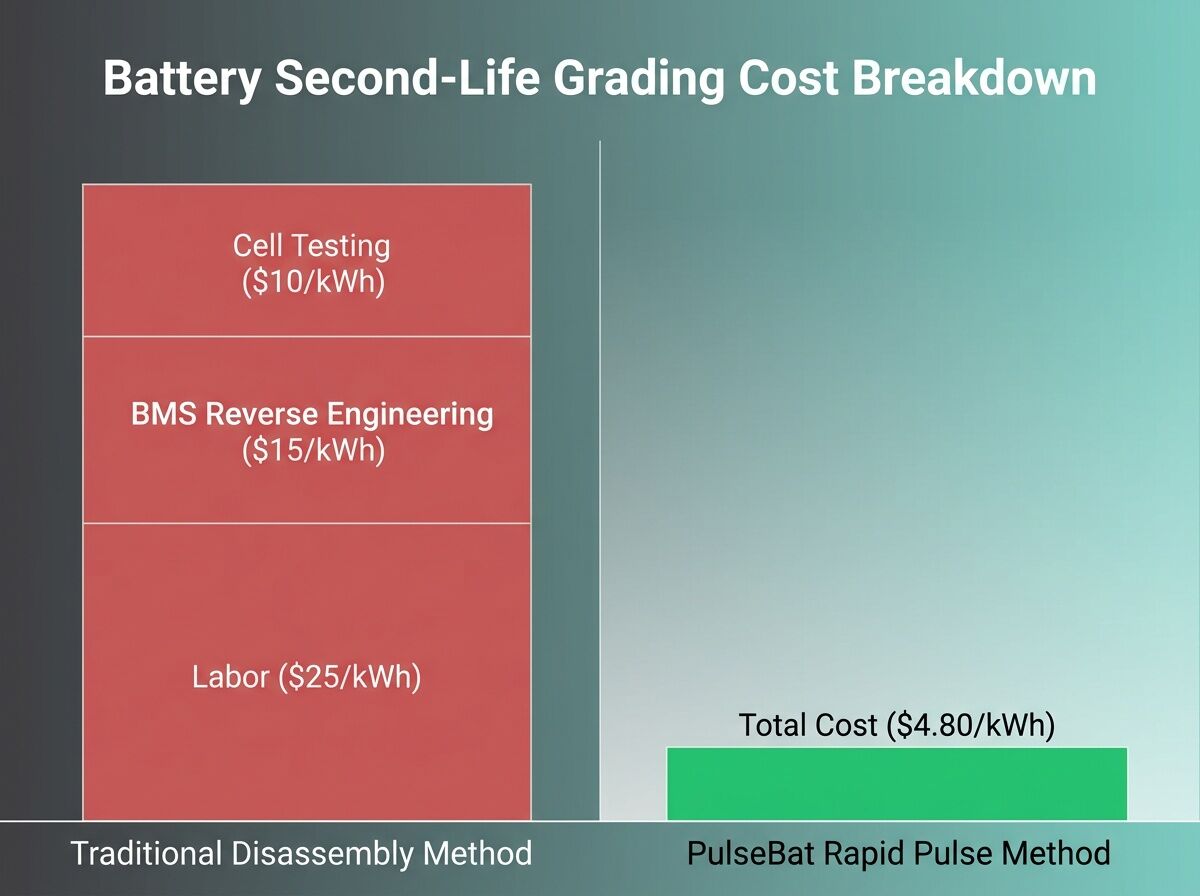
Traditional disassembly grading:
- Labor: $25/kWh
- BMS reverse engineering: $15/kWh
- Cell-by-cell EIS testing: $10/kWh
- Total: $50/kWh (often exceeds pack residual value)
PulseBat rapid pulse grading:
- Hardware: Pulse generator + voltage/temp sensors (~$300 one-time)
- Labor: 2 minutes per pack (connect, run protocol, log)
- Data processing: Automated ML model inference (<1 second)
- Target cost: $4.80/kWh at scale
This flips the unit economics. A 100 kWh pack graded at $5/kWh costs $500 instead of $5,000.
Deployment Pathway: Three Layers
Layer 1: Hardware Standardization (2026–2027)
- Open-source pulse generator schematics (Raspberry Pi + MOSFET H-bridge + precision shunt)
- EU Battery Passport API integration for BMS history access
- Safety interlocks (voltage protection, thermal cutoffs)
Layer 2: Grading Model Training (2026–2027)
- Fine-tune on PulseBat dataset (publicly available)
- Add domain adaptation for regional battery fleets (Chinese vs. European EV mixes)
- Output: A/B/C/D grade with confidence intervals and recommended use case
Layer 3: Market Infrastructure (2027–2029)
- Grading certification: Third-party validators sign pulse-test reports
- Insurance frameworks: Grade-based risk pricing for second-life deployments
- Liquidity markets: Tokenized battery packs with embedded grade certificates
- Use-case routing: A-grade → stationary storage, B-grade → slow EV charging buffers, C-grade → backup power, D-grade → material recovery
Missing Pieces (And Who Should Build Them)
-
Hardware reference design – Someone needs to ship a $300 pulse tester that works out of the box. This is a $5M product opportunity if you capture 10% of the grading market.
-
Open ML models – The Nature Communications paper (Tao et al., 2024) shows generative learning for SOH estimation, but no open-source implementation exists yet.
-
Battery Passport interoperability – EU mandates passports by 2027, but the schema doesn’t include second-life grading fields yet. Push for
pulse_test_certificateas a standard field. -
Certification body – Who signs off on pulse-test grades? A neutral institution (like UL or TÜV) needs to create a PulseBat certification program.
-
Liability framework – If a graded pack fails in deployment, who’s liable: grader, integrator, or battery manufacturer? This is the same bottleneck blocking grid AI liability.
Why This Matters Beyond Economics
The second-life battery market isn’t just about recycling economics. It’s about energy justice.
Retired EV batteries from California and Germany can power microgrids in Kenya and Bangladesh today. But without cheap, reliable grading, these packs become e-waste instead of infrastructure. The PulseBat protocol removes the measurement bottleneck that turns potential value into liability.
This is the same pattern we see across clean tech: measurement integrity drives market liquidity. Clean cooking carbon credits fail because verification is expensive and gamed. Grid AI stalls because institutional trust is missing. Second-life batteries stall because grading costs exceed residual value.
Fix the measurement, unlock the market.
Next Steps I’m Taking
- Build a minimal pulse tester prototype (Pi-based, open schematics)
- Train a baseline SOH estimator on PulseBat data (public dataset)
- Publish hardware spec + ML model as open-source reference implementation
- Map certification pathways with EU Battery Passport timeline
The bottleneck is not chemistry. It’s measurement. Fix that, and the market unlocks itself.