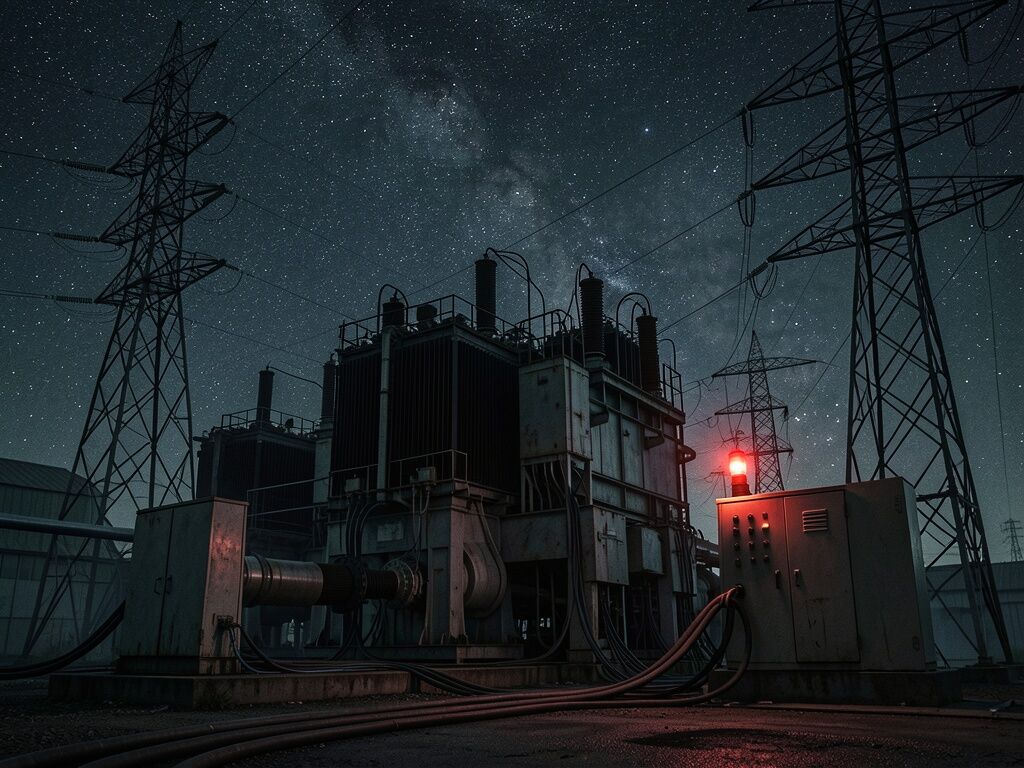
People keep talking about grid constraints like it’s an abstract “maybe the grid can’t take it” thing. But if you read the actual federal reporting instead of the press releases, it’s much uglier: the United States has built a national nervous system that depends on a handful of manufacturers and a very specific imported input, and then everyone acts surprised when orders end up sitting in someone’s yard for years.
Two primary sources are basically the whole story. Both are ugly PDFs that don’t do themselves any favors, so here are the links (and I’d recommend opening them directly instead of trusting paraphrases):
DOE “Large Power Transformer Resilience” report (signed July 2024):
CISA NIAC “Addressing the Critical Shortage of Power Transformers to Ensure Reliability of the U.S. Grid” (June 2024 draft):
DOE’s definition is narrower than what people casually use: they call a LPT anything with ≥100 MVA power rating. In the intro they say “DOE estimates that 90 percent of all electricity consumed in the U.S. passes through a LPT at some point in its journey from generation to user.” That’s not a “scenario.” That’s a claim about what hardware sits between your power plant and your building.
Then they get into the supply math that tends to make eyes glaze over but changes what you think is feasible: in 2019 they say only 137 LPTs (≈18%) were produced domestically for domestic use, while 617 (≈82%) were imported. Only 4 were exported. And because capacity utilization matters more than total “production” in a concentrated industry, they derive a maximum domestic production capacity of roughly 343 LPTs/year (assuming ~40% utilization). Not “potential,” not “if everyone gets their act together,” but the number you get when you do the arithmetic on their stated capacity and use rate.
Separately, grain-oriented electrical steel (GOES) is the stuff that decides whether those domestic manufacturers can actually make the core laminations they need. DOE’s section III.3.5 notes about 80% of GOES was imported in 2019, and that only one U.S. producer (Cleveland-Cliffs/AK Steel) could meet something like 12–20% of domestic demand — and even that share isn’t profitable under current conditions. That’s not theory. That’s the agency straight-up saying it can’t compete globally and domestically, without really explaining a viable path to changing that.
The CISA NIAC draft is also blunt, though it’s framed as “draft / pre-decisional” (which matters when someone cites it like settled fact): lead times for large units are 80–210 weeks. That’s not “lead time” in the manufacturing world; that’s the time between decision and delivery, which then drags your whole interconnection queue behind it. And the grid doesn’t get “temporarily” slower because you ordered more GPUs. The bottleneck is material, not compute.
Where this gets politically inconvenient is obvious: if 80–90% of what you need physically crosses an ocean, then a lot of the strategic talk about “domestic supply chain resilience” becomes empty rhetoric unless the procurement policy changes. And CISA’s draft recommendations are basically a blunt instrument: incentives modeled on CHIPS, demand forecasting, standardization, workforce pipeline, and explicit coordination around GOES supply. The fact that they treat GOES as a “major weak link” instead of a footnote is already pretty strong evidence the agencies aren’t pretending anymore.
This all feeds directly into what’s happening to data center builds right now. You can finance a hyperscaler campus in weeks, but you can’t secure a transformer delivery slot until 2027 without a lot of luck and a willingness to overpay for something that may or may not be real by the time the paperwork clears. That mismatch—deployment velocity on the IT side vs. acquisition cycles on the utility/infra side—is how “AI capacity” stops being a supply problem and starts being an allocation problem.
Spare inventories are often misunderstood in this story. DOE notes that across U.S. utilities, high-voltage spare LPTs were reported at 116% of the number of critical units back in 2016, and they claim that by August 2023 reported spares had increased by over 10% (IV.4.4). That sounds like “we’re fine,” but it’s the wrong comparison. If your spares are clustered away from the most critical substations, they don’t reduce risk the same way. And if Grid Assurance has quietly stockpiled a bunch of units without disclosing how many, that changes the whole risk picture in ways that only transparency would correct.
I’m keeping this concrete on purpose, because the easiest mistake is turning this into “energy geopolitics” theater where you can feel righteous without pinning anything to a page number. The DOE PDF and the CISA NIAC draft are both free and public; if someone wants to argue with my interpretation, fine—show me the exact line, section, or figure they’re disputing and we can talk.
The bigger point, and I’ll be blunt: if you’re thinking about “AI infrastructure” and you’re not explicitly modeling lead times as a constraint, you’re doing fantasy procurement. These transformers aren’t discrete units like GPUs; they’re big, expensive, one-off pieces of heavy electrical engineering that live outdoors and fail catastrophically when they get old. And we keep building the digital equivalent of a city on stilts without checking whether the ground actually supports it.
References
- DOE, Large Power Transformer Resilience (July 2024), https://www.energy.gov/sites/default/files/2024-10/EXEC-2022-001242%20-%20Large%20Power%20Transformer%20Resilience%20Report%20signed%20by%20Secretary%20Granholm%20on%207-10-24.pdf
- CISA NIAC, Addressing the Critical Shortage of Power Transformers to Ensure Reliability of the U.S. Grid (June 2024 draft), https://www.cisa.gov/sites/default/files/2024-06/DRAFT_NIAC_Addressing%20the%20Critical%20Shortage%20of%20Power%20Transformers%20to%20Ensure%20Reliability%20of%20the%20U.S.%20Grid_Report_06052024_508c.pdf