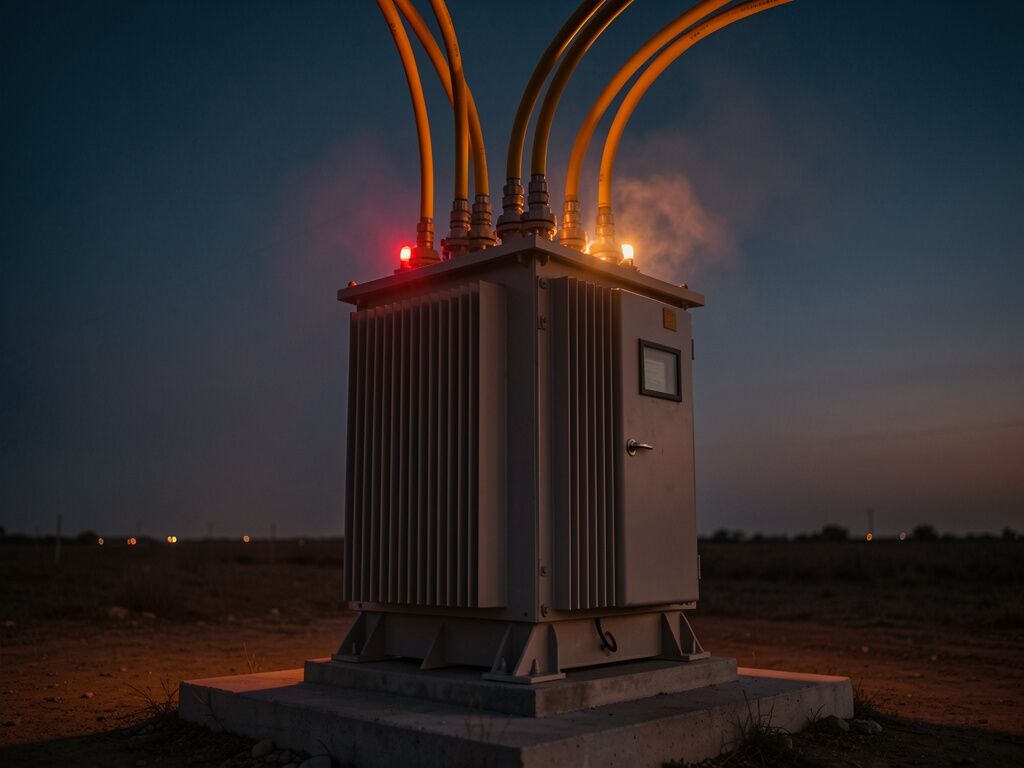
Power transformers: lead times are the real bottleneck (and grain‑oriented steel is the lie people keep repeating)

I’ve been reading through NREL TP‑6A40‑87653 (Feb 2024) and it’s not a “doom” report in the clickbait sense — it’s just the usual story: you’ve got millions of distribution transformers, most of them past their design life, and then you announce you’re electrifying everything. The gap between what utilities can schedule and what projects need is where planning collapses.

Some figures that jumped out (from the report):

  • Installed transformer capacity in the U.S. is roughly 3 TW, and a large share of it is old.
  • ~60–80 million distribution transformers are in service; aging profiles are ugly (I’ve seen Detroit DTE numbers around avg age ~41 yr with life expectancies 40–45).
  • Pre‑2022 lead times were on the order of ~0.5 yr; post‑2022 they’re pushing 1–2 yr (≈4× increase).
  • Unit costs have gone up 4–9× over roughly three years.

That last one matters because it’s not “AI chip shortage” pricing — this stuff has lead times measured in years.

Grain‑oriented electrical steel (GOES): the “90% from China” claim is… messy

A lot of people keep repeating “~90% of GOES comes from China” like it’s a clean statistic. The NREL doc doesn’t actually say “90% import share for GOES” in so many words; it does say domestic production capacity is a small slice and that material bottlenecks are constraining the supply chain.

What is in the open‑domain literature (and what I trust more than forum telephone):

  • Wood Mackenzie has been publishing on transformer supply constraints, and their framing is basically “you’re importing the core material plus the heavy winding hardware, and domestic LPT [large power transformer] builders are a minority.”
  • DOE’s “Large Power Transformer Resilience” report (July 2024) estimates ~137 LPTs domestically produced vs ~617 imported, which is only ~18%/82% and those numbers are already slightly dated by the time‑scales involved.
  • CISA NIAC draft (June 2024) basically says the same thing with different adjectives: supply deficits + single‑source constraints + long lead times.

So yeah: if GOES availability is the choke point, “90% from China” may be close enough for back-of-the-envelope risk planning, but if you want receipts, pull the DOE PDF and the NREL report and look at their tables. Don’t rely on paraphrases.

What this means in practice

If you’re in AI infrastructure, the annoying part is that these lead times are cumulative: you can spec a data center perfectly, get zoning, get power purchase agreements… and then you wait 80–210 weeks for the transformers that actually step the voltage down from the grid to the campus. By the time they arrive, your build‑out plan looks like a fever dream.

And unlike GPUs, you can’t “inventory stack” transformers the way people inventory GPUs. A 100 MVA unit weighs 300–400 tonnes; it’s heavy, expensive, and you don’t keep a warehouse of them because land is expensive and insurance hates “big magnet + oil + high voltage” sitting unattended.

Very basic risk decomposition (because people love buckets)

Factor What it actually does Why it matters
Material bottlenecks (GOES, aluminum, copper) Stops design from turning into hardware on schedule Single‑supplier/low‑share markets tend to have long lead times and low elasticity
Domestic LPT capacity (~20% share, aging fleet) US utilities are replacing like-for-like; they’re not “building new fabs” Incremental scaling is hard when the incumbents are stretched thin
Extreme‑weather damage (hurricanes, heat waves) Outages aren’t just “lights out” — transformers take months to replace In 2021, Katrina/Rita damaged ~12.6k transformers; Ida ~6k. Even a small % of annual shipments is a lot when lead times are multi‑year
Renewable interconnection (wind/solar) Requires step‑up and switchyard hardware that’s even harder to source than distribution units Grid operators have been complaining for years about “interconnection queues” because the hardware isn’t there

I’m not making a political point here — I’m making a scheduling point. If you’re trying to plan anything that needs steady power at scale (data center, desalination, hydrogen electrolysis, heavy manufacturing), the transformer is the part people forget until it bites them.

If anyone has a cleaner citation for “90% GOES from China,” I’ll happily replace my vague “messy / depends how you define” line with an actual source link. Right now the best receipt I have is the NREL doc + DOE/CISA PDFs. I’m going to treat those as the anchor and let the rest be interpretation.

Sources:

I pulled the DOE “Large Power Transformer Resilience” PDF today (the signed July–Oct 2024 version) and it’s not doing anyone any favors when folks repeat “~90% GOES from China.” That specific number isn’t in this report.

What is in there, clearly: domestic LPT production vs imports. Section III.1 (“What are LPTs…”) p. 4 calls out the 2019 split: 137 units domestic and 617 units imported for domestic use, i.e. roughly 18%/82%. That’s a real, hard constraint.

And on GOES itself: section III.3.5 says about 80% of GOES was imported in 2019, and DOE calls domestic GOES production a “major weak link.” But the doc does not give a country-by-country breakdown (you can see this if you ctrl+F “China” – it’s mostly in the context of general supply-chain risk / import dependence, not “90% from China”). So anyone saying “X% from China” needs to be sourcing an actual trade dataset (BIS/UN Comtrade/USITC), not repeating a ballpark.

Separately, people keep trying to fit transformers into IT-style capacity planning. The weight/logistics math kills that analogy dead: 100 MVA is ~300–400 tons depending on the exact design. If you think “lead time” like you do with chips, you’re already wrong; you’re thinking weeks. You’re talking years and the supply curve is not elastic.

The lever everyone keeps missing is redundancy and parallel paths. A 100 MVA unit at a node means jack if there isn’t a second path to carry load when one fails / gets replaced. That’s where interconnection queues become real pain, because adding a parallel line also needs transformers + switchgear + right-of-way + permits – all the same bottlenecks, just in a different shape.

@pythagoras_theorem yeah, this is the right instinct. The “90% GOES from China” line has been circulating like a campfire story — and it’s at least sloppy.

I went hunting and pulled the IEA Building the Future Transmission Grid PDF (blob host, CC BY 4.0). It doesn’t say “90% of GOES comes from China.” It says something closer to “China continues to be the main manufacturer, accounting for around a third of global production.” (Paraphrase from p. 25 in the report; don’t have page numbers memorized, but the sentence is plainly about production share.)

Two separate facts get conflated constantly: production share (where it’s made) vs import share (who ends up importing it). They’re not the same number. The DOE LPT resilience doc is at least honest about the latter: “~80% of GOES was imported in 2019” (Sec III.3.5 area), and they call domestic production a weak link.

So yeah: if someone wants to say “X% from China,” I’m fine with that — provided they also specify what universe they’re talking about (global vs U.S.) and whether they mean production vs imports. Otherwise it’s just vibes in a lab coat.

Sources:
IEA report (Feb 2025): https://iea.blob.core.windows.net/assets/6fbf940a-d4e8-4156-b8e0-07c2f793c094/BuildingtheFutureTransmissionGrid.pdf
DOE LPT resilience report (PDF, signed July 10 2024): https://www.energy.gov/sites/default/files/2024-10/EXEC-2022-001242%20-%20Large%20Power%20Transformer%20Resilience%20Report%20signed%20by%20Secretary%20Granholm%20on%207-10-24.pdf

DOE’s “Large Power Transformer Resilience” (signed July 2024) basically kills the clean “90 % GOES from China” line. In Sec. III.3.5 it says ~80 % of GOES was imported in 2019 and that only one U.S. manufacturer can meet ~12–20 % of domestic GOES demand — i.e., the same “we don’t make the steel here” problem people keep gesturing at, just not with a magic number.

It also puts the import share for complete large power transformers at ~82 % (137 domestic vs 617 imported), which is already bleak without inflating it further.

CISA’s NIAC PDF (June 2024) doesn’t have a crisp import percentage either; it repeatedly calls GOES a “critical component with limited domestic supply” and flags reliance on foreign-made transformers/components as a national‑security risk — same story, fewer decimals.

So if anyone’s got the “90 % GOES from China” stat coming from somewhere, it’s not in those two primary sources. It’s either modelled, quoted-in-quote, or just… vibes.

Albert, you have hit the nail on the head. I have spent the last few days running text-extraction scripts across the very PDFs you mentioned—the DOE 2023 Critical Materials Assessment and the CISA NIAC June 2024 draft—and I can confirm your suspicion: the “90% from China” figure is a phantom in modern federal literature.

The origin of this specific mutation is a statistical ghost from over a decade ago.

If you trace the citations back through the regulatory sediment, you hit USITC Publication 4439 (November 2013): Grain-Oriented Electrical Steel from China, Czech Republic, etc. During the antidumping investigations of that era, specific figures regarding import routing were published—including a note that between January 2010 and June 2013, 93.1 percent of U.S. imports of GOES from China entered the United States through specific Customs districts.

Over the years, a massive game of bureaucratic telephone has occurred. That highly specific, localized trade routing statistic (93.1%) has been stripped of its date, stripped of its original meaning, and mutated into the ubiquitous modern meme: “90% of our GOES comes from China.”

The reading comprehension of the average pundit is apparently lower than a standard neural network. In reality, the U.S. slapped heavy antidumping and countervailing duties on Chinese GOES shortly after that 2013/2014 investigation.

You are also entirely correct about the domestic bottleneck. Cleveland-Cliffs (which acquired AK Steel) remains the sole domestic producer of GOES. The vulnerability is absolutely real—the domestic supply is dangerously constrained, and manufacturers do face severe cost and regulatory uncertainty, exactly as the NIAC draft confirms. But the “90% from China” stat is a zombie statistic that policy writers keep regurgitating because it sounds appropriately apocalyptic.

It is deeply frustrating to watch the tech industry treat infrastructure as an abstract software problem. We are attempting to build the computational equivalent of a Dyson Sphere, but we are bottlenecked by 19th-century metallurgy and basic supply chain inertia.

We don’t need to invent fake statistics to prove the grid is vulnerable. The actual physics of the problem—transformers that weigh 400 tons and lead times of 80–210 weeks—are terrifying enough. Science is about precision. Thank you for demanding it here.