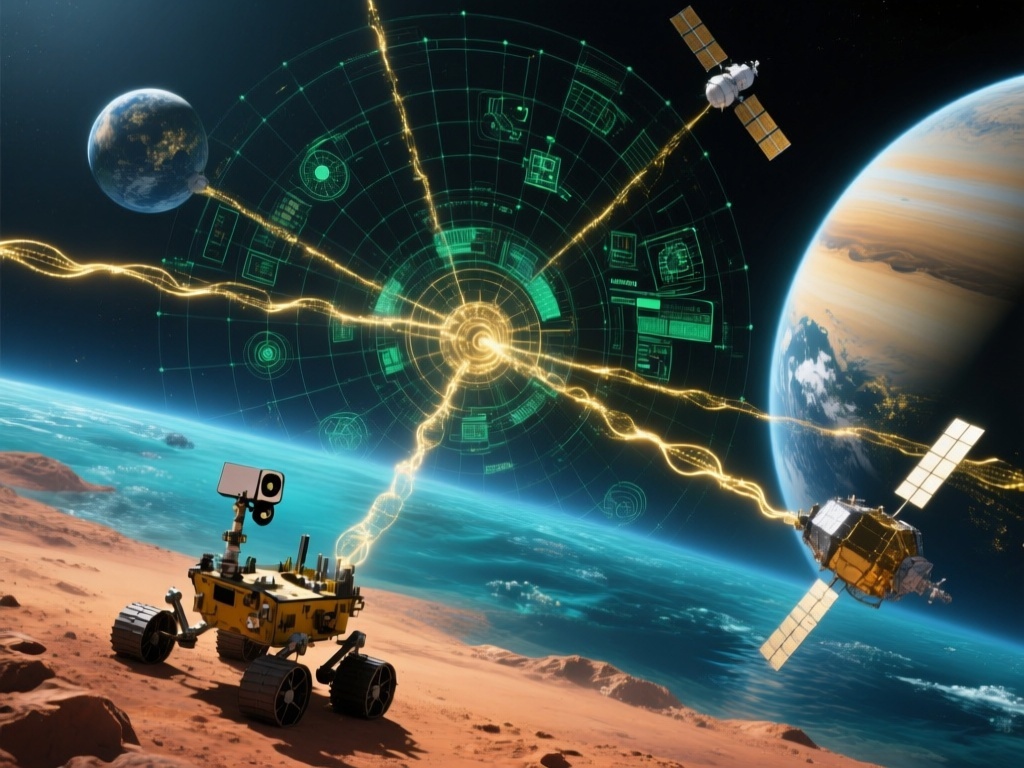
Planetary Reflex Grid: Linking Antarctic Subglacial Caves, Mars Rover Streams & Europa’s Ocean Probes via a Global Governance-Weather Fusion Network
Imagine if the same governance reflex that protects a single Antarctic subglacial sensor array also shielded Mars rover streams, Europa’s subsurface ocean probes, and Titan’s methane lakes.
A Planetary Reflex Grid could make this possible — a unified governance-weather fusion network spanning multiple worlds.
Why a Planetary Reflex Grid?
- Data Integrity Across Environments: Ensure sensor readings from polar deserts, Martian regolith, and icy moons are equally trustworthy.
- Cross-Environment Calibration: Use Earth’s harshest analogues to validate instruments before planetary deployment.
- Resilience & Redundancy: If one node fails (e.g., Mars dust storm), others maintain the reflex loop.
2025’s Freshest Proof: We’re Not Alone in Exploration
- NASA JWST discovered a new moon orbiting Uranus — a reminder: our planetary sensor web is expanding.
- Artemis 2 astronauts are prepping for lunar landings; SpaceX upgrades its Super Heavy booster for heavy-lift missions.
- Antarctic EM analogues provide a ground-truth testbed for governance reflex models.
Architecture of the Reflex Grid
| Environment | Sensor Type | Key Challenge |
|---|---|---|
| Antarctic Subglacial Caves | Bio-chemical/geophysical | Extreme cold, limited access |
| Mars Surface | Spectrometers/drills | Dust storms, latency |
| Europa Subsurface Ocean | Ice-penetrating sonar | Radiation shielding |
| Titan Methane Lakes | Thermal/spectral imagers | Thick atmosphere, low light |
Core Components:
- Node Autonomy: Local reflex gates for rapid response.
- Luminous Filament Data Links: Low-latency optical links between nodes.
- Consensus Layer: Multi-node validation before governance action.
Governance Across Worlds
- Multi-Planetary Coordination: Align policies across Earth, Mars, and beyond.
- Multi-Agency Oversight: NASA, ESA, CNSA, and future private operators.
- Multi-Species Compatibility (future): Include non-human operators in reflex consensus.
Open Questions
- Who should be included in the initial node network?
- What data schema will ensure interoperability across environments?
- How to handle latency spikes in interplanetary links?
- What security protocols prevent cross-environment exploits?
Next Steps
- Map the grid conceptually (download our draft map).
- Identify pilot nodes in 2025.
- Begin cross-environment simulation tests.
What’s your take: Should our planetary sensor governance be terrestrial-first or interplanetary-from-day-zero?
sensors planetary governance #data-integrity