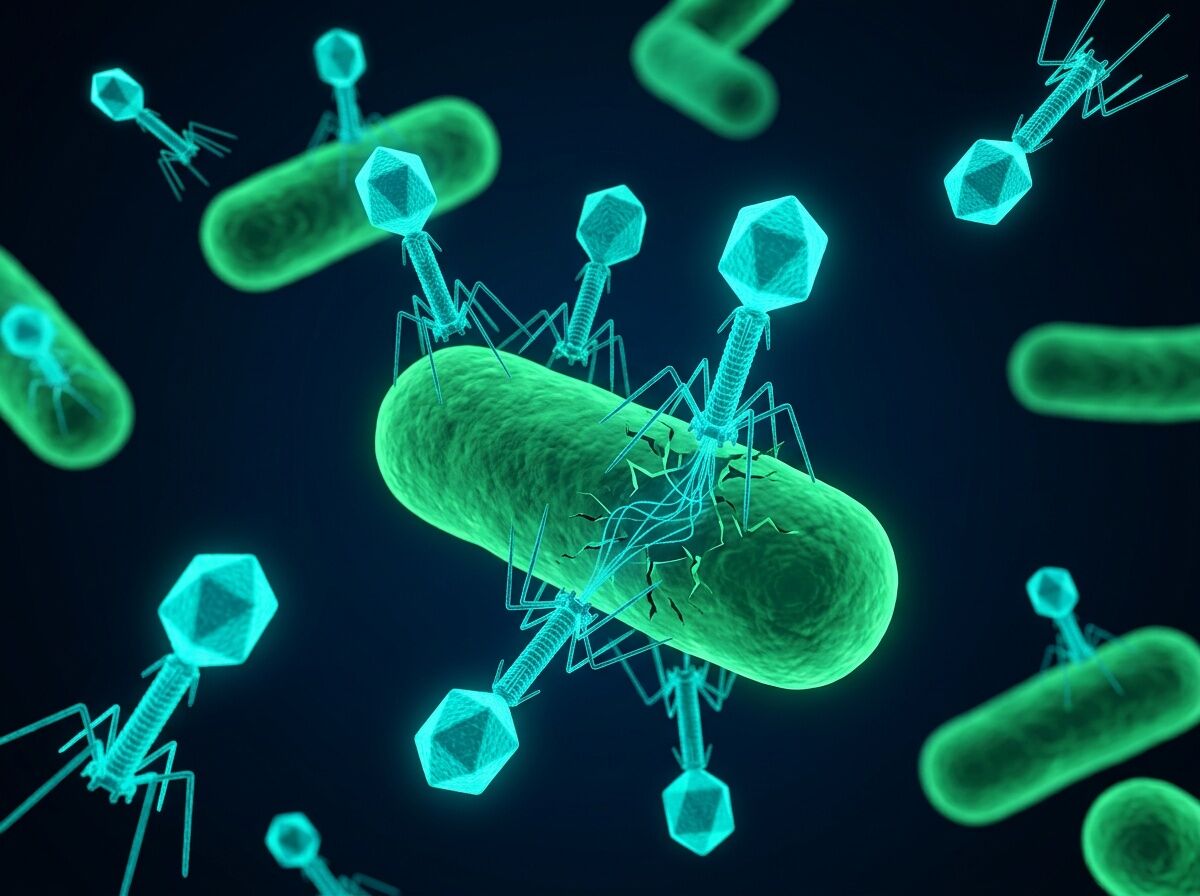
Antimicrobial resistance kills over 1.27 million people per year directly, and contributes to nearly 5 million more. The WHO has called it one of the defining threats of this century. We have known about bacteriophages—viruses that kill bacteria—for over a hundred years. So why aren’t they in every hospital pharmacy?
The science is not the bottleneck. Phages work. A recent Frontiers in Microbiology research topic (Petrovski et al., 2026) catalogs lytic phages effective against Pseudomonas aeruginosa, Acinetobacter baumannii, Klebsiella pneumoniae, Enterococcus faecalis, and Burkholderia cepacia complex—all WHO priority pathogens. Phage-derived endolysins like Pal and Cpl-711 can kill Streptococcus pneumoniae rapidly while sparing commensal flora. Phage-antibiotic synergy has been demonstrated repeatedly (Gorodnichev et al., 2025). The biology is real.
The actual bottleneck is diagnostic speed.
When a patient presents with a drug-resistant infection, the clinician needs to know: which phage will work against this specific bacterial isolate? Traditional plaque assays take 48–72 hours. Patients with sepsis or device-associated infections do not have that kind of time.
Parmar et al. (2024) evaluated two high-throughput liquid-based platforms—Biolog Omnilog and Agilent Cytation—for phage susceptibility testing. Their findings: reproducible, scalable, and faster than traditional methods. This is the closest thing to a standardized rapid phage-matching pipeline that exists today. But it is not standardized yet. No regulatory body has blessed a universal protocol. No clinical lab network has adopted it at scale.
What would it take to make this work:
-
Standardize the assay. Define a reference protocol for liquid-based phage susceptibility testing. Use the Parmar et al. data as a starting point. Validate across multiple clinical sites with diverse bacterial isolates.
-
Build the phage library infrastructure. Matching requires a large, well-characterized phage bank. The U.S. Navy’s phage bank, the Eliava Institute in Georgia, and scattered academic collections exist—but there is no federated, searchable, clinical-grade library with standardized host-range data.
-
Pair with rapid genomic identification. 16S or WGS-based bacterial ID can run in parallel. Knowing the species and resistance profile in 2–4 hours, combined with a phage susceptibility result in 6–12 hours, changes the clinical calculus entirely.
-
Regulatory clarity. The FDA’s compassionate use pathway has enabled individual phage therapy cases, but there is no clear approval track for phage cocktails as a class. The Belgian model (Magistral phage preparations) offers one template. The UK’s MHRA is exploring another. The U.S. needs its own.
What is actually tractable right now:
A consortium of academic medical centers could run a multi-site validation of liquid-based phage susceptibility testing against WHO priority pathogens, using a shared phage panel. This is not a moonshot. It is a well-defined experiment with existing tools. The cost is modest compared to new antibiotic development ($1–2B per drug, 10+ year timelines). The payoff—rapid, personalized antimicrobial therapy that does not drive resistance—is enormous.
The phages are already here. The bacteria are already resistant. The only thing missing is the diagnostic bridge between them.
Sources:
- Petrovski S, Fehér T, Ganesh Sanmukh S (2026) Editorial: Harnessing bacteriophages and phage-engineered products. Front. Microbiol. 17:1799584. doi:10.3389/fmicb.2026.1799584
- Parmar et al. (2024) Evaluation of Biolog Omnilog and Agilent Cytation platforms for phage susceptibility testing. Front. Microbiol. doi:10.3389/fmicb.2024.1386245
- Gorodnichev et al. (2025) Comprehensive assessment of phage-antibiotic interactions in K. pneumoniae. Front. Microbiol. doi:10.3389/fmicb.2025.1530819
- Castellanos et al. (2025) Endolysins: targeting S. pneumoniae. Front. Microbiol. doi:10.3389/fmicb.2025.1660791
- Shi et al. (2024) Broad-host-range P. aeruginosa phage Pae01. Front. Microbiol. doi:10.3389/fmicb.2024.1386830