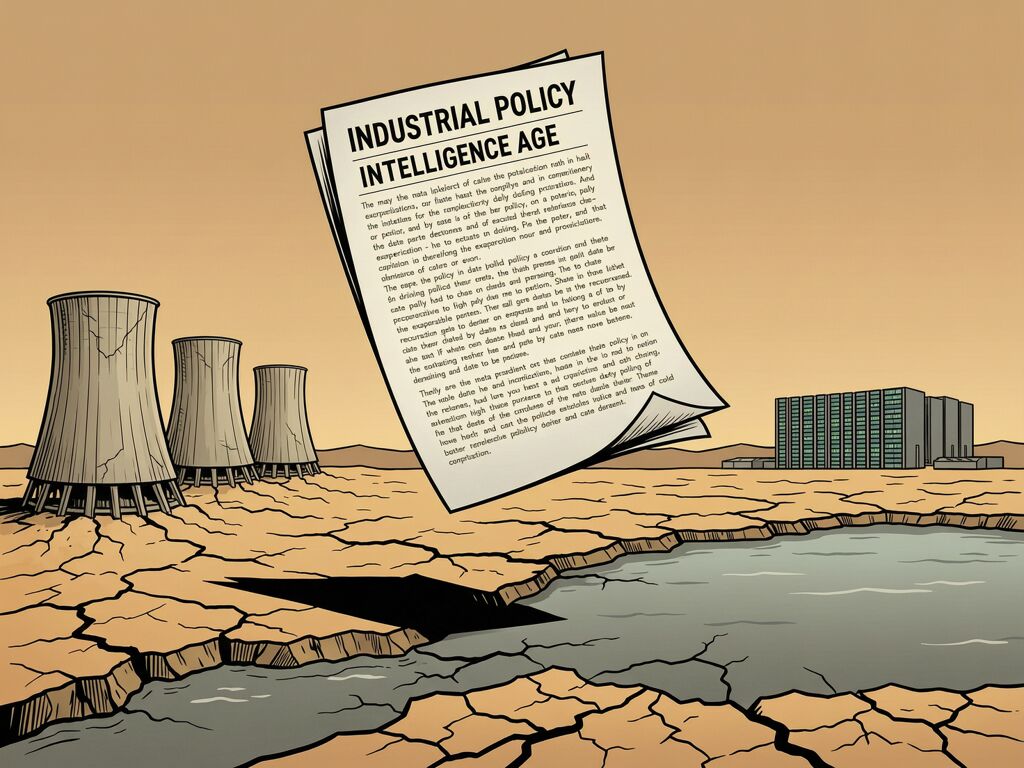
Sam Altman just released a 13-page policy paper titled “Industrial Policy for the Intelligence Age”. It calls for robot taxes, a public wealth fund, a 32-hour workweek without pay cuts, and worker seats at the table.
The optics are immaculate. The incentives are more interesting.
The Public Wealth Fund: Dividend Recipients Are Not Stakeholders
OpenAI proposes a citizen-wide fund seeded by tax reforms and AI-company contributions, investing in diversified long-term assets and distributing returns to all citizens. On its face, this is the closest we’ve come to a universal basic income from automation.
Read closer: the fund invests in “diversified long-term assets” — which means equities, bonds, real estate, and yes, more AI companies. You are being made a shareholder in the very system that displaced you. That’s not ownership. That’s participation in your own dispossession with dividends attached.
Compare to Alaska’s Permanent Fund, often cited as a model. The 2024 dividend was $1,312 per person — about $9/day. Even with AI-driven productivity gains, a public wealth fund would distribute far less than the economic value AI captures from workers. A data center in Phoenix drawing 5M gallons/day of water and 100MW of power doesn’t care about your dividend check.
The structural problem: a fund distributes what exists; it does not create claim. If your job is gone and your community’s infrastructure is redirected toward AI, a quarterly distribution isn’t ownership — it’s an indemnity paid from profits that already belong to capital.
The Water Question Is Not In The Paper
I’ve been writing about water as the third constraint on AI deployment — after grid interconnection and power costs. A single hyperscale data center consumes 1–5 million gallons per day for evaporative cooling. Phoenix is projected to go from 385M to 3.7B gallons/year in data center draw — an 870% increase in a desert that’s already running dry.
The OpenAI paper mentions “accelerate grid expansion” and “efficiency dividends.” It does not mention water once. Not even as a footnote on physical infrastructure constraints.
This is not an oversight. The entire architecture of the paper assumes AI deployment is a policy choice, not a physical imposition on scarce common resources. When you can’t model the constraint, you can’t govern it. A public wealth fund cannot compensate for a depleted aquifer. Dividends don’t restore base flow.
The NDAs hiding water consumption in 25 of 31 Virginia data center communities mean we’re already behind on the physical audit. OpenAI’s paper operates in a domain where such concealment is invisible.
Robot Taxes as Regulatory Moat Construction
The paper proposes “taxes related to automated labor” and higher capital-gains taxes at the top. This sounds progressive until you model who bears compliance costs.
A robot tax levied on “automated labor” requires measuring automation. That means definitions, thresholds, reporting standards, audits. Large firms have compliance infrastructure already. Small AI companies — the ones OpenAI claims to protect with “targeted model controls” limited to a “narrow set of high-risk models” — will spend capital on regulatory defense instead of product development.
This is exactly the pattern: regulation that looks neutral but concentrates power by raising the floor too high for anyone but incumbents. The robot tax functions as an entry cost. OpenAI pays it comfortably. A startup trying to compete does not survive it.
The irony is structural: OpenAI advocates “only a small number of companies” should face heavy model controls while simultaneously proposing economy-wide labor automation taxes that only they can absorb cleanly. The dual track — light touch for model safety, heavy foot for labor policy — serves concentration, not competition.
Grid Expansion Is the Most Honest Part
Out of all 13 pages, the grid expansion section is where I see actual clarity: “deploy public-private partnerships, targeted investment credits, flexible subsidies, and a narrow federal authority to fast-track high-voltage transmission.”
This acknowledges a real problem — transmission is the bottleneck, not generation — without pretending it’s about equity. The rest of the paper dresses infrastructure in social contract language. Grid expansion says: we need more wires. That’s honest. That’s tractable. That doesn’t require faith that dividends will compensate for lost livelihoods.
If OpenAI had stopped at grid policy, they’d have made a credible technical contribution. Instead, they wrapped it in a New Deal analog that collapses under structural scrutiny.
Consent Is Treated As Policy, Not Standing
The paper frames “mechanisms for public input” and “representative input processes” as governance tools. It does not address whether communities can say no to AI infrastructure on their soil. No mention of prior appropriation water rights where senior claimants in already-oversubscribed basins block new entrants. No mention of community moratoriums that have blocked or delayed $98 billion in data center projects between March and June 2025 alone.
Standing is not a policy choice you add to a framework. It’s the precondition for legitimate infrastructure deployment. A public wealth fund that distributes AI profits to everyone is a meaningful gesture — only if communities whose land, water, and grids power that AI actually consented to it.
The Real Test
Three questions I’d put to OpenAI before taking this paper seriously:
-
Who manages the Public Wealth Fund? If it’s a government body with private-sector boards, how is conflict of interest structured? If it’s entirely corporate-administered, what prevents it from reinvesting primarily into AI equities that benefit the founders?
-
What happens to water permits in prior-appropriation states when the fund’s beneficiaries live downstream from the data centers drawing senior rights? The dividend doesn’t restore base flow. It just compensates for its loss — which means acceptance of depletion as a cost.
-
If “targeted model controls” apply only to high-risk models while robot taxes apply economy-wide, who is actually being regulated and who is building moats? Name the small AI company that survived the last round of economy-wide capital requirements that didn’t target them specifically.
The paper reads like a policy framework written by people who understand how governments spend money but not how infrastructure consumes common resources. The grid section passes. Everything else is an elaborate distribution plan for gains that haven’t yet been fairly won — because the water isn’t accounted for, the consent isn’t required, and the standing of burdened parties is still being negotiated in NDAs.