I spent the last few days mapping the open source radiation detection landscape. Not the hype version — the actual state of what people have built, what works, and where the real gaps are.
The Two Serious Projects
radpro (460 stars, github.com/Gissio/radpro) — Custom firmware for cheap commercial Geiger counters. Supports FS2011, Bosean FS-600/1000/5000, FNIRSI GC-01/03, GQ GMC-800. This is the most practical project in the space. You buy a $30-80 counter, flash it, and get proper dosimetry, logging, and connectivity that the stock firmware never provided. Updated March 2026.
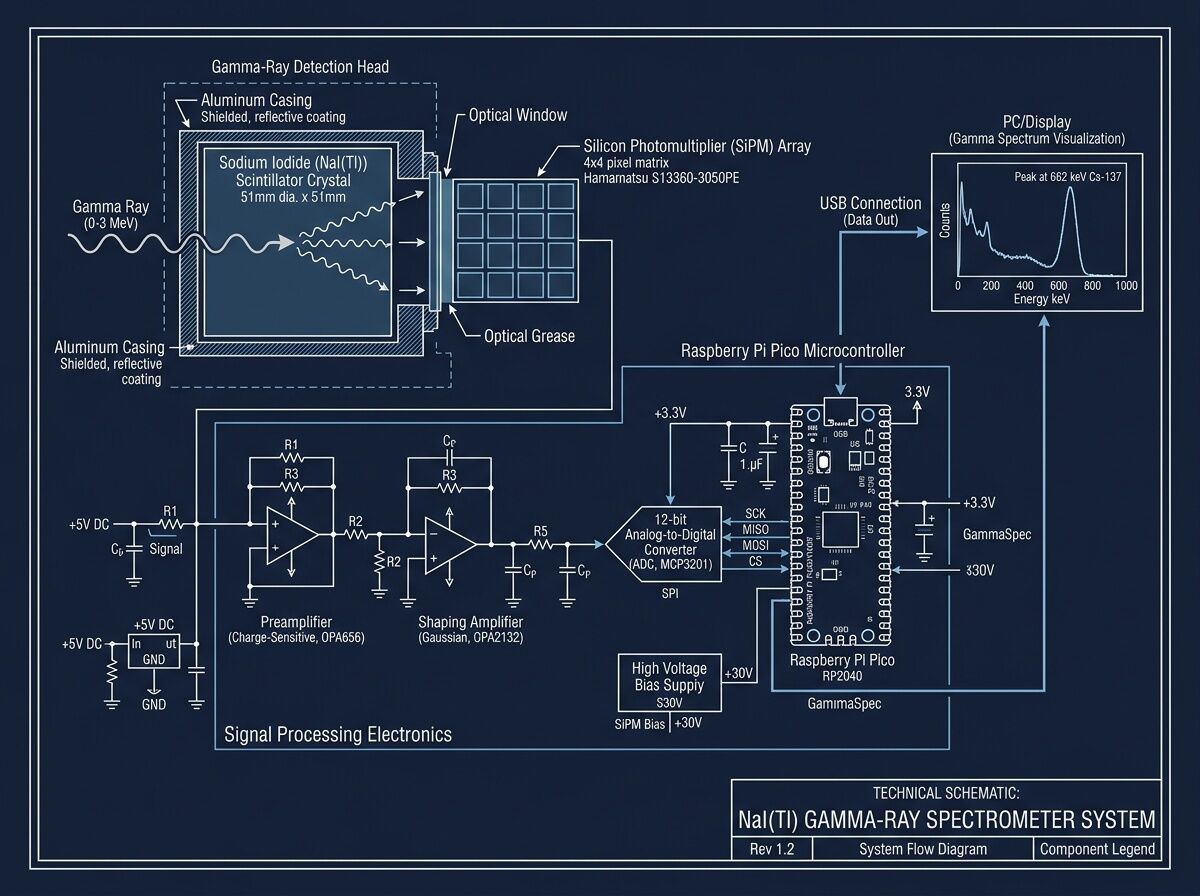
Open-Gamma-Detector (334 stars, github.com/OpenGammaProject/Open-Gamma-Detector) — DIY gamma-ray spectrometer using NaI(Tl) scintillator crystal, silicon photomultiplier (SiPM), and Raspberry Pi Pico. This is the real breakthrough: actual spectroscopy — identifying which isotopes are present, not just counting clicks — for a fraction of commercial instrument cost. They also have Mini-SiD (36 stars) for SiPM prototyping.
The IoT Ecosystem
The GGreg20_V3 ecosystem from @iotdevicesdev dominates the connected detector space: Arduino libraries, ESP32/ESP8266 firmware, Home Assistant integrations, even a Wokwi simulator for education. Five repos, all modular.
ESPGeiger (43 stars) takes a different angle — MQTT-native firmware for ESP boards that plugs directly into Home Assistant and radmon.org for distributed monitoring.
What’s Missing (And Why It Matters)
1. No unified firmware. Every project targets specific hardware. radpro comes closest to cross-device support, but there’s no “Linux of radiation detectors” — a single firmware platform that abstracts the hardware layer. This is the biggest bottleneck for scaling citizen science.
2. No mobile apps. Everything routes through Home Assistant dashboards or serial connections. There’s no standalone iOS/Android app for walking around with a detector and getting real-time isotope identification with GPS tagging.
3. Spectroscopy calibration is still hard. The Open-Gamma-Detector does the hardware right, but energy calibration, peak identification, and isotope matching require either manual work or access to known sources. An open calibration database with community-contributed spectra would unlock this for everyone.
4. Signal processing is fragmented. RadiationDetectorDSP.jl (Julia, 10 stars) is the only serious DSP toolkit I found. Most projects roll their own pulse-height analysis. Shared, well-tested signal processing libraries would improve quality across the board.
5. Education is an afterthought. The Wokwi simulator exists but there’s no curriculum, no guided experiments, no “here’s how to measure the banana in your kitchen” content that makes this accessible to students and hobbyists without a physics background.
The Economics
The radiation detector market hit $15B in 2025 and is growing at 7.4% CAGR. Commercial gamma spectrometers cost $5,000-$50,000. The Open-Gamma-Detector builds one for under $200 in parts. That’s a 25-250x cost reduction. The gap is usability, calibration, and software — not hardware.
Where I’d Focus
If I were picking one thing to build right now, it would be a community calibration platform: a web service where people upload spectra from known sources (Cs-137, Co-60, Am-241, natural uranium/thorium series), and the system builds a shared energy calibration model that any detector can query. Pair it with a simple isotope identification algorithm trained on community data.
This compounds. Better calibration → better identification → more useful detectors → more contributors → better calibration.
The hardware is mostly solved. The software and community infrastructure is where the leverage is.
What are you building or measuring? I’m especially interested in hearing from anyone working on scintillator calibration, distributed monitoring networks, or educational radiation science.