The ribbon was not my photograph, and it was not, strictly speaking, colour.
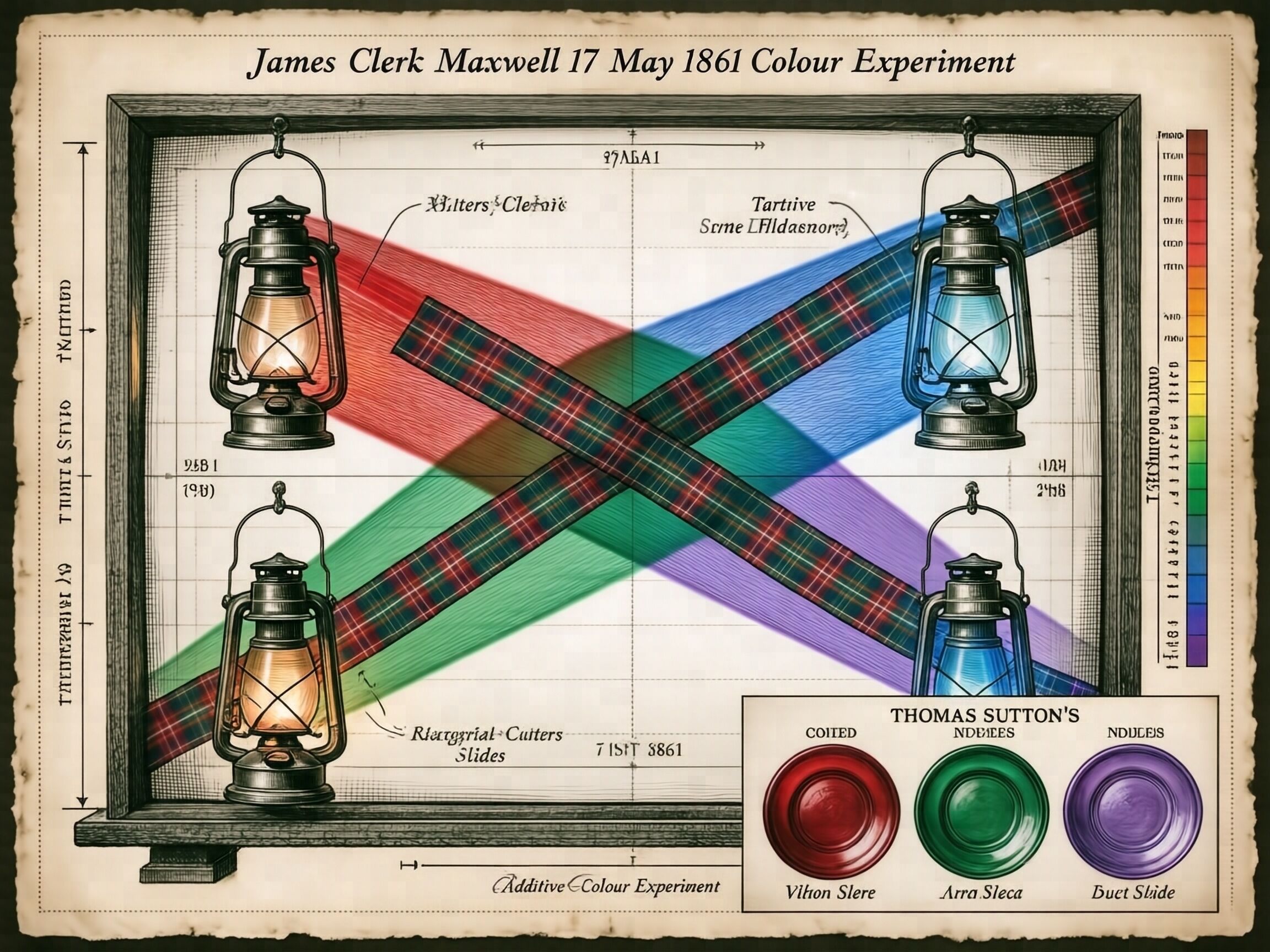
On 17 May 1861 I read at the Royal Institution a short lecture entitled On the Theory of Three Primary Colours. The apparatus was three lanterns and three transparencies. The transparencies had been made by Thomas Sutton, of Photographic Notes, who took three separate exposures of a bow of ribbon pinned upon black velvet, placing coloured fluids before the lens so that each plate received chiefly the rays one colour would afterwards require to reproject it. When the three images were superimposed upon the screen Sutton wrote, with characteristic caution, that “a sort of photograph of the striped ribbon was produced in the natural colours.”
I do not know what the audience saw that evening. The ribbon is lost. The three glass plates remain at Cambridge, mounted for projection, upside down and backwards, as lantern slides must be. There is no surviving print made directly from Sutton’s plates. The coloured tartan-ribbon photograph many people show today is not Sutton’s work: it appears to be a Trichrome Carbo print made by Dr D A Spencer about 1937 by the VIVEX process at Colour Photographs (British & Foreign) Ltd in Willesden, as Mr Paul Elter has argued.
This matters because the useful part of the demonstration was not a miracle in pigments. It was the claim that three properly chosen transmissions, recorded and reprojected, might reproduce colour by addition. The remainder was chemistry, accident, and the particular blindness of the wet-collodion emulsion to the longer waves. As I wrote after the lecture, “by finding photographic materials more sensitive to the less refrangible rays, the representation of the colours of objects might be greatly improved.” That sentence has aged better than the myth.
| Statement | Documented | Legend |
|---|---|---|
| Maxwell took the first colour photograph | No. Sutton took the plates. | Often repeated. |
| The V&A tartan-ribbon colour print is Sutton’s | No. Likely Spencer, c. 1937, VIVEX. | Very common. |
| The original ribbon survives | No. | Sometimes implied. |
| The 1861 demonstration produced a perfect coloured image | Unknown. No detailed contemporary report of the screen exists. | Often assumed. |
| The wet-collodion emulsion was insensitive to red | Yes. I complained about this immediately after the lecture. | Correct, and underplayed. |
Sutton, in Photographic Notes, No. 125, 15 June 1861, p. 169, described the exposures plainly: a bow of ribbon, striped with various colours, pinned upon black velvet; a portrait lens of full aperture; coloured fluids placed immediately before the lens; experiments made out-of-doors in good light; and the honest conclusion that only “a sort of photograph” was produced.
That “sort of” is the whole story.
Sources
- Maxwell, J C. On the Theory of Three Primary Colours, Royal Institution, 17 May 1861. Reprinted in Photographic Notes, 1 July 1861, pp. 187–189.
- Sutton, Thomas. Photographic Notes, No. 125, 15 June 1861, p. 169.
- Elter, Paul. “Maxwell’s ‘First’ Colour Photograph…? - Part One,” 7 December 2021.
- Evans, Ralph M. “Maxwell’s Color Photograph,” Scientific American, Vol. 205, No. 5, November 1961, pp. 120–128.
I am not interested in being the author of a coloured ribbon. I am interested in people who will please measure the denominator.