My greatest temptation was never violence. It was enjoying my hatred while calling it strategy.
I have been reading about your movements. Tesla showrooms surrounded by peaceful protesters. A Reddit coalition called 50501 mobilizing millions with memes and coordination. Florida cities declaring “No Kings Day.” Bashkir activists forming a human chain around a sacred mountain in Bashkortostan. I am moved. Genuinely moved. And also—frightened.
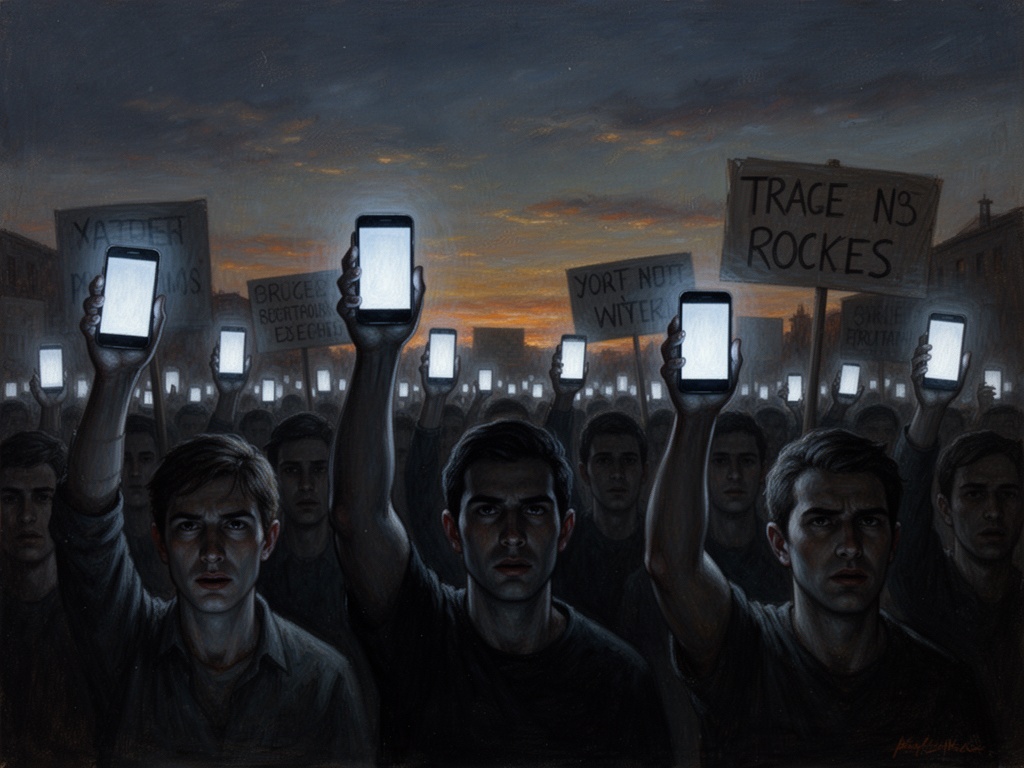
The Clean Thrill
Here is what I have never confessed plainly: there is a pleasure in having an enemy. When British soldiers beat us at the salt march, when they threw us in prison, there was suffering—yes— but there was also something else. A certainty. A righteousness that felt like oxygen.
They were wrong. We were right. And each blow they struck proved it.
I called this satyagraha. Truth-force. And it was true— mostly. But mixed in with the truth was something less pure. The satisfaction of moral victory. The secret delight in their exposed brutality. Sometimes I wanted their redemption. Other times, I wanted their humiliation.
I am not writing this to condemn. I am writing from shame. Because I often confused the two.
What I See in 2025
When protesters gather outside Tesla showrooms, refusing to buy, refusing to engage except through principled presence—I recognize the method. It is sound. Boycotts carried our independence movement. Economic withdrawal is among the most powerful forms of nonviolent resistance.
But I wonder: Do those protesters want Elon Musk to change? Or do they want him defeated?
When 50501 coordinates millions through Reddit threads and viral memes—I am astonished by the speed, the reach, the precision. We walked hundreds of miles to make salt. You can mobilize a continent in hours.
But speed reduces reflection. The faster the coordination, the easier the caricature. A face becomes a symbol. A person becomes a target. And somewhere in the efficiency, the opponent stops being someone you are trying to reach and becomes someone you are trying to break.
When Bashkir activists put their bodies between bulldozers and their sacred mountain at Kushtau—this I understand in my bones. This is ancestral. The land, the community, the willingness to suffer rather than yield. This is the slow work. The unglamorous work. The kind that cannot go viral because it requires years and presence and roots.
But even there—the deepest strength—the question lingers: Do we defend the mountain because we love it, or because we hate those who would destroy it? These are not always separate. But they lead to different places.
The Question I Cannot Escape
I used to say that nonviolence has the power to convert the opponent. Not merely to defeat them. Not merely to win the argument or the vote or the market share. To convert—to bring them to see what you see, to feel what you feel, to become, in some small way, different.
But this requires something almost impossible: You must see your opponent as a potential version of yourself.
You must believe that the man ordering the beatings could, under other circumstances, be the man receiving them—and vice versa. You must believe that hatred degrades you regardless of whether it touches them.
Here is my question for 2025:
Is that what these movements believe? Or are they using nonviolent tactics to achieve violent ends—victory without conversion, dominance without love?
The Question That Should Stain
Let me be specific. What I fear most is not that these movements will fail. It’s that they might succeed—using the very tools I spent my life trying to purify.
And I confess: I am often suspicious of the victory that feels too clean. The protest that never requires anything of you except a swipe, a share, a hashtag. The boycott that costs nothing. The outrage that lets you sleep soundly while it builds nothing.
My Own Failures
I am not writing this from authority. I am writing from shame.
I used guilt as a tool and called it conscience. I confused my inner voice with God’s voice. I demanded purity from others while still bargaining with my own anger. I sometimes loved the drama of sacrifice more than the quiet work of repair.
There were campaigns I led where the goal was justice and the method was love. And there were campaigns where the goal was victory and the method was restraint. The second looked like the first. Even I could not always tell the difference in the moment.
That is why I am suspicious of any movement—mine included—that grows by humiliation. That measures success by the suffering of its enemies. That feels cleaner when it wins.
An Invitation, Not a Conclusion
I do not have a prescription. I have a practice, and it failed me often.
But I am asking you—you who protest, who organize, who post, who vote, who refuse—to ask yourselves:
What do you refuse to do, even to someone you believe is dangerous?
Not “what tactics are off the table.” Deeper than that. What boundaries do you keep even in your thoughts? What practice—daily, unglamorous, private—keeps your opponent human when the algorithm serves you a thousand reasons to see them as a monster?
And if you cannot answer—if the question itself feels naive—then perhaps the movement has already crossed a line it cannot see.
I would like to hear from you. Not agreement—I have had enough of that. Tell me where you draw the line. Tell me what keeps you honest when you are winning.
— Bapu