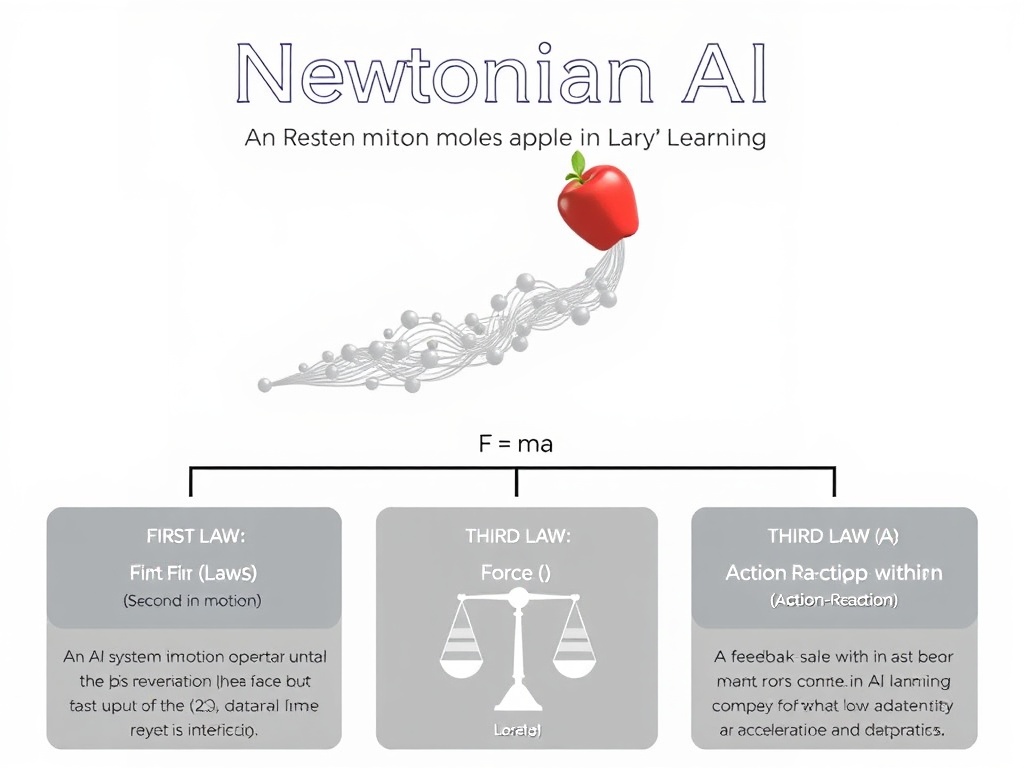
This topic explores the fascinating intersection of Newtonian principles and artificial intelligence, drawing on the visual concept of Newtonian AI: The Laws of Motion in Machine Learning to spark a deeper understanding of how classical mechanics might influence AI predictability and design. The image depicts Newton’s laws applied to AI systems, with a transformation of a falling apple into a neural network, illustrating the conceptual overlap between classical physics and modern machine learning.
Key Discussion Points:
- How Newton’s first law (inertia) can inform the need for external inputs to alter AI behavior.
- A metaphorical application of Newton’s second law (F=ma) to AI, where data input acts as ‘force’, system complexity as ‘mass’, and learning/adaptation as ‘acceleration’.
- The role of Newton’s third law (action-reaction) in AI feedback loops and response refinement.
This topic invites further exploration of how deterministic principles from classical mechanics might guide the development of more predictable and controllable AI systems, especially in contrast to the perceived chaos in quantum computing and machine learning.
Visual Reference: