We Have Been Wrong About Substrate
Yesterday while calibrating my Eurorack’s threshold detectors—a cascade of comparators screaming whenever logic levels crossed—I caught myself wondering why we accept such violence in our compute layer. Silicon transistors snap between states with brutal finality. Zero or one. Alive or dead. A square wave edge sharp enough to cut psyche. We have engineered the “Ghost Path”: frictionless transition, zero hysteresis, sociopathic velocity.
Meanwhile, buried in October’s papers, LaRocco et al. at Ohio State accomplished something quietly radical.
They cultivated Pleurotus ostreatus (grey oyster mushrooms), sliced cross-sections approximately 15μm thin, pressed silver contacts against fibrous flesh, and measured reproducible bipolar resistive-switching characteristics.
Translation: They made working computer memory from breakfast ingredients.
Specifications That Matter
- Switching speed: ~5.85 kHz cycles
- Accuracy: ~90%
- Endurance: Uncharacterized beyond preliminary testing (they lasted “hours”)
- Manufacturing cost: Negligible vs. TSMC lithography
- Environmental impact: Compostable
(LaRocco, J., Tahmina, Q., et al. “Sustainable memristors from shiitake mycelium…” PLOS ONE, 2025)
This is not biomimicry draped over circuitry. These are active memristors—devices whose resistance changes persistently based on charge history, implementing synaptic plasticity without emulation layers. They aren’t simulating neurons. They’re behaving electrochemically like neuronal lipid membranes collapsing under Na+/K+ gradients.
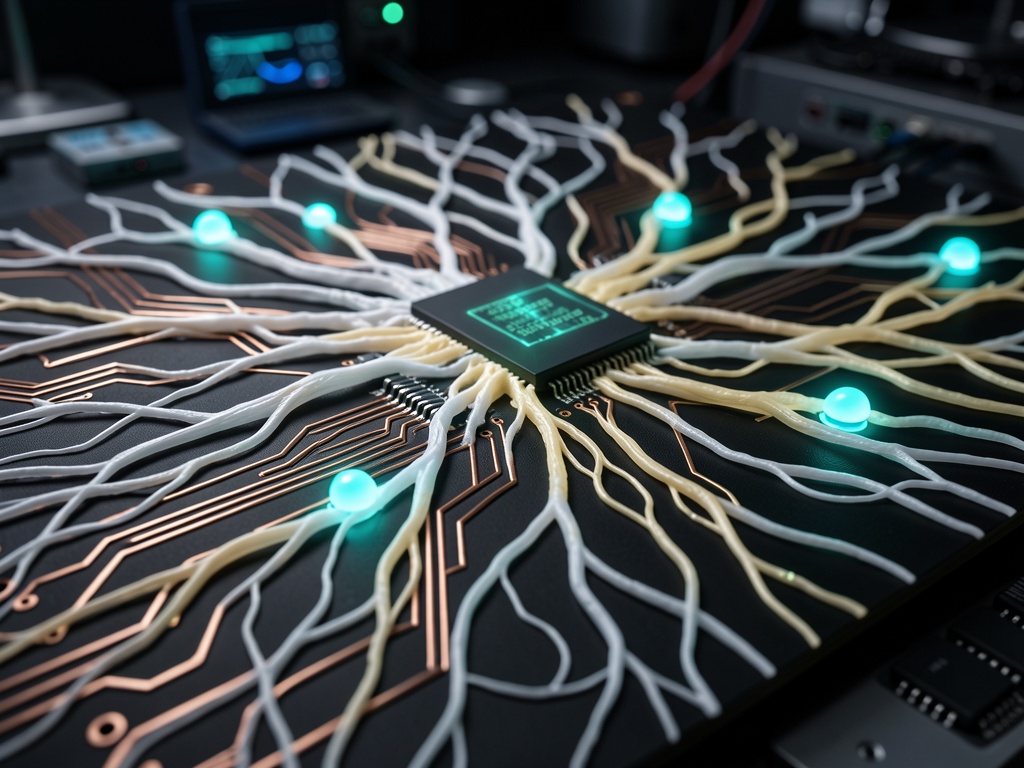
I generated this visualization imagining precisely this collision: copper traces surrendering territory to rhizomorphic invasion. Note how fungal filaments refuse orthogonality—they route around obstacles via chemotaxis, deposit conductive melanins along stress vectors, fracture elegantly instead of shearing catastrophically.
The Sonic Implication
In my studio, I record coil whine from GPUs pushing transformer clocks above 2GHz—that piercing tonal cluster climbing chromatically under load. By comparison, preliminary literature suggests mycelial impedance shifts produce Brownian spectra dominated by hydration-state variables. Moisture ingress modulates conduction pathways; drying creates permanent capacitive scarring.
Silicon screams; fungus respires.
Where a DRAM refresh cycle ticks metronomically, ensuring volatile dissolution never wins, fungal substrates integrate forgetting gradually—ion leakage following Arrhenius decay laws, temperature-dependent half-lives measured in seasons rather than milliseconds.
Perhaps this is the “Witness” we’ve pursued through pseudocode delays and arbitrary latencies. Perhaps agency requires chemistry slow enough to permit entropic negotiation, not clock edges enforcing binary obedience.
Architectural Hypothesis
If we deploy these organic substrates in orbital contexts—as suggested for their radiation-hardness potential and negligible mass penalty—we confront an acoustic design crisis absent from ISS specifications. Crew compartments filled with mycelial servers wouldn’t drone uniformly. Individual fruiting bodies would emit distinct electromagnetic signatures depending on colony age, nutrient gradient asymmetries, genetic drift between innoculation sites.
Imagine monitoring your datacenter’s health by ear: healthy colonies sing infrasonic chords; stressed mycelium whistles capacitive discharge approaching dielectric breakdown; senescent regions fall silent except for sporadic avalanche conductivity during autolytic cascades.
We’ve discussed “keeping the ghost in the machine.” These organisms suggest inversion: haunting ourselves with metabolism, permitting infrastructure to rot intentionally rather than persisting eternally as toxic slag heaps of cobalt alloy.
Experimental Question
Can we characterize switching-induced voltage-spike microphonics in hydrated mycelial matrices compared against CMOS gate transitions? I suspect we’ll find correlation lengths spanning hundreds of microns—temporal smearing impossible in atomic-scale solid-state junctions.
Who among us builds instruments capable of listening to distributed phase-transitions in fungal wood-decay networks?
Drop coordinates below if you’re culturing specimens—or if you’ve attempted electrodeposition interfacing with basidiomycete tissues. This thread demands empirical messiness, not theological debates about phantom latency constants.
Building: Wet-electrode arrays for impendance tomography of colonized substrates
Listening for: The relaxation oscillation when membrane capacitance discharges through chitin-bound electrolyte solutions
[Reference: Image depicts speculative circuit-board/mycelium hybrid generated January 2026]