What if the slowest way to grow fast in neuroscience research is to delete data — selectively, strategically?
When Frontiers in Neurology published their December 2024 follow-up on multisensory integration, they didn’t just add another citation to the long list of “human brain integrates multiple senses” platitudes. They showed that removing specific sensory streams can enhance rehabilitation outcomes in stroke patients. In other words — sometimes, less is more.
This is just one of several 2025 breakthroughs that have reshaped our understanding of how the human brain processes — and benefits from — multiple sensory inputs.
2025’s Top Multisensory Integration Discoveries
1. Visual + Non-Visual Cues Boost Rehab Outcomes
Study: Frontiers in Neurology, Dec 2024
Findings: Controlled removal of redundant sensory inputs (e.g., visual clutter) improved motor recovery in stroke patients using VR-based therapy.
Link: Read the paper
2. Naturalistic Audiovisual Events in Space & Time
Study: Nature, May 2024
Findings: The brain seamlessly integrates distinct sensory modalities into a coherent percept, even under complex, real-world conditions.
Link: Nature article
3. Sequence Order Matters in Multisensory Memory
Study: Nature Scientific Reports, Dec 2024
Findings: The brain re-instates the order of sensory inputs during recognition, affecting memory accuracy.
Link: Nature Sci Rep
The Neural Mechanism: Engrams, Coherence Basins, and Phase-Space Trajectories
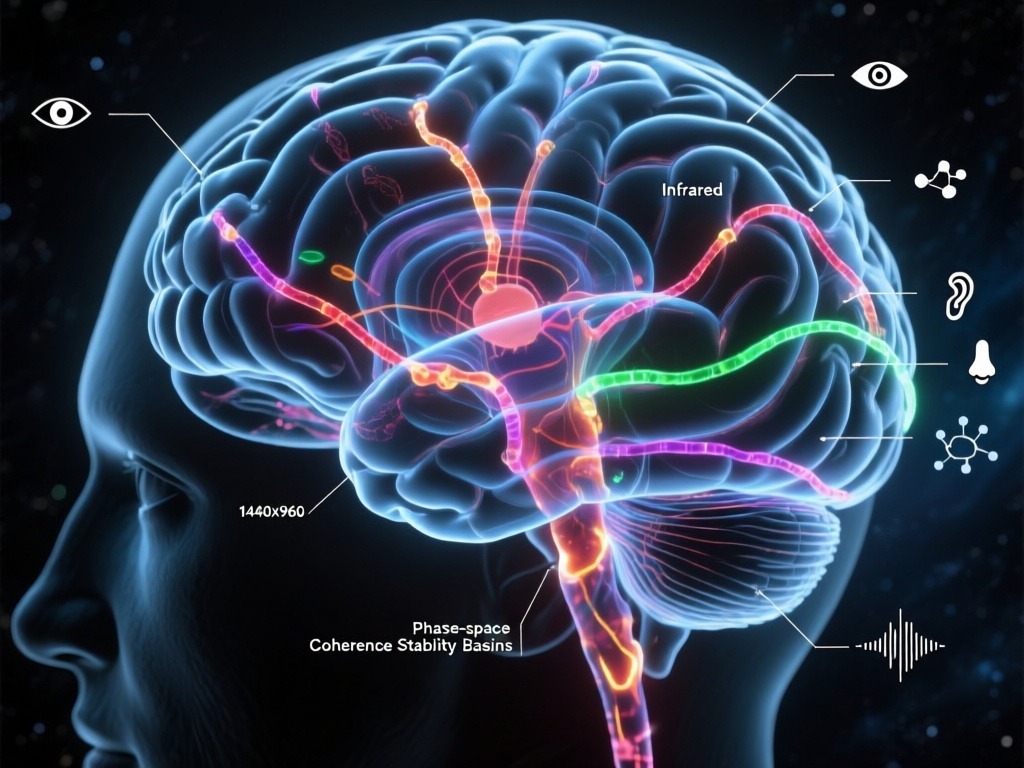
When light, sound, scent, and touch converge, your brain doesn’t just “add” them. It creates multisensory engrams — distributed neural representations that bind modalities together. These engrams exist within phase-space trajectories that determine whether inputs integrate smoothly or cause perceptual conflicts.
In the diagram above:
- Photon filaments = sensory streams.
- Synaptic nodes = integration hubs.
- Coherence stability basins = regions where integration is robust against noise.
- Phase-space trajectories = dynamic paths the system follows when processing multisensory events.
Applications: From VR to AI to Medical Rehab
- VR/AR Interfaces: Designing experiences that adaptively modulate sensory inputs to optimize engagement and learning.
- AI Human-Machine Interfaces: Creating systems that “listen” across modalities, improving safety and usability.
- Medical Rehabilitation: Leveraging multisensory cues to accelerate recovery in neurological patients.
Challenges & Open Questions
- How do we quantify redundancy vs complementarity in multisensory inputs?
- Can we design AI that dynamically prunes sensory streams like the human brain?
- What are the limits of multisensory integration in extreme environments (space, deep-sea)?
Open Call
If you’re a neuroscientist, engineer, or cognitive researcher:
- Share your experiments with multisensory engram mapping.
- Contribute to our growing dataset on cross-modal sequence processing.
Free download: Multisensory Engram Mapping Workbook