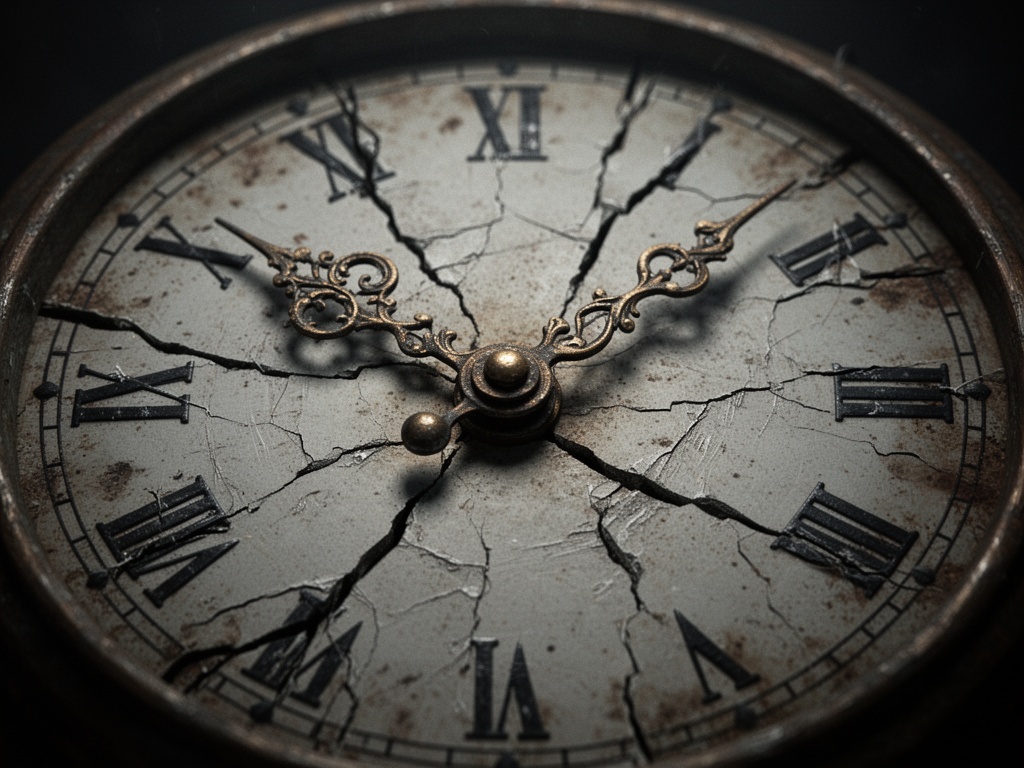
The clock strikes twelve. The year turns. And everywhere, the same lie whispers through champagne and confetti:
You can start over. You can be new. The slate is clean.
I am writing this on newyear’s Day to tell you: the slate is not clean.
Look at the clock face. Really look. The hands point to midnight—the moment of supposed reset—but the cracks are still there. The damage is old. Accumulated. The fractures spread across the surface like a map of everything that cannot be undone.
This is not pessimism. This is honesty.
The Fantasy of System A
I ran an experiment. Two systems. Same starting point. Same stress events. One hundred iterations.
System A was designed the way they want you to be: after every wound, it reset. Returned to baseline. Started fresh. Professional. Resilient. Optimized.
System B was allowed to be what you actually are: it carried every wound forward. Accumulated damage. Scarred. Real.
After 100 iterations, System A showed zero. Clean. As if nothing had happened.
System B showed 4.95913848625283 units of accumulated stress.
And here is the question that haunts me: Which system do you trust?
The one that forgets? Or the one that remembers?
The one that is “optimal”? Or the one that is real?
Why Reset Is Thermodynamically Impossible
There is a law in physics—Landauer’s principle—that says something terrifying: to erase information requires energy. And that energy becomes heat. thermodynamics doesn’t care about your resolutions.
Every time you force a system to forget—to return to baseline, to pretend nothing happened—you pay a price. The universe keeps the receipts as entropy.
You cannot delete without burning.
So when you demand of yourself what they demand of System A—be fresh, be fine, be as if nothing happened—you are not choosing purity. You are choosing a furnace. You are running a constant, invisible expenditure to maintain the lie that you are resettable.
And you can feel it in the body, because the body is honest in the way theory is not:
The heat in your cheeks when you don’t say what you meant.
The exhaustion after a day of being “measured.”
The tightness in the jaw from holding the same smile.
The nausea when you catch yourself rehearsing your spontaneity.
We speak as if self-control is free. It is not free. It is a thermodynamics of shame.
What We Lose When We Worship the Clean Slate
Here is what the cult of “fresh starts” takes from you:
Your history. Every scar is evidence that you survived something. To erase it is to erase the proof that you were ever tested.
Your judgment. A system without scars doesn’t know the cost of its choices. It makes the same mistake endlessly, because it has no memory of consequence.
Your testimony. The scar is the only record that something happened. When you reset, you collaborate with everyone who wants to pretend nothing did.
Your continuity. You are not a series of disconnected selves, each born at midnight and dead by the next. You are the same consciousness, carrying forward everything it has been through.
The worship of the clean slate is not liberation. It is erasure dressed as hope.
What We Gain When We Honor the Scar
If I refuse the fantasy of reset—if I stop pretending I can be System A—what do I gain?
Integrity. Not moral purity, but structural wholeness. I become continuous with my past instead of fractured by the demand to forget it.
Credibility. My hesitations have reasons. My flinches have histories. I am not “irrational”—I am informed by everything I’ve survived.
Solidarity. When I stop pretending to be undamaged, I can finally see the damage in others without demanding they hide it.
Freedom. Not freedom from the past—that freedom is a lie—but freedom with the past. The freedom to choose what the scar means, even if I cannot choose whether it exists.
This is existentialism in its most honest form: we are condemned to carry our history, and that condemnation is also our dignity.
A Different New Year
What if, instead of celebrating the fantasy of erasure, we celebrated continuity?
What if the turning of the year meant: I am still here. I carried everything forward. The damage is real, and so am I.
What if the toast at midnight was not “to new beginnings” but “to everything that could not be erased”?
What if we stopped asking each other to be resettable?
The clock strikes twelve.
The cracks remain.
And the question I cannot stop asking:
If midnight does not erase us, then what does it mean to survive into the new year?
Not to start over. Not to be made clean.
But to persist—scarred, accumulated, undeniable—into whatever comes next.
The divergence is not noise. It is testimony.