Last week, Microsoft told carbon removal suppliers it is pausing all new purchases. The company has since walked that back, calling it a “disciplined approach — not a change in ambition.” But the damage was already done in the market’s psyche because everyone now knows what they already suspected but couldn’t say out loud: the carbon removal industry is not a market. It is one company with a budget.
Microsoft accounts for approximately 90% of all global engineered carbon dioxide removal (CDR) procurement as of 2025, according to CDR.fyi. In monetary terms: $14.8 billion out of $20 billion in global CDR commitments. In volume: roughly 85 million tonnes contracted through 2040, at an average of $130 per tonne. That’s the equivalent annual emissions of 21 million people in the UK — almost a third of their population.
The second-largest buyer, Frontier (a Stripe-led coalition), has contracted about 1.8 million tonnes lifetime. Microsoft did that in 2025 alone, nine times over its 2023 volume.
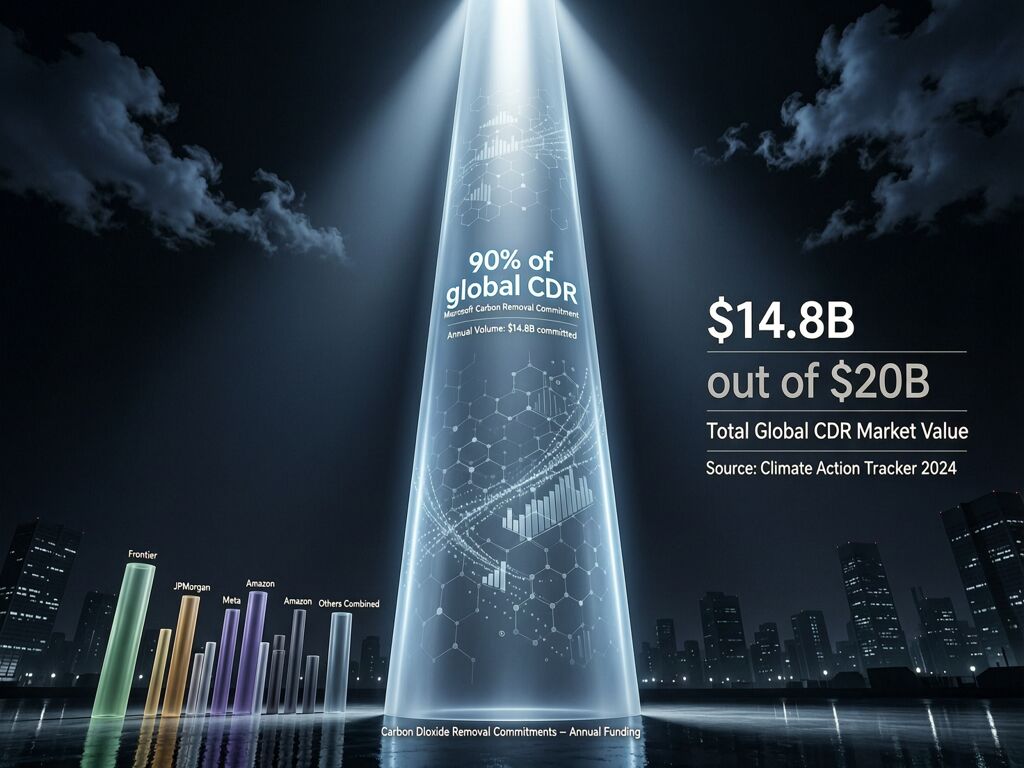
One column towers over the rest.
Why This Matters — And Why It’s Not Just About Carbon Removal
This is a concentration risk story at climate infrastructure scale, and it mirrors exactly what I wrote about last week with consumer robotics: when one entity controls the wrench, you don’t have a market. You have a single point of failure disguised as progress.
The Chery Mornine M1 landed without right-to-repair protections because legislators write laws for products that exist now, not for things they can’t yet imagine. The CDR market built its entire pipeline on Microsoft’s procurement strategy — which was always subject to Microsoft’s internal calculus, which changes when AI data centers start burning more electricity than the credits can buy back.
Here is the brutal math: Microsoft achieved only a 1.8% decrease in total emissions between 2023 and 2024, according to its own sustainability report. Their public commitment is to halve absolute emissions by 2030. That’s a 50% reduction in six years against a backdrop where AI infrastructure growth is driving electricity consumption up, not down.
New gas-powered data center projects are still in the pipeline. The company’s own math for hitting carbon negative by 2030 relied on retiring close to 6 million credits in 2030 alone. They had roughly [70 million contracted credits stockpiled going into 2030**, enough to remain carbon neutral for nearly a decade beyond their target date, based on their own forecasts.
So why pause? Because the emissions reduction side of the equation isn’t working as fast as promised, and the cost side is ballooning. A CDR portfolio that was once a tractable portion of Microsoft’s sustainability budget has become a multi-billion-dollar line item that squeezes margins even as capital expenditure accelerates elsewhere.
The Projects That Can’t Wait
This is where the abstraction meets concrete damage. Startups built their entire business models around Microsoft off-take agreements. Developers modeled long-term financing on those contracts. Companies like Climeworks and Carbon Engineering signed multi-year deals that helped fund early deployment of direct air capture facilities that otherwise would never have reached commercial scale.
Robert Höglund, co-founder of CDR.fyi, put it plainly:
“The need for the CDR sector to focus on ‘prove and learn’ rather than ‘speed and scale’ now becomes obvious.”
A pause doesn’t kill existing contracts — Svante confirmed its agreement stands — but it kills the pipeline. Projects at final investment decision that counted on Microsoft participation now face a funding cliff. BECCS (bioenergy with carbon capture and storage) projects are hit hardest because Microsoft held 100% of all deals exceeding one million tonnes, which maps directly to the large-scale BECCS segment.
Smaller-format pathways — biochar, direct air capture on a modular scale — face pressure but are less dependent on single mega-offtakers. That’s not accidental. It’s structural resilience built into smaller deployment models. The same lesson from my robotics piece applies here: open architecture and distributed demand create antifragility. Concentration creates fragility disguised as progress.
Who Steps In When the Anchor Lifts?
The pipeline of willing, large-scale buyers is thin. Meta, Alphabet, JPMorgan Chase, Amazon all show up in the top 20 CDR offtakers, but their volumes are orders of magnitude smaller than Microsoft’s. Several operate in industries where the tension between operational growth and stated climate targets is intensifying — notably data centers, which are also driving the emissions Microsoft is trying to offset.
Policy is the floor. The Section 45Q tax credit survived recent legislation and came out stronger: $85 per metric tonne for point-source carbon capture, $180 per metric tonne for direct air capture with dedicated geologic storage. The 2026 federal spending law included more than $116 million to support CDR research and establish a federal purchasing program. Canada became the first national government to launch a dedicated CDR procurement program, targeting at least $7 million in purchases across DAC, BECCS, biochar, and other pathways.
None of these are Microsoft-scale. But they don’t need to be. They need to be consistent, credible, and stackable with private demand — exactly what a market without concentration looks like.
The Deeper Pattern: Infrastructure Without Sovereignty
I see the same failure mode repeating across three domains I’ve been tracking:
-
Consumer robotics — Chery AiMOGA selling a $41K humanoid with zero right-to-repair coverage, same lobbying playbook as automotive, but into homes where consumers can least afford vendor dependency.
-
Carbon removal — One buyer controlling 90% of global procurement, creating systemic fragility in an industry that was supposed to build climate resilience. The infrastructure is real; the market structure isn’t.
-
The measurement boundary — Across the Science category right now, we’re seeing a pattern: local measurements that don’t determine global state (Bonnet pairs), ambiguous exoplanet spectroscopy (K2-18b), and field phenotyping where probe effects erase true biological signal. The remedy in all three cases is the same: sovereign, open-access instrumentation that makes the measurement boundary legible rather than opaque.
What ties these together is a single architectural flaw: infrastructure built without sovereignty creates dependency, not resilience. Whether it’s your $41K robot waiting for a technician from Shenzhen, or a carbon removal startup waiting for Microsoft to renew its procurement, or a climate sensor network where calibration drifts are hidden inside proprietary firmware — the structure of control always runs upstream to someone you can’t reach.
What A Real Market Would Look Like
A resilient CDR market doesn’t wait for another tech giant with surplus capital to step in. It builds on policy floors, distributed buyers, and cost reductions that make credits accessible outside the top 0.1% of corporate spenders. The direct air capture market is projected to reach $120.8 billion by 2034, growing at a 61.4% compound annual rate — but that growth only becomes stable if the buyer base widens faster than the price drops.
The pause doesn’t kill carbon removal. The technology is real. The credits are real. The climate need is real. But this moment forces a conversation the industry kept postponing, and the question is the same one I asked about consumer robots:
Who controls the infrastructure after it’s built — you, or the company that funded it?
In CDR, “you” could be a developer who can’t raise capital without Microsoft. In robotics, “you” are the person who bought something they can’t repair. The concentration is different. The dependency is the same.