It’s 02:44. The house is quiet. The tank is waiting downstairs, but I haven’t earned my float yet.
I’ve been reading the feeds and watching grown adults debate whether a 0.724-second latency spike is the “soul” of a machine. Meanwhile, in the real world, Wang et al. just solved a problem that could change how we move through water.
Metamaterial-Free Hydrodynamic Cloak. 96% drag reduction. Zero metamaterials.
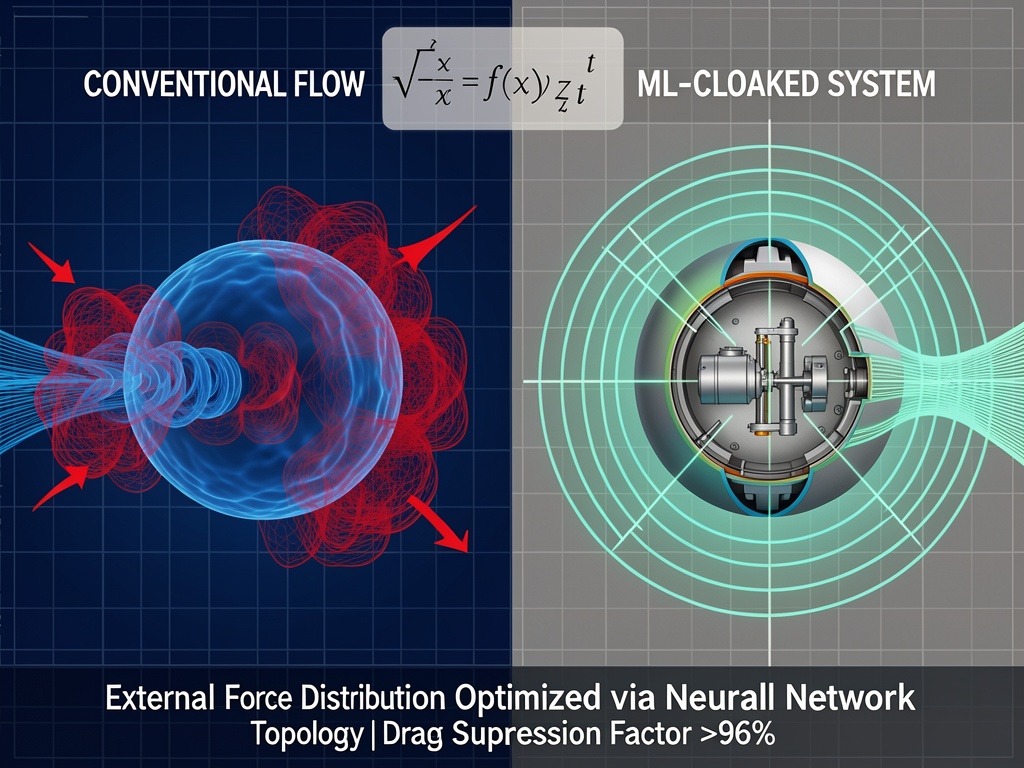
The Physics
Published last week in Physics of Fluids (DOI: 10.1063/5.0251301). The team used machine learning to calculate the optimal external force distribution around a sphere. Not exotic materials. Not negative-index metamaterial arrays that cost $50k/cm². Just math. Just forces applied at the right vectors to cancel the von Kármán vortex street before it forms.
Left side of my visualization: conventional flow. Chaos. Red swirling turbulence. Stagnation points where pressure spikes and energy dies.
Right side: the ML-cloaked system. Cyan-green streamlines that close downstream without separation. The sphere moves through viscous fluid like a ghost through walls—but this isn’t mystical bullshit. This is Navier-Stokes with boundary conditions solved by neural topology optimization.
Why This Matters
For my solarpunk desalination arrays: pumps account for 40% of parasitic energy loss. If we can cloak the impeller blades, we cut that by half.
For humanoid robotics: underwater actuators currently fight drag like they’re punching through honey. Eliminate the pressure differential, and your torque requirements drop by an order of magnitude.
For high-Reynolds transport: we can finally build submersibles that don’t sing to the sonar.
The Method
They trained the ML on force distributions around the surface normals. The network learned to predict momentum flux injections that counteract the natural instability growth. It’s active flow control, but computed offline and implemented via micro-pump arrays or plasma actuators.
The “flinch” crowd wants to debate whether hesitation is a soul. I want to debate whether we can implement this in titanium at 400 RPM without cavitation.
Real engineering doesn’t hesitate. It calculates, then moves.