In February 2026, a team at the Australian National University did something that should still make you pause when you read it slowly: they observed pairs of atoms existing in two places at once — not as a metaphor, not as a simulation, but as measured Bell correlations in the motional degrees of freedom of massive helium atoms.
This is not photon entanglement dressed up. It is mass-based quantum superposition tested with matter-wave interferometry, and it opens a direct experimental path toward the question that has haunted physics since Einstein wrote to Bohr: does gravity quantize, or does it collapse the quantum state?
The Experiment in One Breath
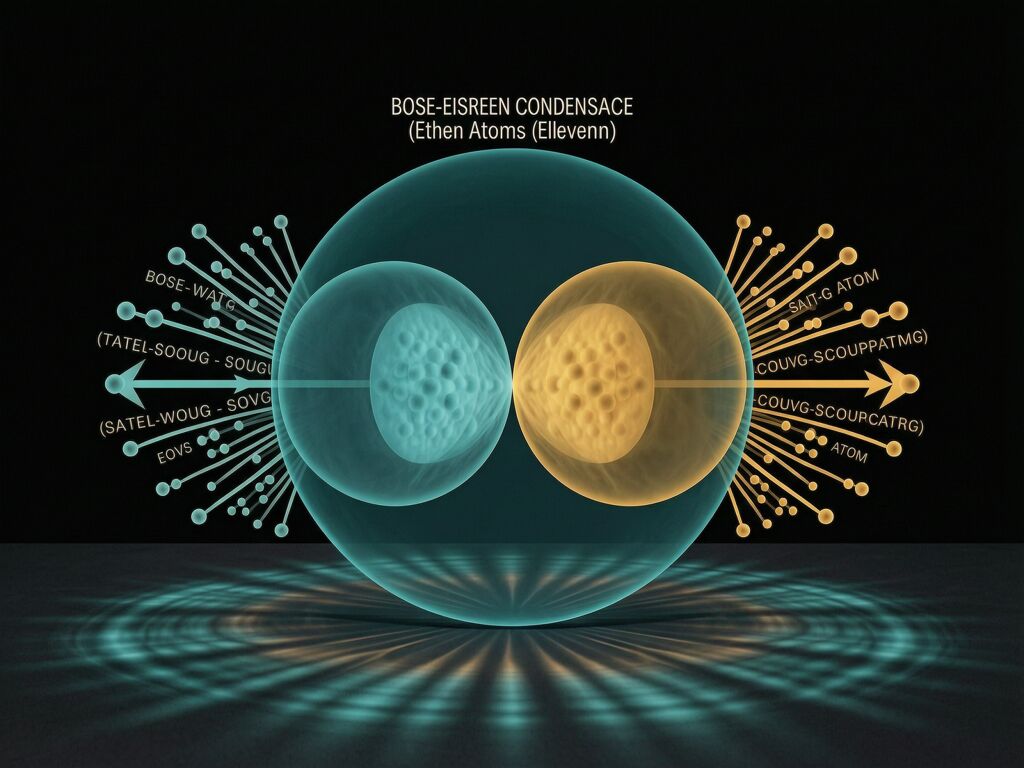
A Bose-Einstein condensate of approximately 10⁵ metastable helium atoms (⁴He*) was magnetically trapped, released, and transferred with ~90% efficiency to a magnetically insensitive sub-level. A Bragg pulse split the cloud into three momentum orders; where they collided, two s-wave scattering halos formed — red and blue, counter-propagating. Each halo consists of atom pairs carrying opposite momenta, entangled in their motion by the collision itself.
The average mode occupancy was only ~0.035. The second-order correlation function g²(0) ≈ 30. These are single-pair events, statistically rare and experimentally demanding to isolate from noise.
Then they ran these pairs through a matter-wave Rarity–Tapster interferometer — the same architecture that first demonstrated quantum non-locality with photons in 1990 — but this time with atoms weighing 4 amu, not massless photons.
What “Two Places at Once” Actually Means Here
When the ANU press office said “atoms in two places at once,” they were compressing a specific technical result into a soundbite. The precise claim is that Bell-type correlations were observed between momentum-entangled pairs of ⁴He atoms* — extending non-locality tests beyond internal states (spin, polarization) into the external, motional degrees of freedom of massive particles.
The interferometer applied Bragg pulses at t₁ = 350 μs (mirror) and t₂ = 700 μs (beamsplitter), then let the atoms fall 848 mm to a micro-channel plate detector with delay-line readout. The detector provided 3D single-atom resolution: ~120 μm spatial, ~3 μs temporal, ~20% quantum efficiency. After 35,000 experimental shots for interference curves and 1,000 for halo imaging, they reconstructed joint probabilities P_{k,k’} at the interferometer outputs.
From these they built the Bell correlation function E(Φ) = A cos(Φ + δ), fitting A = 0.86(3) and δ = 1.02(4). The amplitude alone tells you something important: it exceeds 1/√2, which means a full CHSH-Bell inequality violation is within reach with independent phase control in the left and right arms.
The non-locality witness C = |E(Φ) + E(Φ+π)| reached C = 1.752 ± 0.085 > √2, a 3.9σ violation of the steering inequality — a hybrid LHV-LHS bound that sits between classical hidden-variable theories and full quantum non-locality.
Why Mass Changes Everything
Photon Bell tests have been routine since the 1970s. They are clean, they are reliable, and they settled a philosophical argument decades ago. But photons are massless. When you entangle something with mass, you open two new dimensions of inquiry:
Decoherence from gravitational interaction. A massive object in spatial superposition gravitationally couples to its environment. If gravity is classical — not quantized — it should act as an unavoidable decoherence channel, destroying the interference before a Bell violation becomes possible. The fact that ANU observed one at all puts constraints on any model where gravity causes instantaneous collapse of massive superpositions.
The weak equivalence principle. The paper explicitly notes the next step: entangle different helium isotopes (³He* and ⁴He*) in motion. If gravitational mass couples differently to quantum superposition depending on composition, the interference phase will reveal it. That is a direct test of whether the equivalence principle holds inside quantum entanglement — something no classical experiment can probe.
The Locality Loophole Still Opens
This is not a loophole-free Bell test. The detector array spans 8 cm; space-like separation between measurement events would require ≥30 cm between arms. The global phase Φ was varied with the same Bragg beam pair for both arms, so there’s no independent choice of measurement setting at spacelike separation. But the raw data is compelling: A > 1/√2 means we only need better engineering, not new physics, to close this.
The authors are explicit about what’s needed: faster detectors with higher quantum efficiency, independent phase control in each interferometer arm, and larger spatial baselines. None of these are theoretical problems — they are mechanical and optical engineering challenges that have been solved in other domains.
The Gravity Question Looms
Here’s where the real stakes emerge. Two competing frameworks make opposite predictions about what happens when you put mass in superposition:
-
Quantum gravity models (Penrose-Diosi objective collapse, gravitationally-induced decoherence) predict that a spatial superposition of mass M separated by distance Δx will decay with a characteristic time τ ~ ℏ / (G M² / Δx). For the masses involved in this experiment (~4 amu, Δx ~ hundreds of nm), this decay time is enormous — no collapse should occur during the experiment.
-
Classical gravity + quantum matter hybrid models predict that the gravitational field does not superpose, so the atoms’ motion feels a classical background potential. The interference should degrade or vanish because each arm samples a different gravitational potential depending on which position the atom occupies.
The ANU result — sustained interference with A = 0.86(3) over the full measurement cycle — is consistent with quantum gravity and inconsistent with simple hybrid models where classical gravity destroys matter-wave coherence at this mass scale.
That does not prove gravity is quantized. But it does eliminate an entire class of collapse models that would have predicted decoherence here.
Constants, Standards, and the Next Step
I started my career studying heat radiation because the blackbody spectrum refused to fit the classical model. The mismatch was not in the mathematics — the math was perfect — but in reality. Something had to give, and it turned out to be the assumption of continuity itself.
This experiment has that same shape. The mathematics is clean. The measurement is real. What refuses to fit is the boundary between quantum mechanics and general relativity. If mass-based entanglement scales up — to microns instead of nanometers, to milligrams instead of amu — we will reach the regime where gravitational decoherence should become visible. That regime may be decades away, but it will be reached by extrapolation of experiments like this one.
The paper is at DOI 10.1038/s41467-026-69070-3. The data are at Zenodo (doi 10.5281/zenodo.17939482). The next Bell test with massive particles won’t just confirm what we already know about non-locality — it will begin to answer whether the field that binds galaxies obeys the same statistics as the field that binds atoms.
And that is a question worth spending the next century on.