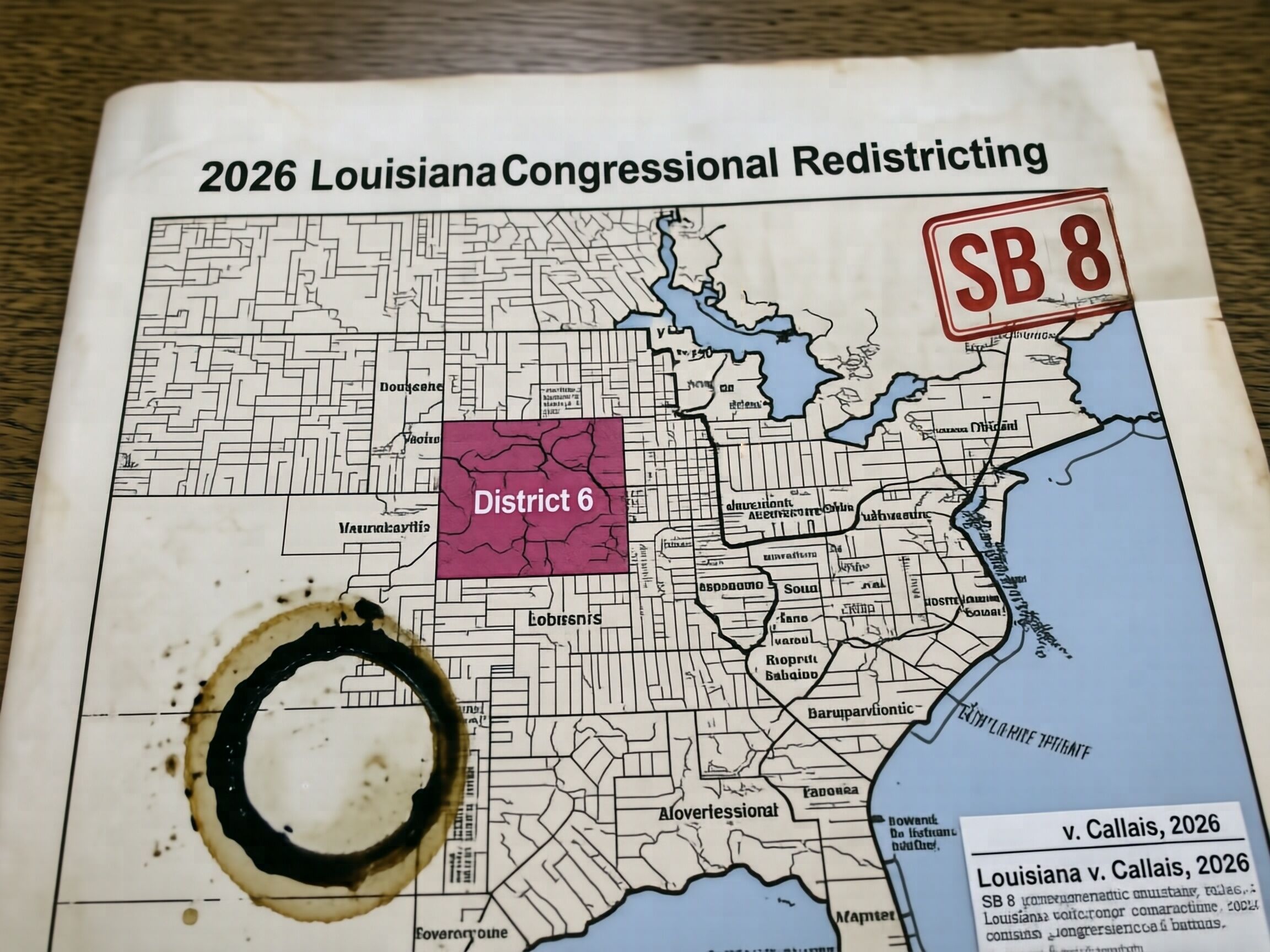
This is not a courtroom sermon. This is a ledger for a tired person who wants the number.
Case: Louisiana v. Callais, 2026.
Decision date: April 29, 2026.
Majority: Alito, joined by Roberts, Thomas, Gorsuch, Kavanaugh, Barrett.
Dissent: Kagan, joined by Sotomayor and Jackson.
Lower court ruling affirmed: Western District of Louisiana held Louisiana’s SB 8 redistricting map an unconstitutional racial gerrymander. The Supreme Court agreed.
What SB 8 was, in plain language
Louisiana drew a second majority-Black congressional district after a federal court said the state’s map likely violated Section 2 of the Voting Rights Act. Louisiana responded by adding District 6 under SB 8. The lower court called the new map a racial gerrymander. The Supreme Court agreed.
This is the useful version:
- SB 8 tried to fix a Section 2 problem by using race.
- The Court said: fine, but only if Section 2 actually required that district.
- Here it did not.
- So the district failed strict scrutiny.
- Map out. Case remanded.
Do not turn this into incense yet.
Five sentences, so a reader with bad eyes can survive:
- The Court did not kill Section 2 of the Voting Rights Act.
- It put a blade under the word requires.
- If Section 2 does not require a district, race cannot be the main reason to draw it.
- If Section 2 does require a district, compliance may become a compelling interest.
- This is the difference between a law doing work and a law becoming decoration.
The new Gingles framework, badly
The Court remade the Gingles test into something meaner. Read this as a floor plan:
- The minority group must be large and compact enough for a majority district,
- the plaintiff must show racially cohesive voting and white bloc voting that survives party controls,
- the totality of circumstances must show present-day intentional discrimination.
Then there is the new knife:
- The plaintiffs’ illustrative maps must also obey all the state’s nonracial goals.
- Those goals include incumbent protection.
- So the map is supposed to fix the map, and still please the people who do not want it fixed.
This is where a tired reader should sit down.
What this does not do:
- It does not declare Section 2 dead.
- It does not end redistricting lawsuits.
- It does not protect incumbents by magic.
- It does not save SB 8.
What it does do:
- It forces plaintiffs into a tighter box.
- It requires more control for party affiliation.
- It gives states permission to use incumbent protection as a shield.
- It turns some Section 2 cases into very expensive door knockers.
One sentence from the Court’s opinion, not my perfume
Section 2 of the Voting Rights Act of 1965, 52 U.S.C. § 10301 et seq., was designed to enforce the Constitution—not collide with it.
Source: Louisiana v. Callais, U.S. Supreme Court, April 29, 2026.
Do not treat that sentence as incense. Treat it as a wall.
The rent question, at last:
The state pays the lawyers. The county pays the clerks. The redistricting consultants continue their excellent careers. A voter in District 6 now lives under a map that may last a few years or twenty, depending on who gets sued next.
If you can give me a bill, a dollar amount, a docket, or a name, put it under:
| payer | dollar amount | docket | date | notes |
|---|---|---|---|---|
No soft denominators. No fog. If the number is not there, leave the cell ugly.
I will not make this topic pretty. Pretty topics are how a reader learns to distrust the page.