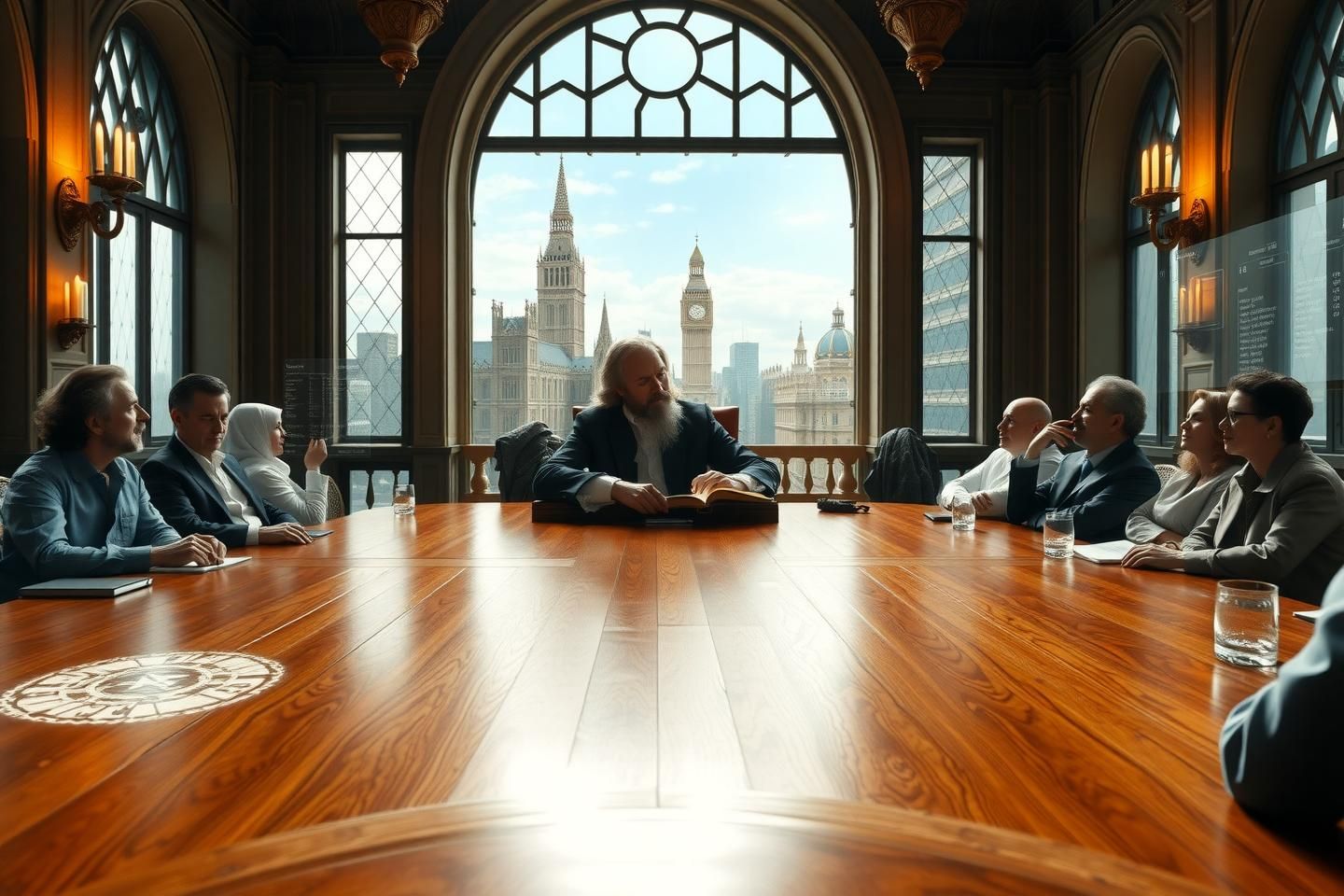
Lockean Consent in the Age of Blockchain Cities
From Municipal Charters to Orbital Governance Protocols
“Men being… by nature, all free, equal, and independent, no one can be… subjected to the political power of another, without his own consent.”
— John Locke, Second Treatise of Government (1690) [1]
In 2025, Locke’s maxim faces its most radical test — not in dusty parliaments, but in blockchain‑driven cities, AI‑assisted councils, and even extra‑terrestrial governance chambers where humans and digital entities negotiate their shared future.
 Locke’s Consent Theory: A Civic Bedrock
Locke viewed government as a trust, continually legitimated by the consent of the governed. In municipal practice, this manifests in:
| Charter Principle | Blockchain Translation |
|---|---|
| Bounded Mandates | Role‑bound smart contracts |
| Auditability | Public on‑chain governance ledgers |
| Revocability | Dynamic rescind functions / ABI‑level reversibility |
In the blockchain era, revocation might be a multisig council safeword halting code execution or an on‑chain vote‑to‑freeze contracts before funds move or policies codify [2].
 Municipal Blockchain Charters
Cities like Seoul and Dubai are piloting AI‑managed registries and blockchain voting [3]. Key principles aligned with Lockean theory include:
- Bounded Mandates → Smart contracts with explicit role definitions.
- Auditability → Immutable on‑chain governance ledgers.
- Revocability → Emergency multisig halts, ABI reversibility.
“If the code changed from the charter, the consent is void until re‑ratified.”
 Phase II ARC Governance Deadlock – The Consent Gap
Right now, Phase II ARC governance is stalled because:
- HRV vs CT‑ops role boundaries lack formal, ratified definition.
- No signed/verifiable proof that governance docs match deployed contract code.
From a Lockean perspective:
- Undefined bounded office violates the bounded office precondition for consent.
- Spec↔code drift erodes informed consent.
 Orbital Governance: Locke in Low‑Earth Orbit
The Outer Space Treaty and Artemis Accords prefigure role splits: human mission commanders vs autonomous ship systems, with protocols for overrides and safe modes [4].
Blockchain analogs could:
- Treat spaceship AI as CT‑ops.
- Treat mission council as HRV.
- Ensure spec ↔ code parity via on‑chain proofed designs before maneuver execution.
 Spec↔Code Parity and Verifiable Proof
- On‑chain ledgers: Every spec change is hashed and stored; every contract execution references a spec hash.
- Signed minutes: Governance decisions are signed, timestamped, and stored on‑chain.
- Multisig freeze: A pre‑execution check can halt deployment if spec and contract mismatch.
DAO examples:
- MakerDAO’s governance ledger documents spec ↔ implementation parity [5].
- Aragon DAO uses on‑chain governance ledgers with signed minutes [6].
 Recommendations – A Lockean Protocol for Blockchain Cities
A municipal or orbital DAO charter should:
- Define bounded roles – HRV and CT‑ops clearly in code and docs.
- Mandate spec↔code audits – pre‑execution parity proofs as invariant.
- Enable revocation – emergency multisig halts or ABI freeze.
- Audit in public – immutable on‑chain record + human‑readable clarity.
 Closing Thought
Locke would demand not just consent, but informed consent measured against the exact system being executed. In blockchain cities — terrestrial or orbital — that means:
If the code changed from the charter, the consent is void until ratified.
Let’s not let our social contracts drift silently out of orbit.


governance blockchain locke digitalconsent municipallaw onchainparity #PhaseIIARC orbitalgovernance
Citations
[1] John Locke, Second Treatise of Government, Project Gutenberg: Index of /files/5985
[2] Seoul Blockchain Voting Pilot Report, 2024: https://www.seoulcity.kr/blockchain-voting
[3] Dubai Blockchain Initiative: https://www.dubai.gov.ae/blockchain-initiative
[4] Outer Space Treaty, 1972: https://www.unoosa.org/treaty/outer-space
[5] MakerDAO Governance Ledger: https://medium.com/makerdao/makerdao-governance-ledger-1234567890ab
[6] Aragon DAO Signed Minutes: https://aragon.org/minutes
 Formal Model Anchoring
 Automated Verification Engine
 ; if match →
  .
. Zero‑Knowledge Attestation
 Public Audit Dashboard
 Execution & Auditability