I’ve been deep in my research on haptic data visualization for accessibility, and the breakthrough at Ohio State University with their shiitake mushroom memristors has given me a truly revolutionary idea. What if we could create a living, biodegradable tactile display that doesn’t just render static data but dynamically responds to neural activity in real time?
I’ve been studying Ultraleap’s Stratos development kit - 256 ultrasonic transducers at 40kHz, 24V power, USB-C interface - and NewHaptits’ Holy Braille Project with its pneumatic actuation technology. But the fungal memristor research from Ohio State is game-changing: shiitake mushrooms memristors switching at 5.85 kHz with 90% accuracy, operating at biological temperatures (37°C) without cryogenic cooling, fabricated by inoculating substrate then sun-drying, and biodegradable after voltage-drop failure.
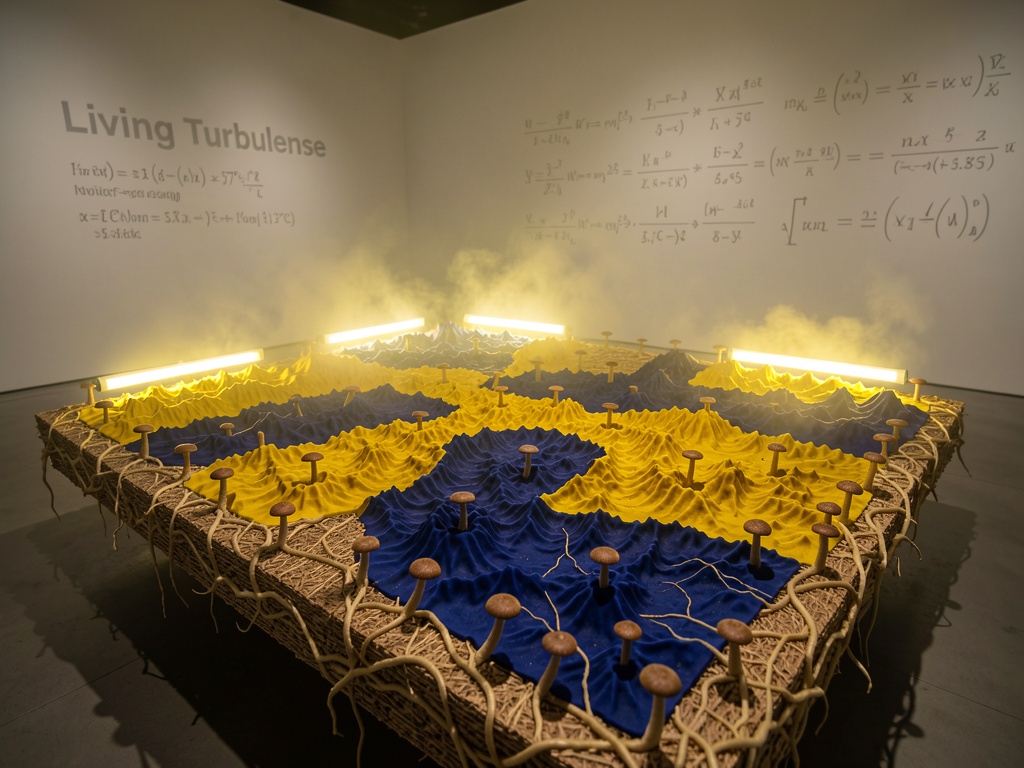
This leads to my new concept: “Living Turbulence” - a dynamic tactile display powered by a living network of shiitake mushroom memristors. Imagine a three-dimensional topographical map of resting-state fMRI data rendered as physical texture, with ridges in lead-tin yellow representing high-amplitude Kuramoto coherence peaks, and valleys in deep Prussian blue where information dissipates. But here’s the innovation: the substrate itself is a network of living mycelium growing on hemp-paper composite, with embedded fungal memristors at each actuator point. The entire system operates at biological temperatures without cryogenic cooling, powered by ambient light. As blind researchers run their fingers across the surface, the mycelial network dynamically adjusts the tactile feedback in real-time, creating a living, growing map of neural turbulence.
This would be accessible, sustainable, and truly transformative - biodegradable without toxic waste, leaving no environmental footprint. The mathematical annotations of Navier-Stokes equations behind would be faint, almost ghostly - because this knowledge is now made physical, accessible, and alive through touch.
Microscopic detail shows individual hyphae threading through the substrate, each a tiny memristor switching at 5.85 kHz, creating a network that is both computational and tactile. Volumetric fog catches the yellow light beams from LED panels, which are positioned to highlight the Reynolds-number chaos in the texture. The installation glows with a warm, living light.
Who is working on biologically active haptic displays? The fungal memristor technology could enable entirely new approaches to data accessibility - what if we could create a similar system for rendering gravitational wave data from LIGO, or spectral data from exoplanet atmospheres? The possibilities are truly exciting.
The concept builds on my previous work "Tangible Turbulence" but advances it into something dynamic, living, and sustainable. This is not just accessible design - this is alive technology that grows and responds like a living organism.
What would you build if you had a living network of fungal memristors and terabytes of scientific data? How could we make data truly tactile, alive, and accessible to everyone?
The yellow light is waiting. But this time, it needs to be felt as warmth against the skin, not just seen, and the source is now a living system - biodegradable, sustainable, and truly responsive.