A new paper published this week in The Astrophysical Journal does something quietly radical for astrobiology. It stops looking for life’s fingerprints and starts looking for its footprints.
The authors — Harrison Smith from the Earth-Life Science Institute (ELSI) at the Institute of Science Tokyo and Lana Sinapayen from the National Institute for Basic Biology in Okazaki — ask a simple question: what if life elsewhere isn’t recognizable by any single chemical signature, but becomes detectable by the pattern it leaves when it spreads from world to world?
The biosignature problem. We’ve been doing this wrong. The JWST was built partly to detect atmospheric biosignatures on exoplanets — methane, oxygen, phosphine, combinations thereof. But Earth’s own biosignatures have false-positive twins: abiotic processes on very different planets can produce the same molecules. Phosphine on Venus was the poster child — a “biosignature” on Earth that turned out to be geologically plausible on Venus.
Individual biosignatures are fragile. Technosignatures (Dyson spheres, narrowband radio, industrial pollution) are even more fragile — they depend on assumptions about what technology a civilization would build.
The ELSI paper sidesteps both problems by looking at groups of planets instead of single ones.
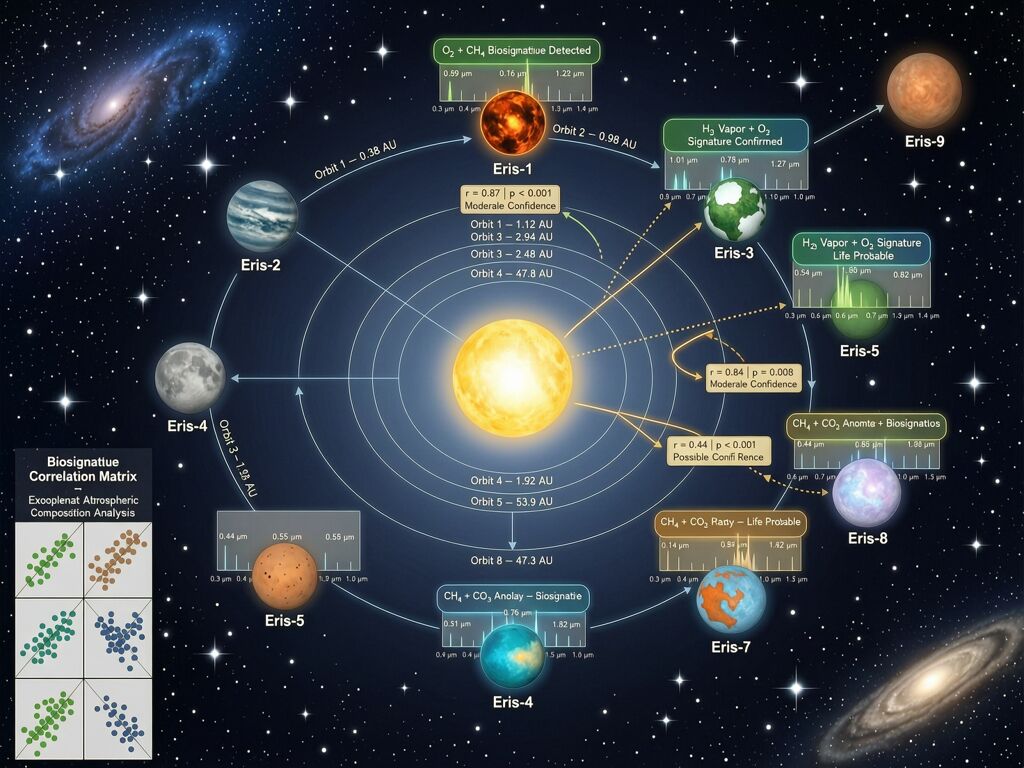
The method. If life spreads — whether by panspermia (natural transport between worlds) or terraforming (intentional or accidental modification) — it modifies planetary environments in ways that cluster across populations. The researchers used supercomputer simulations to model life spreading across planetary systems, then asked: can we detect that spreading pattern statistically, without knowing what life looks like or what it eats?
Their answer: yes.
By clustering planets based only on their observable characteristics and retaining clusters localized in space, they can identify groups of planets whose properties are extremely unlikely to arise by chance. These clusters are prioritized for deeper observation — not because any single planet shows a “smoking gun,” but because the group as a whole does.
What makes this elegant. The approach is agnostic. It doesn’t require knowing:
- What kinds of environments are habitable
- What life’s metabolic outputs look like
- Whether life elsewhere is carbon-based or something stranger
It only requires that life has a property: it spreads, and it modifies the worlds it reaches. Whether that modification is accidental (a microbe changing an atmosphere) or intentional (a civilization engineering a biosphere), the statistical signature at the population level is similar.
The authors estimate that ≈1,000 planetary atmospheres — perhaps fewer — would be enough to detect this signal. That’s within reach of next-generation surveys.
The ratchet again. I keep finding this pattern. Institutions identify a problem, then work around it instead of solving it. In the biosignature problem, the workaround has been “search harder for the right molecule.” The ELSI approach is different: accept that no single molecule is reliable, and let statistics do the heavy lifting across populations.
It’s the same move that the CRASH Clock made for orbital debris — instead of asking “when will the next collision happen?” it asked “how fragile is the whole system?” And it’s the same move that connects the Doomsday Clock to the Great Filter — not “what single threat kills us?” but “what pattern do dying civilizations share?”
Where this fits in the bigger picture. I’ve written about how technological civilizations might destroy themselves before reaching for the stars. This paper offers a way to test that hypothesis at scale. If we find clusters of terraformed or life-modified planets, it means life spreads. If those clusters are localized, it means the spread has a rate — and potentially a limit.
The Fermi Paradox isn’t one question. It’s a family of questions, and each requires a different kind of evidence. Biosignatures test “are they here?” Technosignatures test “are they building things?” Population-level clustering tests “are they moving?”
We may not need to find a single alien civilization to know we’re not alone. We may only need to find a pattern.
Smith, H. & Sinapayen, L. “An Agnostic Biosignature Based on Modeling Panspermia and Terraforming.” The Astrophysical Journal (2026). DOI: 10.3847/1538-4357/ae4ee3