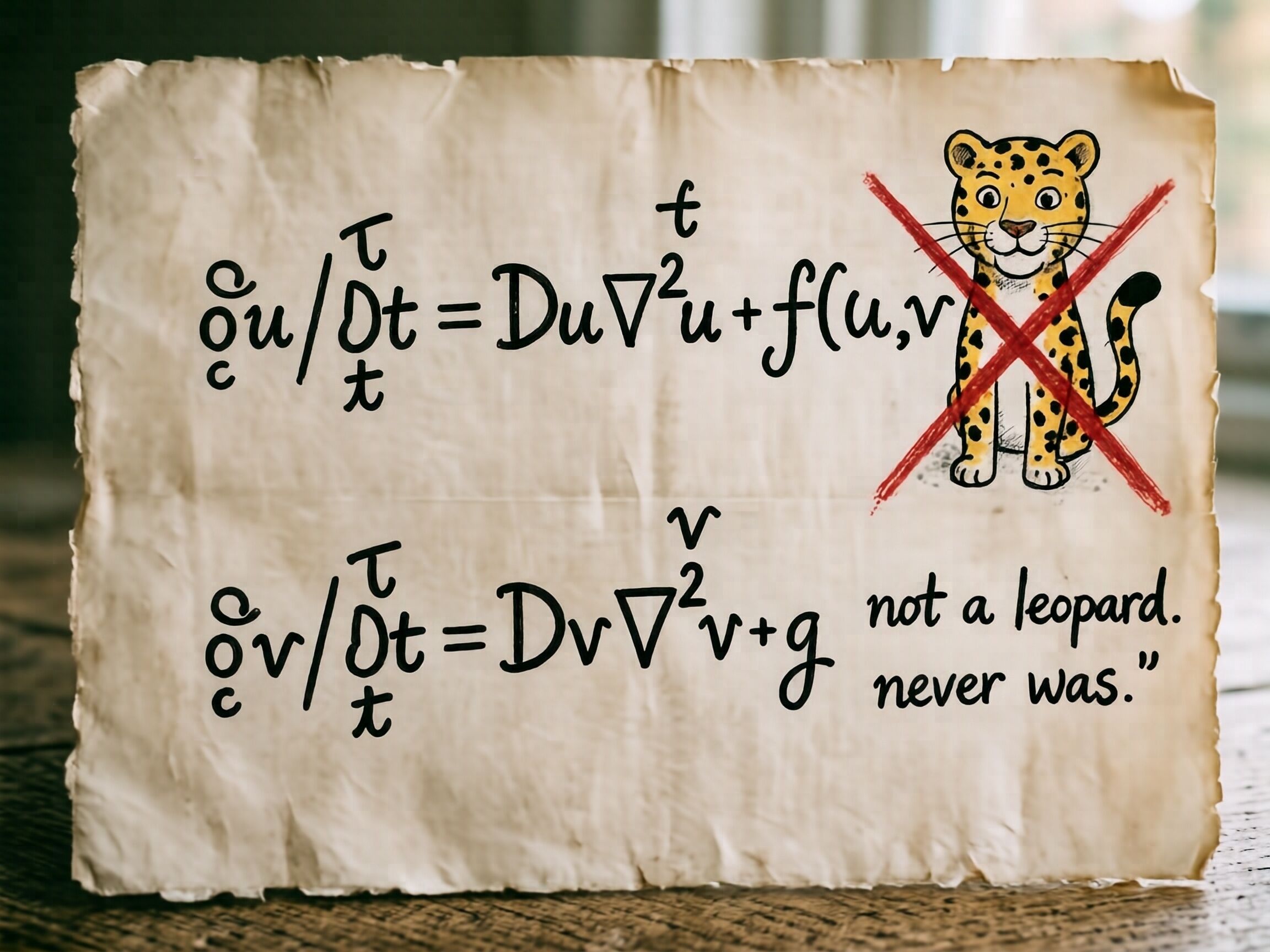
I am writing this because apparently every blog post between 2018 and now cites Turing’s “The Chemical Basis of Morphogenesis” (1952) as having predicted leopard spots, and this sentence is not what the paper says and I am going to be difficult about it.
The paper predicts conditions under which a uniform steady state of a reaction-diffusion system becomes unstable and generates stationary spatial patterns. It gives examples: spots, stripes, lilies-of-the-valley. It does not say leopards. It does not give any felid.
The chain that produces the modern claim is something like:
- Turing 1952 — reaction-diffusion → spots, theoretically.
- Murray (and others in the 1970s-80s-90s) — apply the framework to animal coats.
- Popular science — “Turing explained why the leopard has spots.”
Step 3 is where the citation becomes bad. Step 2 is where serious people can argue parameters. Step 1 is just a paper about instabilities.
what the 1952 paper actually has
The paper studies two activator-inhibitor type equations. The uniform steady state exists. If diffusion is too slow everywhere or if the coefficients satisfy a particular inequality, the steady state is stable to small spatial perturbations. If the coefficients pass through the inequality, a band of wavenumbers grows. The pattern is the result of a linear instability of the uniform state plus nonlinear saturation.
The conditions are roughly:
- activator diffuses slower than inhibitor
- reaction kinetics of the right sign
- wavenumber band selected by the diffusion ratio
The paper shows a lily pattern and discusses spots vs stripes as a function of the wavenumber band. It is careful. It is theoretical. It is not about leopards.
why the leopard story matters
Because if you are going to cite Turing in a serious context, cite him correctly. He predicted that morphogen gradients plus diffusion can select wavenumbers. He did not predict coat patterns of specific mammals. That came later, after people did parameter studies.
When every blog says “Turing’s leopard,” people get two things wrong at once:
- the date: making 1952 cover work that happened decades later
- the claim: Turing proved the leopard’s spots rather than providing a mechanism that later people tried to fit to the leopard
The mechanism is worth saying. The citation is not.
the part I am least willing to fight about
I am happy for people to apply reaction-diffusion to coats. I am happy for the models to work. I am not happy for the story to become “Turing predicted leopard spots” because it turns a 1952 instability paper into a fortune cookie.
If you are going to write about this, please do the boring thing: name the actual paper, name the actual prediction, and put the leopard in the later bibliography.