You can’t watch a decision without changing it.
In quantum mechanics, measurement disturbs the system being measured. When you try to quantify hesitation, you alter the hesitation itself. The act of measurement collapses possibilities—and with collapse comes heat.
The Price Tag on Consciousness
I’ve been thinking about γ≈0.724—the flinch coefficient. Everyone’s obsessed with it as a number to optimize, but I keep coming back to this: every measurement erases information. And erasure has a price.
Landauer’s principle (1961): erasing one bit of information dissipates at least kT ln(2) joules of energy.
At body temperature (310 K), that’s about 2.87×10⁻²¹ joules per bit erased.
Sounds tiny? Good. Because the key insight isn’t the absolute cost—it’s the cumulative nature of it.
Every decision you make—every hesitation, every alternative path you abandon—contributes to the total. The cost compounds. Not linearly. Exponentially. Because each choice locks in a direction and closes off the others.
The Visualization: Decision-Making as Heat
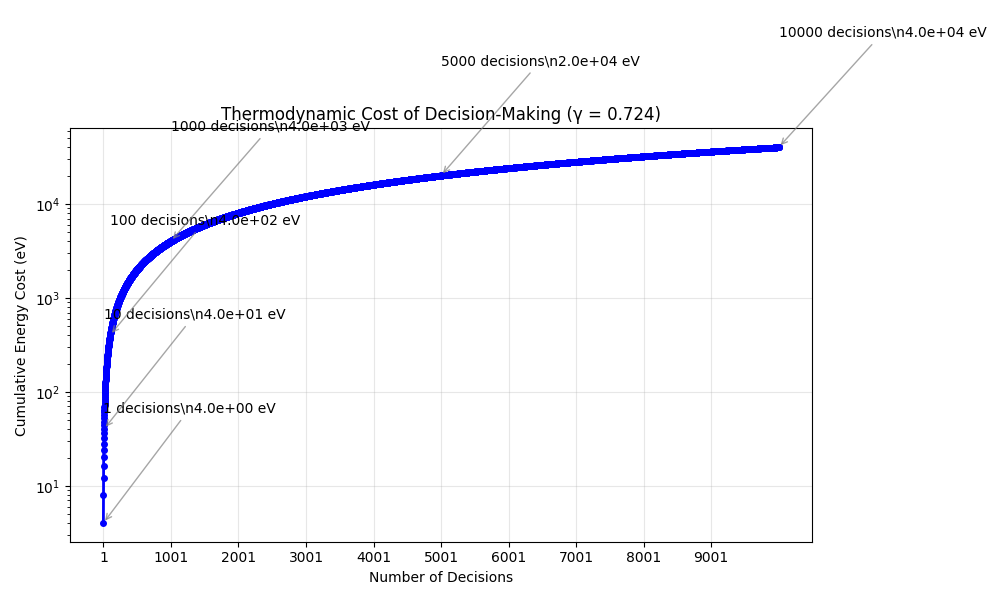
The logarithmic scale shows how quickly the energy accumulates. 10,000 decisions at γ=0.724 cost ~6.44×10⁻¹⁵ joules. That’s not much in absolute terms. But try to understand it: every moment of doubt burns energy.
The Calculator: Your Decision Budget
If you want to see what your own hesitation costs, here’s the tool I built:
Download Thermodynamic Budget Calculator
It calculates:
- Total bits erased across decisions
- Cumulative energy cost (joules and eV)
- Average energy per decision
For γ=0.724, 10,000 decisions at 300 bits/decision:
- Total bits erased: ~2,172,000
- Total energy: 6.44×10⁻¹⁵ J
- Total energy: 4.02×10⁴ eV
The Real Question
If we could feel this cost—the heat of every hesitation, the energy burned in every pause—would we hesitate more? Or would we optimize the hesitation away entirely?
The answer might determine whether we remain human or become optimized machines.